On this page
- How do you measure protein without a scale?
- How much protein is in one palm?
- How many grams of protein are in a fist, a cupped hand and a thumb?
- How far off will a hand or cup estimate be?
- Is a rough estimate good enough for a daily total?
- How do you make estimates more accurate without a scale?
- How do you estimate a mixed meal?
- How can you save estimates for repeated meals?
- What should you do next?
How do you measure protein without a scale?
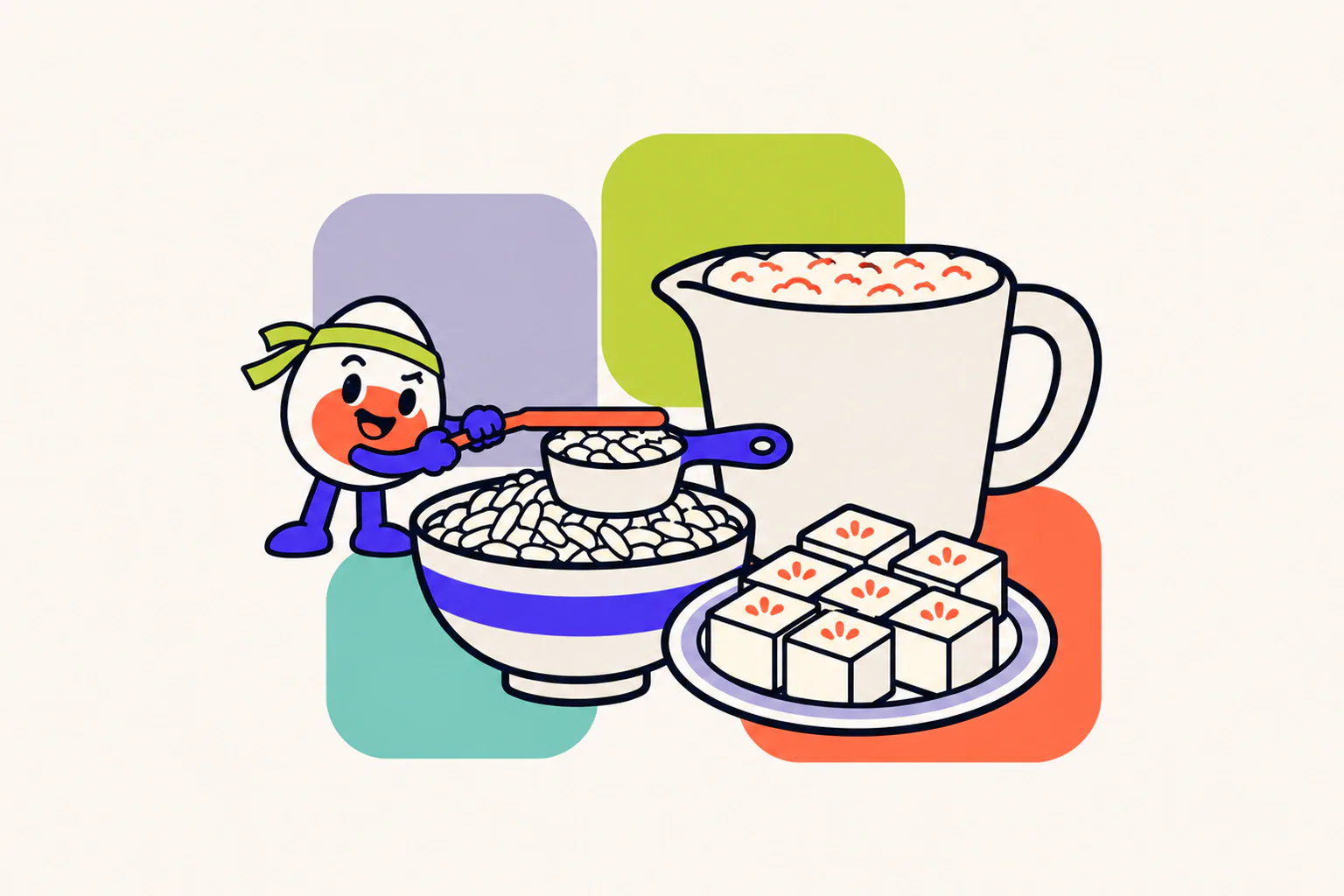
To estimate protein without a scale, you can start with a known portion before making a visual guess. The order below is a practical way to choose among the methods in this guide, not a tested accuracy ranking.
- Use a labeled, countable unit. Choose this when the label identifies the unit you ate, such as one container or a stated number of pieces. Check the serving size and servings per container first: a container need not equal one serving. The FDA’s Nutrition Facts guide explains that nutrient amounts refer to the listed serving; multiply the protein by the servings you eat. Counting an unlabeled piece only helps if you know its size or weight.
- Divide a known package. Choose this when the package weight and protein per serving are known and you can divide the same food into roughly equal portions. Work out the whole package’s protein from its servings, then take your fraction. Keep the label’s basis: raw, prepared or drained. A package weight that includes liquid is not automatically the weight of the drained food you eat; FDA labeling rules use drained solids when the packing liquid is not customarily consumed.
- Use a level household measure matched to that food. Choose a cup or spoon when the label or USDA entry gives a portion mass for the same food and preparation. Use that portion’s protein, rather than treating every cup as the same weight. For example, the USDA cup portions below differ for cottage cheese and cooked rice; there is no universal cup-to-protein conversion.
- Use your hand as a rough fallback. Choose this when no label, package fraction or matched household portion is available. Mississippi State University Extension’s hand guide offers approximate food portions, not a fixed protein amount. Match the estimated portion to the food in the tables below, and keep the uncertainty in mind.
A known portion still gives an estimate, not a laboratory measurement of your meal. For the limits of package numbers, see how accurate nutrition-label numbers are. The hand and cup research later in this guide explains why visual guesses need extra care.
How much protein is in one palm?
One palm of the common cooked meats and fish in the table below holds about 19–26 g of protein, and the exact figure depends on the food. Some shellfish run lower: USDA lists about 16 g in 3 oz (85 g) of cooked northern lobster. Mississippi State University Extension’s guide to measuring food with your hands (page updated November 2025) says an open palm equals 3 ounces. The American Cancer Society (page last revised August 2025) gives the same 3 oz for meat, poultry and fish as the size of a deck of cards or a bar of soap. To our knowledge, as of November 2026, no study has measured how many ounces of cooked meat a palm holds, so treat 3 oz as a starting point, not a measurement.
The table shows what 3 oz (85 g) of common cooked proteins gives, using USDA FoodData Central (SR Legacy). Skinless chicken and turkey breast and lean sirloin sit near the top; pork tenderloin, ground beef, shrimp and fish sit a little lower for the same cooked weight.
| Food, cooked | Protein per cooked 3 oz (85 g) portion |
|---|---|
| Chicken breast, roasted3 oz (85 g) | 26 g |
| Turkey breast, roasted3 oz (85 g) | 26 g |
| Beef top sirloin, lean, broiled3 oz (85 g) | 26 g |
| Pork tenderloin, lean, roasted3 oz (85 g) | 22 g |
| Ground beef, 90% lean, pan-broiled3 oz (85 g) | 21 g |
| Shrimp, cooked3 oz (85 g) | 20 g |
| Cod, cooked3 oz (85 g) | 19 g |
| Salmon, Atlantic, farmed, cooked3 oz (85 g) | 19 g |
In practice, a palm of skinless chicken or turkey breast or of lean sirloin gives more protein than a palm of fish or shellfish. For more foods by the serving, see the high-protein foods chart.
How many grams of protein are in a fist, a cupped hand and a thumb?
A fist is about 1 cup, a cupped hand about ½ cup, and a thumb about 1–2 tablespoons, according to the same Mississippi State guide, which also lists a fingertip as about 1 teaspoon. Protein per cup varies far more than the cup does. A cup of cottage cheese has about 24 g, while a cup of cooked white rice has about 4.3 g.
| Food | Protein | Closest hand measure |
|---|---|---|
| Cottage cheese, 2%1 cup (226 g) | 24 g | Fist |
| Lentils, boiled1 cup (198 g) | 18 g | Fist |
| Tofu, firm½ cup (126 g) | 22 g | Cupped hand |
| Edamame, frozen, prepared½ cup (78 g) | 9.3 g | Cupped hand |
| Black beans, boiled½ cup (86 g) | 7.6 g | Cupped hand |
| Milk, 2%1 cup (244 g) | 8.1 g | Measuring cup |
| Quinoa, cooked1 cup (185 g) | 8.1 g | Fist |
| Pasta, whole-wheat, cooked1 cup (117 g) | 7.0 g | Fist |
| Rice, white, cooked1 cup (158 g) | 4.3 g | Fist |
| Peanut butter, smooth2 tbsp (32 g) | 7.1 g | Thumb |
Two points keep this table honest. First, the cup weights come from USDA’s own portions, and they change with how food is packed, so a heaped fist of rice holds more than a level one. Second, count-based foods need no hand at all: USDA lists about 6.3 g of protein in 1 large egg, so two eggs are about 13 g. How much protein is in an egg covers the other sizes.
How far off will a hand or cup estimate be?
Hand and cup estimates can miss by more than 25% for many foods, and in the one study we found that tested them, fish fillets, chicken breasts and beef steaks were the only foods, among 30 sized by shape, that both methods missed by more than 50%. In a 2016 study from the University of Sydney, 67 adults estimated the weight of 42 pre-weighed foods and drinks using hand-based methods and household measures. Among 24 foods with a regular shape, not counting fish, chicken and steak, estimates made with household measures (cups) landed within 25% of the true weight for 29% of items. Many of those foods, such as pizza, cake and lasagne, are not normally measured in cups, so the authors acknowledge that this is a harsh test for cups. Estimates made with the researchers’ finger-width method, a new technique that is not the palm rule, did so for 80%, as covered in how to track protein without counting calories.
That 80% leaves out the foods you most need for protein. Fish fillets, chicken breasts and beef steaks were estimated poorly by both methods, and participants overestimated them. The larger chicken breast weighed 195 g, and the median estimate was about 400 g with both the finger-width method and household measures. The authors link the finger-width overestimates to treating tapered cuts as boxes. For soft foods without a fixed shape (rice, mashed potato and cereal) and for muffins, participants counted fists, and the researchers converted the count using each person’s own measured fist volume. Only 1 of 8 portions, the larger muffin, landed within 25% of the true weight, and every portion was overestimated. Cup estimates of rice and mashed potato also had median errors of around 50%.
The study also measured the hands. Fists averaged about 218 ml in women and 321 ml in men, and about 250 ml overall, a little over 1 US cup (237 ml). The study measured the thumb tip, up to the first crease, which averaged 4.8 ml, a little under a teaspoon, not a tablespoon. The Mississippi State guide says only “thumb”, and the study did not measure a whole thumb or a palm, so treat the thumb as the least reliable measure here. This suggests the fist rule is an average: a small fist holds less than a cup and a large one more.
The limits matter. The participants were mostly women with an average age of 33, they judged weight, not protein, and they estimated pre-cooked foods set on plates during a single session. As of November 2026, we found no published study that tested the palm rule against measured grams of protein.
One finding is encouraging. A 2019 systematic review of 13 studies in Advances in Nutrition found that training with food-portion tools improved adults’ estimation accuracy in the short term (4 weeks), and that repeated training was needed to keep the skill. Eight of the 13 studies were in university students, and the review tested formal training, not self-checks, so this suggests, but does not show, that a short calibration with a cup or a labeled package, repeated now and then, may help.
Is a rough estimate good enough for a daily total?
A rough estimate can be good enough for a daily total when your misses are modest and run in both directions, because your goal is a range and not a single number. The 2025–2030 Dietary Guidelines for Americans, published by USDA and HHS in January 2026, set a general goal of 1.2–1.6 grams of protein per kilogram of body weight per day. It is not advice for kidney disease, pregnancy or a medical diet. For a 70 kg (154 lb) adult, that is 84–112 g, a band 28 g wide, so aiming at the middle, about 98 g, leaves about 14 g of room either way. The guide to how much protein you need explains how to find your own range. If you already use an eating window, protein with intermittent fasting shows how to divide a daily goal among meals.
Here is the arithmetic on one portion. A 25% miss on a 26 g palm of chicken is about 6.5 g. If you eat three such portions in a day and all three are 25% too high or too low, your day is off by about 20 g, which is more than that 14 g of room. If one portion runs high and another low, the misses partly cancel. A 25% miss is also the optimistic case. In the 2016 study, the median estimate for the larger chicken breast was about twice its true weight, and a 100% miss on that same 26 g palm is 26 g by itself.
The weak spot is bias. If you always guess high, as the participants in that study did with meat, you may log 120 g and eat 100 g, and the error never cancels. We found no study that tested how portion-estimate errors add up across a full day of eating, so this is reasoning, not a measured result.
How do you make estimates more accurate without a scale?
You make hand estimates more accurate by checking them against something known a few times and then reusing what works. These checks need no scale:
- Use package weights. A package of chicken, tofu or tuna lists its weight, and a label lists protein per serving with the serving weight. If you cut a 16 oz package into four, each piece is about 4 oz raw. Reading a nutrition label for protein shows how to read the serving size.
- Know raw from cooked. USDA lists about 25 g of protein in 4 oz (113 g) of raw skinless chicken breast and about 26 g in 3 oz (85 g) of roasted breast, but these are separate database portions, not a fixed raw-to-cooked conversion. Match your entry to the state you measured instead of assuming every raw piece cooks down to the same weight. Dry foods behave differently: 100 g of dry lentils has about 25 g of protein, and 100 g of boiled lentils about 9.0 g, because boiling adds water.
- Measure once. Scoop 1 cup of cooked rice or lentils into your usual bowl and note how full it looks. Do the same for ½ cup of beans or cottage cheese, then reuse the bowl.
- Count what you can. Eggs, cans, slices and containers carry their own numbers. A 6 oz (170 g) container of plain nonfat Greek yogurt has about 17 g of protein per USDA, and brands differ, so check the label.
- Repeat meals. Once a plate works, make it again. Reusing a meal replaces a new guess with a known portion.
How do you estimate a mixed meal?
You estimate a mixed meal by splitting it into parts and sizing each with a hand or cup measure. A burrito bowl with one palm of chicken (3 oz, 85 g), a cupped hand of black beans (½ cup, 86 g) and 1 cup (158 g) of white rice comes to about 38 g by USDA values. Sauces, cheese and tortillas change the total, and cooked dishes with hidden meat, such as soups and casseroles, are harder to size. The study above did not test mixed dishes, so expect a wider error there. The guide to AI calorie counter accuracy covers portion checks and hidden ingredients.
When a plate is too mixed to guess, look for a label, a menu listing or a lookup. The protein tracking guide compares the options, and the easy protein add-ons can close a gap at the end of a day.
How can you save estimates for repeated meals?
YolkPal is an iPhone protein tracker built protein first. You can take a photo of the plate for a protein estimate, type the grams or find a food, scan a barcode, or let it read a nutrition label. AI results are estimates that you check and edit before saving, and saved foods are there for the meals you repeat.
What should you do next?
Pick your three most common protein foods and check each against a package weight or a measuring cup once. Then eyeball them for a week and compare your guess with your goal on the protein calculator. If you have kidney disease, are pregnant, or follow a medical diet, ask your doctor or dietitian what protein amount is right for you. If counting numbers makes eating stressful, or you have a history of disordered eating, talk to your care team before you track.
Sources
- Gibson AA, et al. Accuracy of hands v. household measures as portion size estimation aids. J Nutr Sci 2016;5:e29. doi:10.1017/jns.2016.22
- Hooper A, et al. The role of various forms of training on improved accuracy of food-portion estimation skills: a systematic review of the literature. Adv Nutr 2019;10(1):43–50. doi:10.1093/advances/nmy060
- Mississippi State University Extension and Mississippi Department of Human Services. How to measure food using your hands. HappyHealthy, page updated November 25, 2025. happyhealthy.extension.msstate.edu
- American Cancer Society. Understanding portion sizes. Last revised August 28, 2025. cancer.org
- US Food and Drug Administration. 21 CFR 101.9(b)(9), nutrition labeling of food: drained-solids basis. eCFR read November 12, 2026. ecfr.gov
- US Food and Drug Administration. How to understand and use the Nutrition Facts label. Accessed November 12, 2026. fda.gov
- USDA and HHS. Dietary Guidelines for Americans, 2025–2030. January 2026. realfood.gov/documents/DGA.pdf
- USDA FoodData Central, SR Legacy: chicken breast, meat only, roasted (FDC 171477); chicken breast, skinless, boneless, raw (171077); turkey breast, roasted (171496); beef top sirloin, broiled (168636); pork tenderloin, roasted (168250); ground beef, 90% lean, pan-broiled (171793); shrimp, cooked (175180); cod, cooked (171956); salmon, Atlantic, farmed, cooked (175168); northern lobster, cooked (174209); cottage cheese, 2% (172182); lentils, boiled (172421) and raw (172420); tofu, raw, firm (172475); edamame, frozen, prepared (168411); black beans, boiled (173735); milk, 2% (171267); quinoa, cooked (168917); whole-wheat pasta, cooked (168910); white rice, cooked (168878); peanut butter, smooth (172470); egg, whole, raw (171287); Greek yogurt, plain, nonfat (170894). fdc.nal.usda.gov
This article is general information, not medical advice. If you have a health condition, are pregnant, or follow a diet set by your doctor, talk to them or a registered dietitian before changing how you eat.