
On this page
- Which household rules should you settle before planning meals?
- How do kitniyot differences change your protein choices?
- Which ingredient swaps can you plan before shopping?
- What is the protein per serving in these Passover meal ideas?
- How can you assemble the meals without complicated substitutions?
- How do you keep meat and dairy menus separate?
- How much should you prepare for a batch?
- How do you store food during a long meal or holiday week?
- How do you log protein when a Passover ingredient changes?

Which household rules should you settle before planning meals?
High protein Passover meals can pair chicken, fish or eggs with vegetables and potatoes, or use yogurt in a separate dairy meal. Choose ingredients and preparation practices your household follows. Ask the host or the rabbi whose guidance you use before buying unfamiliar substitutes. You can write a short shopping note listing accepted protein foods, the certification you look for, and any ingredients you avoid.
Menachem Posner’s What Is Kosher for Passover?, checked November 2026, explains the prohibition on chametz and the need for Passover preparation and certification of processed foods. The guide Kitniyot on Passover: Is It Allowed?, checked in 2026, identifies wheat, barley, spelt, rye and oats as the grains that can become chametz through leavening or fermentation. For shopping, check broth, marinades, dairy products, canned fish, oils, seasonings and powders against the guidance your household accepts. Ask about the exact product and package.
For a practical starting point, choose a familiar chicken dish for a meat meal, an egg-and-yogurt plate for a dairy meal, or eggs with vegetables for a pareve meal. Keep a backup meal on the shopping list so an unavailable ingredient is easy to replace. You can plan everyday breakfasts and lunches separately from the ceremonial meal and its requirements.
How do kitniyot differences change your protein choices?
Kitniyot practices determine whether foods such as lentils and soy belong in your Passover menu. The religious guide Kitniyot on Passover: Is It Allowed?, checked in 2026, describes kitniyot as a customary category that includes rice and legumes. Many Ashkenazi households avoid it. Many Sephardic households eat some kitniyot, with differences among communities and families.
The same guide generally includes soy among kitniyot, while describing disagreement about peanuts and quinoa. Confirm tofu, beans, lentils, chickpeas, peanuts and quinoa individually with your household’s authority. Quinoa’s disputed status should not be read as a universal prohibition or permission. A plant-based label gives you an ingredient category, while Passover suitability requires its own check. Protein powders also need review of their ingredients and Passover certification.
For planning, you can use the chicken, fish, egg and dairy options below when they fit your household. The lentil bowl is an additional option for households that accept lentils. A vegan reader avoiding legumes and soy can bring an accepted-food list to a registered dietitian to work out suitable meals. Simply removing the main protein food from a vegetarian recipe changes what the meal provides.
Which ingredient swaps can you plan before shopping?
Ingredient swaps work best when you keep an accepted backup beside each uncertain item on your list. The options below apply the certification guidance in What Is Kosher for Passover? and the separation guidance in Meat, Dairy and Pareve, both checked in 2026.
| Usual ingredient | Check first | Option to consider |
|---|---|---|
| Yogurt dressing on chicken | Meat and dairy separation | Use accepted oil and herbs. Plan the yogurt for a separate dairy meal. |
| Tofu or beans in a salad | Household kitniyot practice and the exact ingredient | Build an egg or fish plate if those foods fit your diet and household. |
| Regular protein powder | Passover certification and ingredients | Consider accepted plain Greek yogurt at a dairy meal, or eggs at another meal. |
| Packaged broth or marinade | Certification, ingredients and meat or dairy category | Use water with accepted seasonings for vegetables, or prepare the protein plain. |
What is the protein per serving in these Passover meal ideas?
The Passover portion table pairs familiar foods into individual meals. All estimates use USDA FoodData Central, SR Legacy (April 2018), checked November 11, 2026. Choose ingredients, produce preparation and cookware that meet your household’s requirements before using any row.
Chicken, salmon, potatoes, broccoli and lentils are weighed after cooking. Tuna is weighed after draining. Eggs are hard-boiled and weighed without shells, and yogurt is weighed as served. Potatoes use baked flesh without skin. Broccoli uses the fresh, boiled, drained entry without salt. Household measures are approximate, and the gram weights determine the calculation.
| Meal | Portion counted | Approximate protein | Menu check |
|---|---|---|---|
| Chicken, potato and broccoli | Roasted skinless chicken breast 3 oz (85 g), baked potato flesh 6 oz (170 g), boiled chopped broccoli 1 cup (156 g) | 33 g | Meat meal. Use dairy-free accompaniments |
| Salmon, potato and broccoli | Farmed Atlantic salmon, cooked with dry heat, 4 oz (113 g), baked potato flesh 6 oz (170 g), boiled chopped broccoli 1 cup (156 g) | 32 g | Fish meal. Follow household serving customs |
| Eggs with Greek yogurt | Hard-boiled eggs 2 large (100 g), plain nonfat Greek yogurt 6 oz (170 g) | 30 g | Dairy meal. Check the yogurt’s Passover status |
| Egg, potato and broccoli plate | Hard-boiled eggs 3 large (150 g), baked potato flesh 6 oz (170 g), boiled chopped broccoli 1 cup (156 g) | 26 g | Pareve when ingredients and preparation qualify |
| Tuna-stuffed potato with broccoli | Canned light tuna in water, drained, 4 oz (113 g), baked potato flesh 6 oz (170 g), boiled chopped broccoli 1 cup (156 g) | 29 g | Check canned fish certification and added ingredients |
| Lentil, potato and broccoli bowl | Lentils boiled from dry 1 cup (198 g), baked potato flesh 6 oz (170 g), boiled chopped broccoli 1 cup (156 g) | 25 g | Only for households that accept lentils |
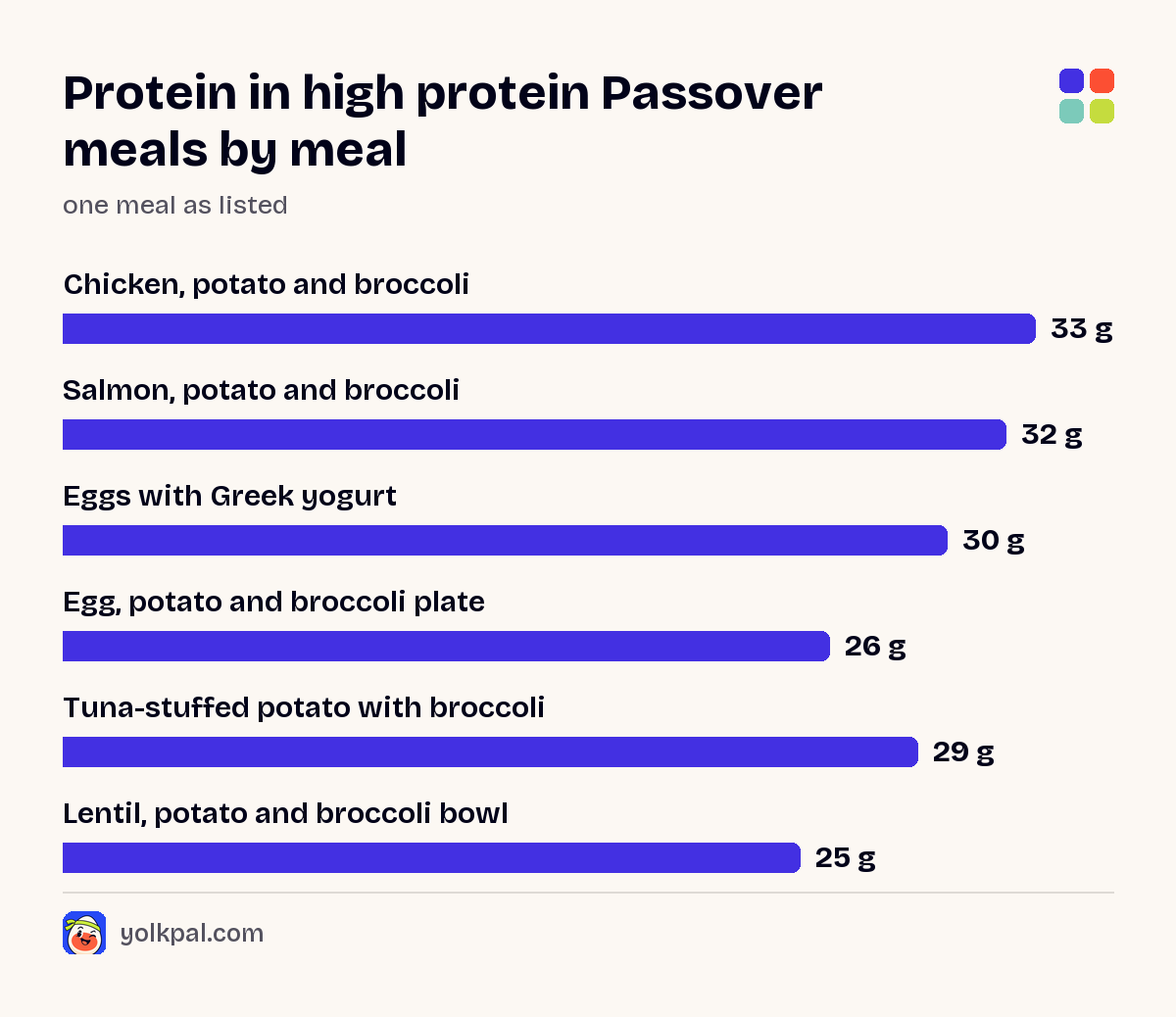
Each row counts only the listed foods. You can add fruit, salad or other accepted sides to make a meal that suits your appetite. Yogurt protein varies by product, so use your label when available. For individual food portions, see protein in an egg and protein in chicken breast.
How can you assemble the meals without complicated substitutions?
Simple assembly methods let you keep the main protein portion visible. The suggestions below use the cooked or ready-to-eat quantities in the table. Follow a trusted cooking method for the raw ingredients, then weigh what you serve. Cooking times, texture and actual batch yield have not been kitchen-tested for this page.
Roast chicken plate for a meat meal
Roast plain chicken using your usual accepted seasonings, and bake potatoes until tender. Boil and drain broccoli prepared according to your produce-checking practice. Remove chicken bones and skin, weigh the breast meat, and serve with the potato flesh and broccoli portions from the table. Keep any cooking juices or sauce separate when portioning.
FoodSafety.gov’s temperature chart, reviewed in 2024, gives poultry a minimum internal temperature of 165°F (74°C), measured with a food thermometer. A trusted family recipe can supply the flavor while the weighed cooked meat supplies the portion estimate.
Cold egg-and-yogurt plate for a dairy meal
Serve peeled hard-boiled eggs with plain Greek yogurt on the side. You can make the yogurt savory with accepted herbs, or serve fruit alongside it. Keep the yogurt cold until serving. Use a separate bowl for additions so you can record the base meal and any extras independently.
The FDA’s 2024 egg-safety guidance says to cook eggs until both the yolk and white are firm. For other egg dishes made from raw eggs, the FDA gives an internal temperature of 160°F. Keep the hard-boiled entry for the plate shown here, and choose a matching entry if you make an omelet instead.
Fish and potato lunch
Bake plain salmon with accepted seasonings, then serve the cooked fish portion beside potato flesh and broccoli. FoodSafety.gov’s 2024 chart gives fish a minimum internal temperature of 145°F (63°C). Check the thickest part with a food thermometer.
For the canned option, drain the tuna and weigh the edible fish before spooning it into a split baked potato. Add broccoli on the side. A sauce changes the ingredients to check and the nutrition to record. The guide to protein in canned tuna and salmon explains drained weights, different fish entries and mercury guidance.
Lentil bowl when lentils fit your household
Cook accepted dry lentils according to the package directions and drain them before measuring. Spoon the cooked portion over baked potato flesh and serve with broccoli. Water can loosen the mixture, and accepted herbs can change the flavor. Recalculate with the label if you use canned lentils or a prepared soup. The table uses plain lentils boiled from dry.
How do you keep meat and dairy menus separate?
Meat and dairy menus need their own dishes and preparation arrangements when you observe kosher separation. Meat, Dairy and Pareve, checked in 2026, describes separate cookware and utensils and explains that poultry and meat broth belong to the meat category. Milk, butter, yogurt and cheese belong to the dairy category.
- Meat menu. You can serve the chicken plate with a vegetable side and fruit. Choose an accepted dairy-free dressing or cooking oil. Check the ingredients of any sauce you put on the table.
- Dairy menu. You can build breakfast or lunch around the egg-and-yogurt plate. Put any additional dairy toppings beside the meal, with their own serving utensils.
- Pareve menu. You can use the egg-and-potato plate, or the lentil bowl where accepted, with qualifying ingredients and preparation. Use water or an accepted vegetable broth when you want that preparation to remain pareve.
Fish has additional serving customs. The guide What Is Kosher?, checked in 2026, describes fish as pareve but says it is not eaten with meat. Follow your household’s guidance for fish courses, fish with dairy, and waiting practices between meat and dairy. You can plan the fish plate as a separate lunch to simplify the menu.
How much should you prepare for a batch?
A chicken batch can be portioned using cooked component weights. For four plates matching the chicken row, portion 12 oz (340 g) cooked skinless breast, 24 oz (680 g) baked potato flesh and 4 cups (624 g) boiled, drained, chopped broccoli. The USDA SR Legacy (2018) calculation gives about 134 g of protein for that batch, or about 33 g per plate before optional additions.
The four plates are a planned allocation of cooked ingredients. Raw shopping quantities depend on trimming and cooking losses. Weigh the cooked components and divide each evenly among the containers. If you finish with less chicken, record the smaller amount or prepare extra before assigning the table’s estimate to every plate.
For soup, you can portion the cooked chicken separately and add it to each bowl. A ladle of broth and dumplings has a different recipe from the roast-chicken plate. Record broth and dumplings from their actual ingredients, and use a matching stewed-chicken entry if the meat was cooked in soup. This makes your own recipe reusable when the pot size changes.
How do you store food during a long meal or holiday week?
Holiday leftovers need prompt cooling and dated containers. USDA FSIS’s Leftovers and Food Safety (2020) advises refrigerating within 2 hours, or within 1 hour when the temperature is above 90°F. Discard perishable food left out longer. Keep cold food at 40°F or below and hot food at 140°F or above.
The same guidance recommends shallow containers and gives refrigerated leftovers 3–4 days. Freeze portions intended for later, and thaw them in the refrigerator. Reheat leftovers to 165°F, checked with a food thermometer. Bring reheated soups, sauces and gravies to a rolling boil. You can put out small serving dishes and replenish them while keeping the rest under safe temperature control.
The FDA’s egg-safety guidance (2024) gives plain hard-cooked eggs 1 week refrigerated and leftover cooked egg dishes 3–4 days. Label containers with their preparation date, and plan later meals around freezer portions or a fresh cooking session.
How do you log protein when a Passover ingredient changes?
Protein logging starts with the food you actually ate and its preparation state. For a packaged food, multiply protein per labeled serving by the number of servings eaten. For a mixed recipe, add the ingredients’ protein and divide by the portions the finished batch actually supplies. Record extra yogurt, eggs or fish separately when portions vary.
Use the table as a meal-building reference and adjust portions to your appetite and existing plan. The guide to how much protein you need explains adult daily targets. If kidney disease, pregnancy, breastfeeding or an individualized medical diet affects your choices, ask your care team about suitable protein amounts and foods. Readers under 18 should get age-specific guidance from a clinician or dietitian before using adult targets.
For your next shopping trip, choose a meal category, confirm its ingredients and certification, and write down a backup protein option. Then use the guide to small protein additions to adapt a familiar meal, checking each suggestion against your household’s Passover rules.
Sources
- USDA FoodData Central. SR Legacy, April 2018. Roasted chicken breast, meat only (FDC 171477). hard-boiled whole egg (173424). plain nonfat Greek yogurt (170894). farmed Atlantic salmon, cooked with dry heat (175168). broccoli, boiled, drained, without salt (169967). baked potato flesh without salt (170033). lentils, boiled without salt (172421). canned light tuna in water, drained solids (173709). Calculations checked November 11, 2026. USDA FoodData Central
- Posner M. What Is Kosher for Passover? Chabad.org. Accessed November 11, 2026. Passover food and certification guidance
- Chabad.org. Kitniyot on Passover: Is It Allowed? Accessed November 11, 2026. Kitniyot customs and ingredient differences
- Chabad.org Staff. Meat, Dairy and Pareve. Accessed November 11, 2026. Food categories and kitchen separation
- Chabad.org. What Is Kosher? Accessed November 11, 2026. Kosher food and serving guidance
- U.S. Food and Drug Administration. What You Need to Know About Egg Safety. 2024. Egg cooking and storage guidance
- FoodSafety.gov. Cook to a Safe Minimum Internal Temperature. Last reviewed November 21, 2024. Safe cooking temperatures
- USDA Food Safety and Inspection Service. Leftovers and Food Safety. Last updated July 31, 2020. Safe serving, cooling, storage and reheating
This article is general information, not medical advice. If you have a health condition, are pregnant, or follow a diet set by your doctor, talk to them or a registered dietitian before changing how you eat.