On this page
- How much protein is in a 1-, 2-, 3- or 4-egg omelette?
- How much do cheese, meat and vegetables add?
- What is the protein in a complete filled omelette?
- How do egg whites change the calculation?
- How should you estimate a restaurant omelette?
- How should you cook, chill and reheat an omelette?
- What should you log next time?
Omelette protein depends on the ingredients and the portion you eat. A filled omelette needs an ingredient count, not just an egg count. Begin with the eggs, add the cheese or meat and vegetables, then divide by your share of the finished dish. The tables below use USDA FoodData Central’s 2018 SR Legacy records and describe food weights before they go into the pan, except for chicken, which is already cooked. These are ingredient-based estimates, not laboratory measurements of your breakfast.
How much protein is in a 1-, 2-, 3- or 4-egg omelette?
A plain omelette’s egg contribution depends on egg size and count. USDA’s 2018 whole-egg record assigns a large egg an edible weight of 50 g and about 6.3 g of protein. “Edible” means the white and yolk without the shell. The baseline below counts whole large eggs only; it does not include milk, cheese, meat or vegetables.
| Eggs in the full omelette | Raw edible weight | Estimated egg protein |
|---|---|---|
| 1 large egg | 50 g | 6.3 g |
| 2 large eggs | 100 g | 13 g |
| 3 large eggs | 150 g | 19 g |
| 4 large eggs | 200 g | 25 g |
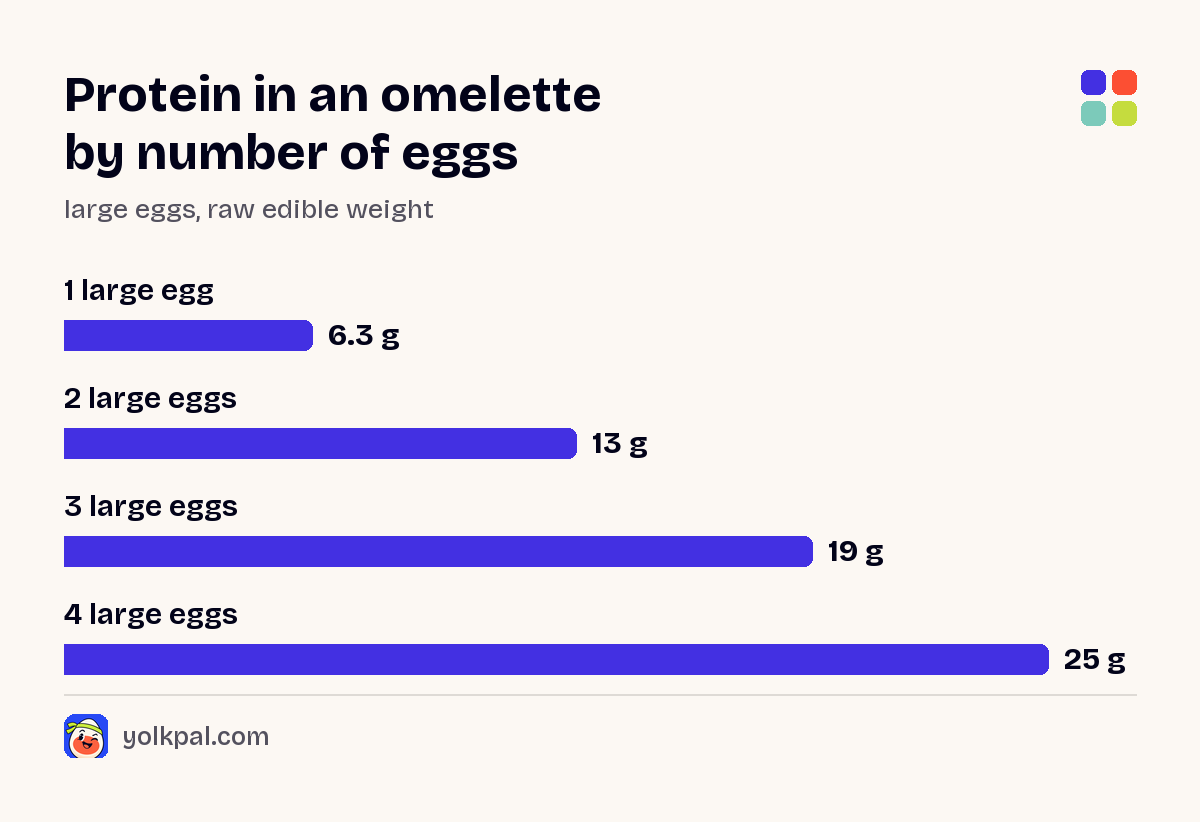
Use the table as the egg part of a recipe, rather than a universal nutrition entry for every finished omelette. A large folded omelette can have a thin egg layer and a generous filling; its appearance alone does not identify the egg count. If your carton lists a different size, use the matching portion in protein in an egg by size and count.
Choose either an ingredient calculation or a matching prepared-food entry. Combining a prepared cheese-omelette entry with an extra log for all its cheese can count the filling twice. At home, ingredients usually make the assumptions easier to see and update.
How much do cheese, meat and vegetables add?
Cheese and meat can change an omelette’s protein total substantially; the vegetable portions below make smaller contributions in USDA’s 2018 records. The table gives separate add-ons, not a recommendation to put every ingredient into the same pan.
| Ingredient added | Amount used | Estimated added protein |
|---|---|---|
| Cheddar cheese | About 1 oz (28 g) | 6.4 g |
| Chicken breast, roasted, meat only | About 2 oz (56 g), cooked | 17 g |
| Spinach, raw | 1 cup (30 g) | 0.9 g |
| Red tomato, raw, chopped | ⅓ cup (60 g) | 0.5 g |
| Fresh egg whites, raw | 2 large whites (66 g) | 7.2 g |
The cheddar estimate comes from USDA’s cheddar record (2018); a different cheese or packaged filling can give a different result. Use the package’s portion weight and protein amount when that better matches what you have. Reading a nutrition label for protein explains how to scale a labeled serving to your own portion.
The chicken estimate uses USDA’s roasted breast, meat-only record (2018). Weigh the cooked chicken before adding it. Do not apply that cooked-food figure to raw chicken or assume it also describes sliced deli poultry. For other filling choices, the high-protein foods chart gives matching foods and portions.
Vegetables still belong in the calculation. USDA’s raw spinach and raw tomato entries (2018) underpin the small contributions shown here. In practice, choose them for the flavor and texture you want, then count their contribution alongside the larger protein ingredients.
What is the protein in a complete filled omelette?
A calculated batch of 3 large eggs, cheddar, spinach and tomato provides about 27 g of protein in total, using USDA SR Legacy (2018). The table makes every ingredient visible so you can replace one without keeping an outdated total.
| Batch ingredient | Edible amount entering the pan | Estimated protein |
|---|---|---|
| Whole eggs, raw, shells excluded | 3 large (150 g) | 19 g |
| Cheddar | About 1 oz (28 g) | 6.4 g |
| Spinach, raw | 1 cup (30 g) | 0.9 g |
| Red tomato, raw, chopped | ⅓ cup (60 g) | 0.5 g |
| Full batch | All ingredients above | 27 g |
| Half the batch | One of 2 equal shares | 13 g |
These quantities are a nutrition calculation, not a kitchen-tested recipe. No exact cooked yield, cooking time or pan performance has been established. Milk, cooking oil, butter, salt, sauces and side dishes are excluded. If you add them, add their own entries to your meal calculation; the table describes only its listed ingredients.
The serving denominator is the full batch you actually made. Eat all of it and use the full-batch estimate. Share it equally and use the half-batch estimate. If you leave a noticeably different fraction, adjust the share rather than automatically treating the whole plate as eaten. A pile of cheese left behind makes an equal-distribution assumption less reliable.
For portions weighed after cooking, weigh the entire finished batch and then the portion you serve. Multiply the unrounded batch protein by portion weight divided by finished-batch weight. That approach uses your actual yield, rather than pretending that raw ingredient weight predicts the final omelette’s weight. The method still assumes the egg and fillings are spread reasonably evenly.
How do egg whites change the calculation?
Fresh egg whites are a separate ingredient, whether you add them to whole eggs or use them instead. USDA’s fresh raw egg-white record (2018) gives about 7.2 g of protein for 2 large whites (66 g). Two large whole eggs plus those whites give about 20 g before fillings, calculated from the whole-egg and white records together.
Keep a whole egg’s white inside the whole-egg entry. Only log additional whites separately. Counting the whole egg and then logging its own white again would duplicate part of your meal.
If you remove yolks, recalculate the ingredients rather than keeping the whole-egg total. USDA’s raw yolk record (2018) confirms that yolks contain protein too; the egg-size guide linked above explains the separate parts. For poured carton whites, follow the package’s weight-based serving information and cooking instructions instead of estimating how many shell eggs the liquid resembles.
How should you estimate a restaurant omelette?
A restaurant omelette has uncertainty in both its egg base and its filling amounts. Start with published nutrition for the exact item and portion if available, including any stated substitutions. A similar menu name elsewhere is not evidence that the recipe matches.
Without published information, ask what the kitchen can tell you: whole eggs or a prepared mixture, approximate egg count, cheese type and whether the meat amount is known. Use those answers to choose matching ingredients. Avoid assigning a precise filling weight from the folded omelette’s footprint or a photograph.
When the kitchen cannot give amounts, record an estimate and the assumptions behind it. For example, you can note the stated egg count and that the cheese portion was estimated. The component tables help you see which unknowns matter without implying that a restaurant used the reference recipe.
Keep toast, potatoes, sauces and other sides outside the omelette entry unless the menu’s nutrition explicitly includes them. If you change your order, check whether the published number still applies. A useful log can acknowledge uncertainty; it does not need an invented decimal to look complete.
How should you cook, chill and reheat an omelette?
Egg safety depends on cooking and storage, not the protein estimate. FDA egg-safety guidance (2024; accessed November 12, 2026) says to cook eggs until whites and yolks are firm and egg dishes to 160°F (71°C), checked with a food thermometer. Wash hands, utensils, equipment and work surfaces with hot, soapy water before and after raw-egg contact.
FDA’s 2024 guidance advises refrigeration at 40°F (4°C) or below and using leftover cooked egg dishes within 3–4 days. Refrigerate promptly: discard cooked egg dishes left out longer than 2 hours, or 1 hour above 90°F (32°C). Include time spent traveling home with restaurant leftovers.
USDA FSIS leftover guidance (2020; accessed November 12, 2026) says to divide large amounts into shallow containers for rapid cooling; hot food can go directly into the refrigerator. Reheat leftovers to 165°F (74°C), checking with a food thermometer. The chicken filling in this page’s table is already cooked; do not treat the omelette’s cooking endpoint as instructions for cooking raw poultry inside it.
What should you log next time?
Your next omelette calculation can start with a short ingredient list: egg size and count, measured filling amounts and the share you ate. Save the assumptions with the meal so that changing a filling or splitting the dish does not silently keep the old portion.
These examples are for adults choosing everyday meals. If you have kidney disease, are pregnant, are under 18 or follow a medically managed diet, talk with your care team about appropriate protein goals and food choices. The FDA’s 2024 egg-safety guidance identifies pregnant people and people with weakened immune systems among those at greater risk of severe illness from Salmonella bacteria.
Count the ingredients for your own omelette, then use the protein calculator to explore how the portion fits your day. For broader meal combinations instead of another omelette calculation, see breakfast ideas with about 30 grams of protein.
Sources
- USDA FoodData Central. SR Legacy, April 2018: whole egg, raw, fresh (FDC 171287); egg white, raw, fresh (172183); egg yolk, raw, fresh (172184); cheddar cheese (173414); spinach, raw (168462); tomatoes, red, ripe, raw, year-round average (170457); chicken breast, meat only, cooked, roasted (171477). Records accessed November 12, 2026. FoodData Central.
- U.S. Food and Drug Administration. What You Need to Know About Egg Safety. 2024 guidance, accessed November 12, 2026. FDA egg safety.
- USDA Food Safety and Inspection Service. Leftovers and Food Safety. Updated July 31, 2020; accessed November 12, 2026. USDA FSIS leftovers guidance.
This article is general information, not medical advice. If you have a health condition, are pregnant, or follow a diet set by your doctor, talk to them or a registered dietitian before changing how you eat.