On this page
What is a complete protein?
A complete protein supplies all nine essential amino acids in adequate proportions. Essential amino acids must come from food. Harvard’s Nutrition Source, read in November 2026, lists histidine, isoleucine, leucine, lysine, methionine, phenylalanine, threonine, tryptophan and valine.
“Contains all nine” is a useful starting point, but amounts matter. A 2020 review by Hertzler and colleagues says a protein counts as complete, or high quality, when it has adequate levels of the nine and is readily digested. USDA FoodData Central (SR Legacy, April 2018) lists all nine in each food in the amino acid table below, including brown rice. An “incomplete” protein can contain all nine while supplying relatively little of one.
Which foods are complete proteins?
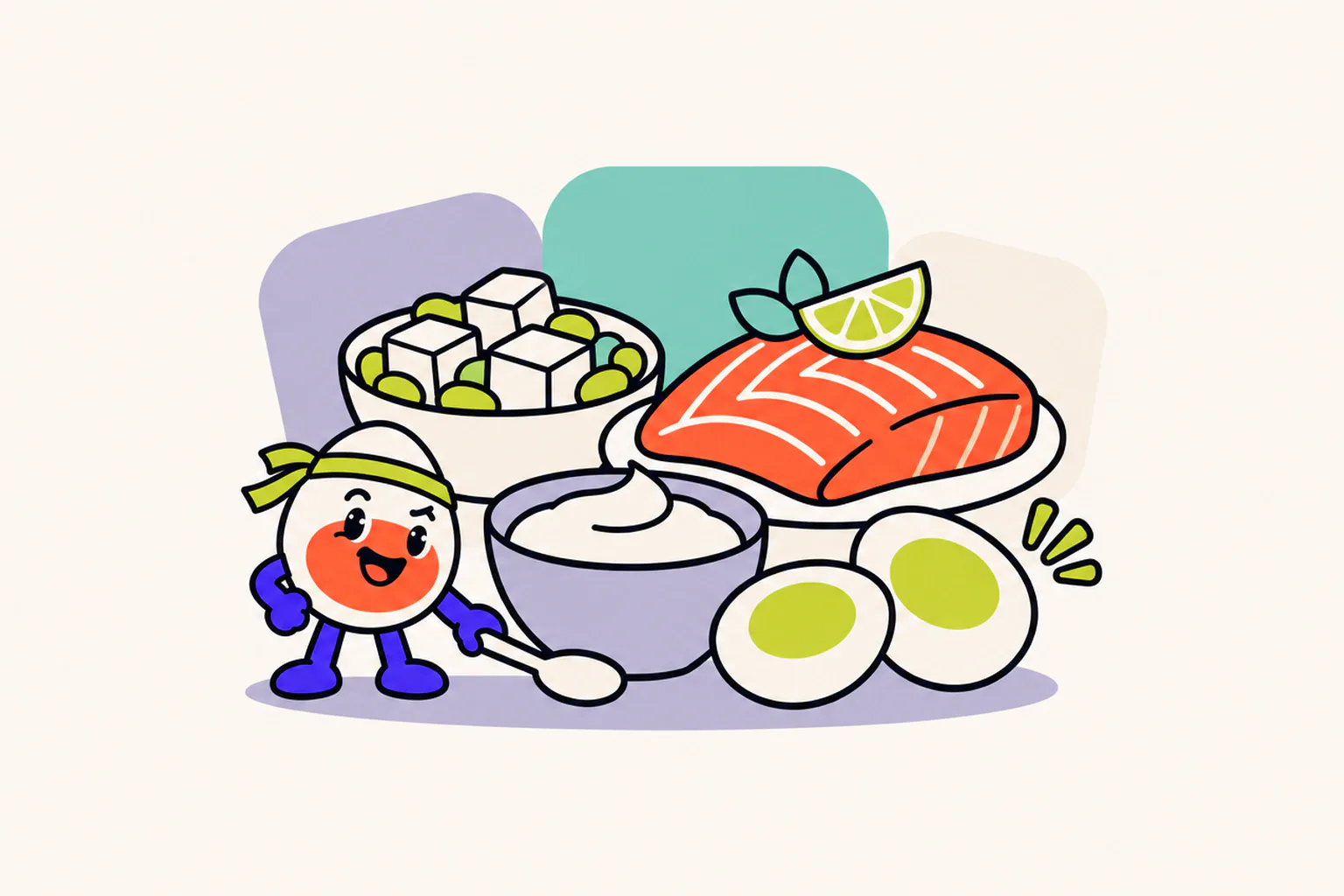
Animal foods and soy are familiar sources. Harvard’s Nutrition Source, read in November 2026, names meat, poultry, fish, eggs and dairy as sources of complete protein. Hertzler’s 2020 review reports scores near the top of the protein quality scale for milk, eggs, beef and soy protein. Its soy scores are for isolates and concentrates, so they do not establish a score for every soy food. The table gives serving amounts, not a quality score for each product.
| Food | About how much protein per serving |
|---|---|
| Eggs, hard-boiled2 large (100 g) | 13 g |
| Chicken breast, roasted3 oz (85 g) | 26 g |
| Beef top sirloin, lean, broiled3 oz (85 g) | 26 g |
| Salmon, Atlantic, farmed, cooked3 oz (85 g) | 19 g |
| Greek yogurt, plain, nonfat6 oz (170 g) | 17 g |
| Milk, whole1 cup (244 g) | 7.7 g |
| Tofu, firm, raw½ cup (126 g) | 22 g |
| Tempeh3 oz (85 g) | 17 g |
| Edamame, frozen, prepared1 cup (155 g) | 18 g |
| Soy milk, original and vanilla, unfortified1 cup (243 g) | 7.9 g |
Soy food values depend on the product; protein in tofu, tempeh and edamame compares their preparations. Phillips’s 2017 review gives hydrolyzed collagen a quality score of 0 on both scales below because it lacks tryptophan. The guide to collagen protein explains how that affects a daily goal.
Is quinoa a complete protein?
USDA FoodData Central (SR Legacy, April 2018) lists all nine essential amino acids in cooked quinoa and buckwheat. Harvard’s Nutrition Source, read in November 2026, names quinoa and chia seeds as complete plant proteins. Hertzler’s 2020 review gives raw or uncooked quinoa a PDCAAS of 0.77–0.89 across four reference patterns, with lysine limiting. That is a result for the reviewed data, rather than a universal score for every quinoa preparation.
How are protein quality scores calculated?
Protein quality scores compare essential amino acid proportions with a reference pattern and account for digestion. FAO’s 2013 report explains both methods. PDCAAS (Protein Digestibility Corrected Amino Acid Score) adjusts the lowest amino acid ratio for whole-protein digestibility and caps the score at 1.00. DIAAS (Digestible Indispensable Amino Acid Score), recommended by the 2011 consultation in that report, uses each amino acid’s digestibility at the end of the small intestine. DIAAS can exceed 100, equivalent to a ratio above 1.00.
| Protein | PDCAAS range |
|---|---|
| Milk protein | 1.00 |
| Soy protein | 0.93–1.00 |
| Pea protein | 0.78–0.91 |
| Quinoa, raw or uncooked | 0.77–0.89 |
| Lentils, boiled | 0.68–0.80 |
| Rice protein | 0.53–0.64 |
| Peanut | 0.46–0.55 |
| Wheat | 0.45–0.54 |
| Corn | 0.41–0.50 |
| Hydrolyzed collagen | 0 |
Scores depend on food form, reference pattern and method. Hertzler’s 2020 review says an individual protein’s score matters less in a diet with varied protein sources. For packaged foods, reading a nutrition label for protein explains how protein quality affects labeling.
Which foods fill each other’s gaps?
Grains and legumes can complement each other’s amino acid proportions, as Hertzler’s 2020 review explains. USDA’s SR Legacy data (April 2018) below illustrate lysine and sulfur amino acids (methionine plus cysteine), expressed per gram of protein. FAO’s 2013 scoring pattern supplies the comparison for older children, adolescents and adults.
| Food | Lysine per gram of protein | Sulfur amino acids per gram of protein |
|---|---|---|
| Egg, hard-boiled | 72 mg | 54 mg |
| Chicken breast, roasted | 85 mg | 40 mg |
| Tofu, firm, raw | 51 mg | 16 mg |
| Brown rice, cooked | 36 mg | 32 mg |
| Whole-wheat pita | 27 mg | 39 mg |
| Peanut butter | 31 mg | 22 mg |
| Lentils, boiled | 70 mg | 22 mg |
| Black beans, boiled | 69 mg | 26 mg |
| FAO adult scoring pattern | 48 mg | 23 mg |
USDA’s rice and beans (SR Legacy, April 2018) illustrate the arithmetic. Put 1 cup (202 g) of cooked brown rice with 1 cup (172 g) of boiled black beans and the plate has about 21 g of protein, about 60 mg of lysine per gram and about 28 mg of sulfur amino acids per gram, above both references. These uncorrected amounts do not establish the meal’s digestibility-adjusted quality score.
USDA’s peanut butter and whole-wheat pita (SR Legacy, April 2018) are both below the lysine reference. Pairing any two plant foods does not guarantee a balanced amino acid profile. Options that follow Hertzler’s grain and legume pairing principle include:
- Rice and beans: or lentils over rice.
- Pita and hummus: grain with chickpeas.
- Beans in a corn tortilla: another legume-and-grain option.
These are pairing ideas, not tested complete-protein recipes; proportions matter. For meat-free food choices, see vegetarian protein sources.
Do you need to combine proteins at the same meal?
Complementary proteins do not have to arrive at the same meal. MedlinePlus (reviewed April 2025; editorial update March 2026) says essential amino acid balance over the day matters more. Mariotti and Gardner’s 2019 review found no evidence that isolated plant proteins need complementary proteins in the same meal, while Young and Pellett’s 1994 review concluded that plant protein mixtures can meet amino acid needs.
Hertzler’s 2020 review describes an estimate that muscle could store 60% of the adult daily lysine requirement within 3 h of a protein-rich meal. The proposed mechanism concerns meals about 3 hours apart; it is not proof of adequacy for every diet.
Variety still matters. The Dietary Guidelines for Americans 2025–2030, published in January 2026, advise diversifying plant protein sources for amino acid balance. Plant protein basics covers everyday choices.
The same-meal advice assumes an adequate overall diet. Mariotti and Gardner’s 2019 review notes that combining proteins at a meal may help when total protein is low, and that older adults need more careful assessment. If you have kidney disease, are pregnant or breastfeeding, follow a medical diet, or are planning dietary changes for someone under 18, talk to your doctor or a registered dietitian.
What should you do with this?
Protein quality and quantity both matter. In practice, you can choose varied protein foods across the day, including beans, lentils or soy when eating mostly plants. The high-protein foods chart compares serving amounts.
YolkPal is an iPhone protein tracker with optional calories. You can log by typing grams, taking a photo, scanning a barcode or label, or speaking. Check and edit AI estimates before saving.
Complete protein foods still need to be eaten in sufficient amounts. Pick a protein food for your next meal, then compare your usual daily total with how much protein you need.
Sources
- Harvard T.H. Chan School of Public Health, The Nutrition Source. Protein, read November 10, 2026. nutritionsource.hsph.harvard.edu
- MedlinePlus, National Library of Medicine. Protein in diet, last reviewed April 1, 2025; editorial update March 24, 2026. medlineplus.gov
- Hertzler SR, et al. Plant proteins: assessing their nutritional quality and effects on health and physical function. Nutrients 2020;12(12):3704. doi:10.3390/nu12123704
- Mariotti F, Gardner CD. Dietary Protein and Amino Acids in Vegetarian Diets—A Review. Nutrients 2019;11(11):2661. doi:10.3390/nu11112661
- Young VR, Pellett PL. Plant proteins in relation to human protein and amino acid nutrition. Am J Clin Nutr 1994;59(5 Suppl):1203S–1212S. doi:10.1093/ajcn/59.5.1203S
- Phillips SM. Current concepts and unresolved questions in dietary protein requirements and supplements in adults. Front Nutr 2017;4:13. doi:10.3389/fnut.2017.00013
- FAO. Dietary protein quality evaluation in human nutrition: report of an FAO Expert Consultation. FAO Food and Nutrition Paper 92, 2013. fao.org
- U.S. Department of Agriculture and U.S. Department of Health and Human Services. Dietary Guidelines for Americans, 2025–2030. January 2026. realfood.gov/documents/DGA.pdf
- USDA FoodData Central, SR Legacy: egg, whole, cooked, hard-boiled (FDC 173424); chicken, broilers or fryers, breast, meat only, cooked, roasted (171477); beef, top sirloin, separable lean only, select, broiled (168636); fish, salmon, Atlantic, farmed, cooked, dry heat (175168); yogurt, Greek, plain, nonfat (170894); milk, whole, 3.25% milkfat (171265); tofu, raw, firm, prepared with calcium sulfate (172475); tempeh (174272); edamame, frozen, prepared (168411); soymilk, original and vanilla, unfortified (172446); rice, brown, long-grain, cooked (169704); bread, pita, whole-wheat (174916); peanut butter, smooth style, without salt (172470); lentils, boiled, without salt (172421); beans, black, boiled, without salt (173735); quinoa, cooked (168917); buckwheat groats, roasted, cooked (170686). fdc.nal.usda.gov
This article is general information, not medical advice. If you have a health condition, are pregnant, or follow a diet set by your doctor, talk to them or a registered dietitian before changing how you eat.