On this page
- Can you get enough protein without meat?
- How much protein should a vegetarian aim for?
- Which eggs and dairy foods give the most protein?
- How much protein do soy foods and legumes add?
- What do grains, nuts and seeds contribute?
- Do you need to combine foods to get complete protein?
- What does a vegetarian day of about 103 g look like?
- Which nutrients besides protein need attention?
- Who should check with a clinician first?
- A simple next step
Can you get enough protein without meat?
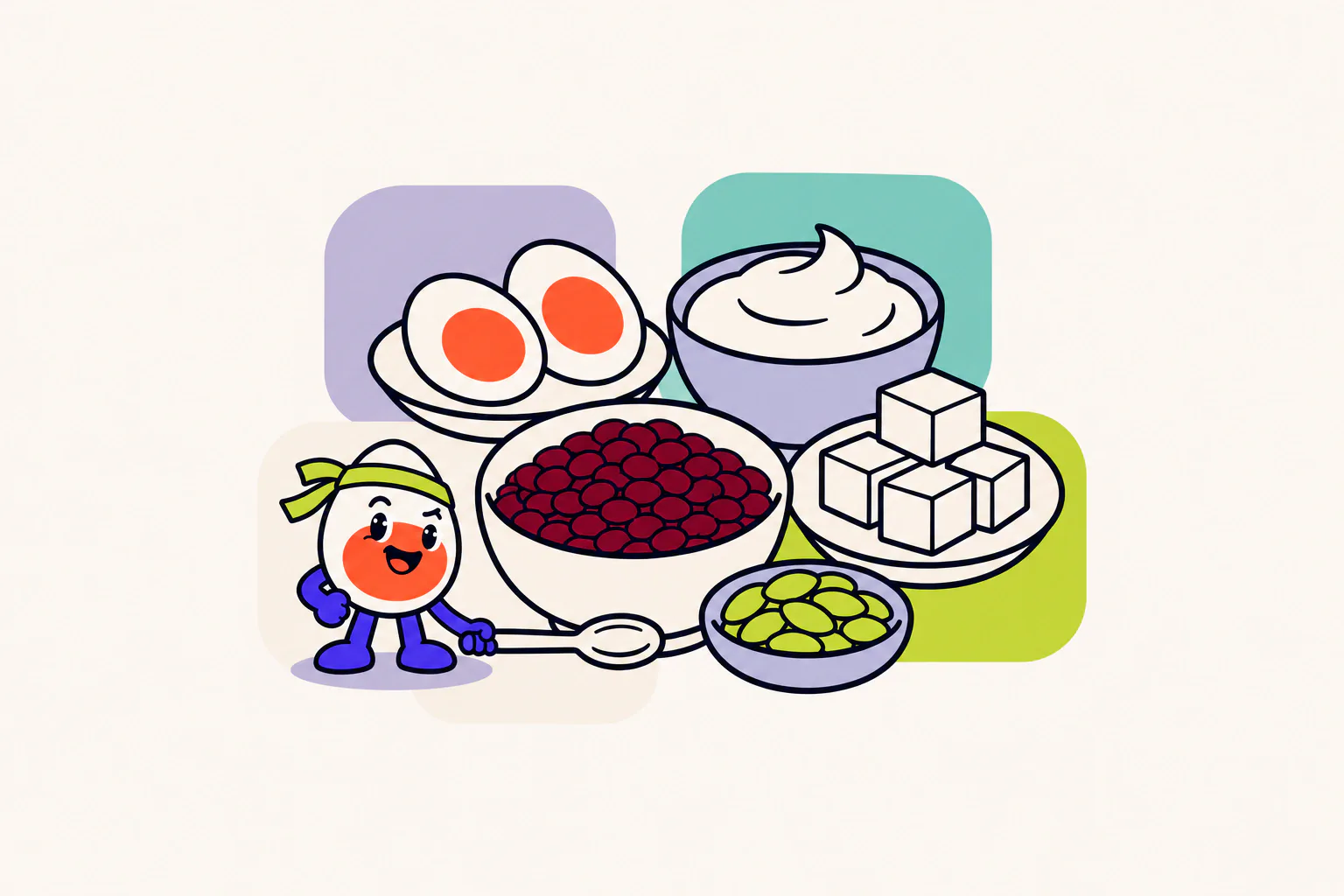
Vegetarian diets can provide enough protein when meals include protein-rich foods. A lacto-ovo vegetarian eats eggs (“ovo”) and dairy (“lacto”) but no meat, poultry or fish. The Academy of Nutrition and Dietetics’ 2025 position paper, corrected in 2026, supports the nutritional adequacy of appropriately planned vegetarian diets for nonpregnant, nonbreastfeeding adults.
Mariotti and Gardner’s 2019 review in Nutrients concluded that protein-rich plant foods, including legumes, nuts and seeds, can meet adult protein needs within a varied vegetarian diet. In practice, you can build meals around eggs, dairy, soy or legumes.
The review reports about 14% of energy from protein among lacto-ovo vegetarians in the Western EPIC-Oxford and NutriNet-Santé cohorts. For EPIC-Oxford, this was about 1.04 g/kg of body weight, or 70 g a day. Using the Estimated Average Requirement, the intake meeting half of healthy people’s needs, the estimated proportions with inadequate intakes were 10% of vegetarian men and 6% of vegetarian women, versus 3% and 1% of meat-eaters. These estimates of possible intake shortfalls are sensitive to dietary-survey error and underreporting.
How much protein should a vegetarian aim for?
Healthy vegetarian adults can use general adult protein guidance. The Dietary Guidelines for Americans 2025–2030, published by USDA and HHS in January 2026, set the protein serving goal at 1.2–1.6 g of protein per kg of body weight a day, adjusted for individual calorie needs. The Recommended Dietary Allowance (RDA) of 0.8 g/kg a day, set by the Institute of Medicine in 2005, is the minimum reference intake covering nearly all healthy adults.
The 2025–2030 guidelines encourage vegetarians to vary their protein foods, including eggs, dairy, soy and legumes. For a 70 kg (154 lb) adult, 1.2–1.6 g/kg works out to 84–112 g a day. How much protein you need explains how targets vary, and the protein calculator does the arithmetic.
Which eggs and dairy foods give the most protein?
Eggs, Greek yogurt and cottage cheese each supply about 12 g or more in the portions below, according to USDA FoodData Central (SR Legacy, 2018).
| Food | Protein | Calories |
|---|---|---|
| Greek yogurt, plain, nonfat6 oz (170 g) | 17 g | 100 kcal |
| Eggs, hard-boiled2 large (100 g) | 13 g | 155 kcal |
| Yogurt, plain, low-fat8 oz (227 g) | 12 g | 143 kcal |
| Cottage cheese, 2% milkfat4 oz (113 g) | 12 g | 92 kcal |
| Milk, 2%1 cup (244 g) | 8.1 g | 122 kcal |
| Swiss cheese1 oz (28 g) | 7.5 g | 110 kcal |
| Mozzarella, part skim1 oz (28 g) | 6.8 g | 71 kcal |
| Cheddar1 oz (28 g) | 6.4 g | 113 kcal |
| Feta1 oz (28 g) | 4.0 g | 74 kcal |
Cheese portions can add flavor and protein. The Dietary Guidelines 2025–2030 favor unsweetened full-fat dairy. The table includes several fat levels so you can compare foods you use. For a drinkable option, try these high-protein smoothies without protein powder.
Eggs fit into almost any meal, and how much protein is in an egg covers sizes, yolks and cooking. For a ranking across all food groups, see the high-protein foods chart.
How much protein do soy foods and legumes add?
Soy foods and legumes give you more meat-free choices. USDA FoodData Central (SR Legacy, 2018) lists the following amounts for the prepared foods and portions named.
| Food | Protein | Calories |
|---|---|---|
| Tofu, firm, raw½ cup (126 g) | 22 g | 181 kcal |
| Edamame, shelled, prepared1 cup (155 g) | 18 g | 188 kcal |
| Lentils, boiled1 cup (198 g) | 18 g | 230 kcal |
| Tempeh, cooked3 oz (85 g) | 17 g | 166 kcal |
| Kidney beans, boiled1 cup (177 g) | 15 g | 225 kcal |
| Black beans, boiled1 cup (172 g) | 15 g | 227 kcal |
| Chickpeas, boiled1 cup (164 g) | 15 g | 269 kcal |
| Soy milk, original and vanilla, unfortified1 cup (243 g) | 7.9 g | 131 kcal |
Use your tofu or soy milk label to check its serving size and protein. Plant protein basics covers protein quality, and protein in tofu, tempeh and edamame compares soy preparations.
What do grains, nuts and seeds contribute?
Grains, nuts and seeds can contribute to your total alongside eggs, dairy or legumes. USDA FoodData Central (SR Legacy, 2018) gives the serving estimates below.
| Food | Protein | Calories |
|---|---|---|
| Hemp seeds, hulled3 tbsp (30 g) | 9.5 g | 166 kcal |
| Pumpkin seed kernels, dried1 oz (28 g) | 8.5 g | 157 kcal |
| Quinoa, cooked1 cup (185 g) | 8.1 g | 222 kcal |
| Peanut butter, smooth2 tbsp (32 g) | 7.1 g | 191 kcal |
| Almonds1 oz (28 g) | 5.9 g | 162 kcal |
| Whole-wheat bread1 slice (32 g) | 4.0 g | 81 kcal |
| Brown rice, cooked1 cup (195 g) | 4.5 g | 218 kcal |
For packaged veggie burgers or seitan, use the product label to calculate your portion. Reading a nutrition label for protein explains the steps. The Dietary Guidelines 2025–2030 also recommend limiting highly processed vegetarian foods with added fat, sugar or salt.
Do you need to combine foods to get complete protein?
Complete protein supplies all the essential amino acids, the protein building blocks your body needs from food, in adequate proportions. Mariotti and Gardner’s 2019 review found no need for same-meal combining when overall protein intake is adequate and varied.
The same review estimated lysine, an essential amino acid, at 58 mg/kg of body weight in EPIC-Oxford lacto-ovo vegetarians, using an average body weight of 65 kg (143 lb). That exceeded the Estimated Average Requirement of 30 mg/kg. These are cohort estimates, so use them as context when planning your own food choices.
You can vary foods across your day. Plant protein basics covers plant-only diets, and complete proteins explains amino acid balance.
What does a vegetarian day of about 103 g look like?
A vegetarian day can reach about 103 g with ordinary foods, spread over four eating occasions, using the USDA SR Legacy (2018) values above. The table counts protein foods and grains. Add vegetables, fruit, cooking fats and other foods to suit your appetite and energy needs.
| Meal | What is on the plate | Protein |
|---|---|---|
| Breakfast | 2 large hard-boiled eggs (100 g) and 2 slices of whole-wheat bread (64 g, weighed before toasting) | 21 g |
| Lunch | 1 cup (198 g) boiled lentils, 1 cup (185 g) cooked quinoa and 1 oz (28 g) feta | 30 g |
| Snack | 6 oz (170 g) plain nonfat Greek yogurt with 1 oz (28 g) pumpkin seeds | 26 g |
| Dinner | ½ cup (126 g) firm tofu, weighed before stir-frying, over 1 cup (195 g) cooked brown rice | 26 g |
| Day | All of the above | about 103 g |
You can use this pattern to spread protein across your day. Protein at every meal explains the research. Browse 30-gram protein breakfasts for morning ideas, high-protein vegetarian meals for recipes, or easy ways to add about 10 grams of protein for small additions.
Which nutrients besides protein need attention?
Vitamin B12 and iron deserve attention alongside protein. The NIH Office of Dietary Supplements’ 2025 fact sheets explain why.
- Vitamin B12. NIH’s July 2025 fact sheet identifies vegetarians, including those eating eggs and dairy, as a group at higher risk of deficiency. It describes fortified foods and supplements as ways to reduce that risk. Ask your care team whether your B12 intake and status need checking.
- Iron. NIH’s September 2025 fact sheet explains that plant iron is less readily absorbed than iron from meat. Vitamin C improves plant-iron absorption. You can pair lentils or beans with a vitamin C food. Discuss concerns about low iron with a clinician.
- Other nutrients. The Dietary Guidelines 2025–2030 flag vitamins D and E, choline and iron as potential gaps in vegetarian diets. They also advise periodic attention to B12, vitamin D, calcium and iodine status.
Who should check with a clinician first?
Talk to your doctor or a registered dietitian before changing your protein if you have kidney disease, are pregnant or breastfeeding, are under 18, follow a medically managed diet or manage anemia. Parents planning vegetarian meals for a child should get age-specific advice too.
A simple next step
Choose one egg or dairy anchor and one soy or legume anchor for tomorrow, then use the day table above as a template. The guide to tracking protein without counting calories shows how to keep a running total.
In YolkPal, an iPhone protein tracker, you can log a meal by typing the grams, taking a photo of the plate, scanning a barcode, reading a nutrition label or saying the meal out loud. AI results are estimates that you check and edit before saving. Foods you repeat can be saved for quick logging.
Sources
- Raj S, Guest NS, Landry MJ, Mangels AR, Pawlak R, Rozga M. Vegetarian Dietary Patterns for Adults: A Position Paper of the Academy of Nutrition and Dietetics. J Acad Nutr Diet Corrected publication, 2026;126(3):156227. doi:10.1016/j.jand.2025.156227
- Mariotti F, Gardner CD. Dietary protein and amino acids in vegetarian diets—a review. Nutrients 2019;11(11):2661. doi:10.3390/nu11112661
- Institute of Medicine. Dietary Reference Intakes for Energy, Carbohydrate, Fiber, Fat, Fatty Acids, Cholesterol, Protein, and Amino Acids. National Academies Press, 2005. doi:10.17226/10490
- U.S. Department of Agriculture and U.S. Department of Health and Human Services. Dietary Guidelines for Americans, 2025–2030. January 2026. realfood.gov/documents/DGA.pdf
- National Institutes of Health, Office of Dietary Supplements. Vitamin B12: fact sheet for health professionals. Updated July 2, 2025. ods.od.nih.gov/factsheets/VitaminB12-HealthProfessional
- National Institutes of Health, Office of Dietary Supplements. Iron: fact sheet for health professionals. Updated September 4, 2025. ods.od.nih.gov/factsheets/Iron-HealthProfessional
- USDA FoodData Central, SR Legacy (April 2018): egg, whole, cooked, hard-boiled (FDC 173424); yogurt, Greek, plain, nonfat (170894); yogurt, plain, low fat (170886); cheese, cottage, lowfat, 2% milkfat (172182); milk, reduced fat, 2% (171267); cheese, swiss (171251); cheese, mozzarella, part skim milk (170847); cheese, cheddar (173414); cheese, feta (173420); tofu, raw, firm, prepared with calcium sulfate (172475); edamame, frozen, prepared (168411); lentils, boiled (172421); tempeh, cooked (172467); beans, kidney, boiled (173740); beans, black, boiled (173735); chickpeas, boiled (173757); soymilk, original and vanilla, unfortified (172446); seeds, hemp seed, hulled (170148); seeds, pumpkin and squash seed kernels, dried (170556); quinoa, cooked (168917); peanut butter, smooth style, without salt (172470); nuts, almonds (170567); bread, whole-wheat, commercially prepared (172688); rice, brown, medium-grain, cooked (168875). fdc.nal.usda.gov
This article is general information, not medical advice. If you have a health condition, are pregnant, or follow a diet set by your doctor, talk to them or a registered dietitian before changing how you eat.