
On this page
- What makes a lentil recipe high in protein?
- How do dry lentils turn into cooked lentils?
- Which high-protein lentil recipes should you cook?
- How do the four plates compare?
- How much do soy, dairy or meat add to a lentil plate?
- Are lentil recipes low-carb or good for weight loss?
- How do you batch, store and freeze lentil dishes?
- Who should check with a clinician first?
- A simple next step
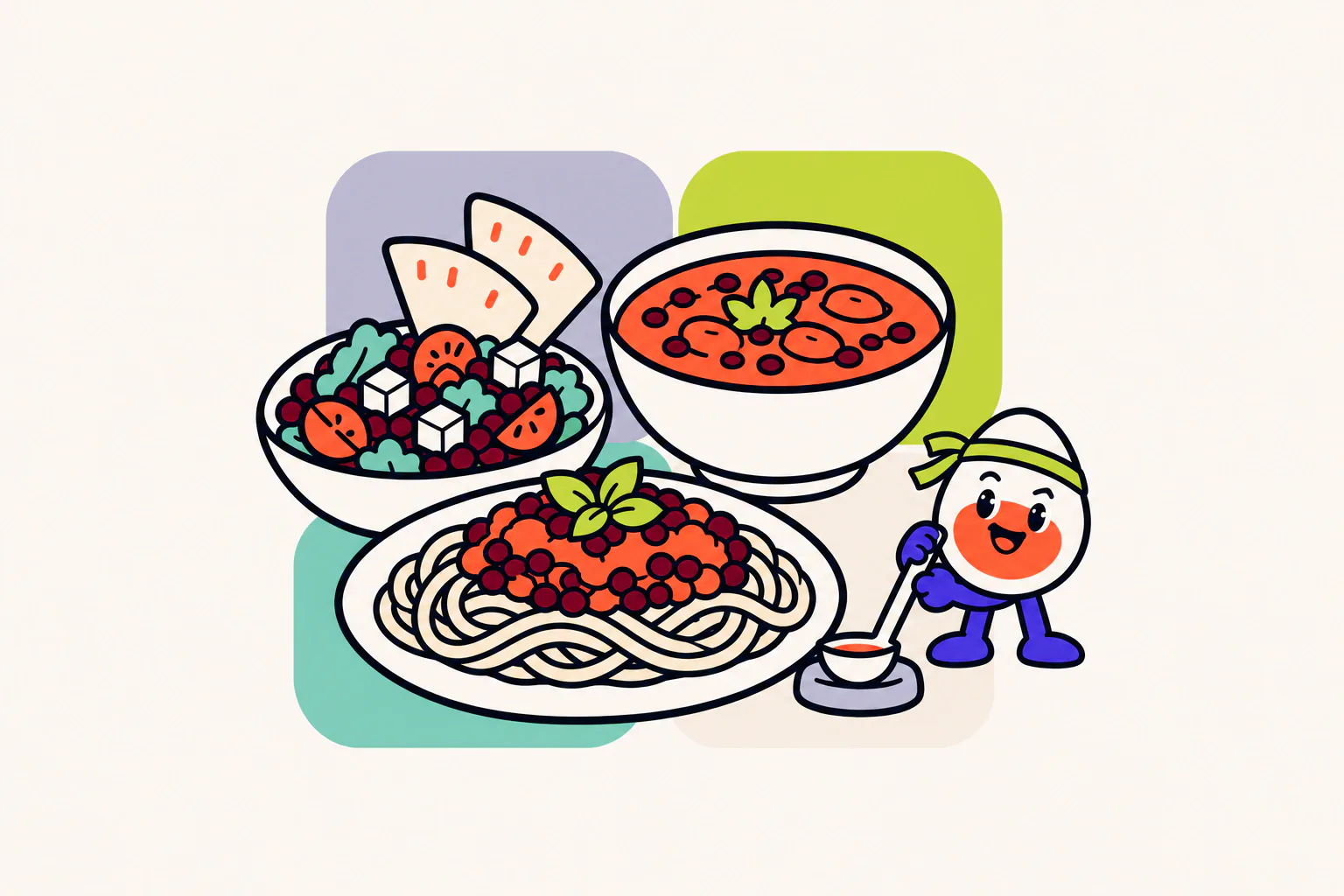
What makes a lentil recipe high in protein?
On this page, a high-protein lentil recipe means a plate with at least 20 g of protein. That is the page’s own yardstick, not an official label claim, and it takes weighed lentils plus something beside them. USDA’s SR Legacy data (April 2018) lists about 25 g of protein in 100 g of dry lentils and about 9.0 g in 100 g of boiled ones. The four high-protein lentil recipes here use 75 g of dry lentils per serving, which is about 18 g, and the grain or topping beside them adds the rest.
A useful target is your own. The Dietary Guidelines for Americans 2025–2030 (USDA and HHS, January 2026) set a daily goal of 1.2–1.6 g of protein per kilogram of body weight. A 2018 review by Schoenfeld and Aragon suggested about 0.4 g/kg per meal, across at least four meals, for people doing regular resistance training. For a 70 kg (154 lb) adult that is about 28 g a meal, and for a 55 kg (121 lb) adult about 22 g. It is a muscle-building suggestion, not a requirement. How much protein you need and the protein calculator help you set your own number.
These recipes do not repeat the per-cup lentil table; protein in beans and lentils has it. This page is about what happens when you cook them.
How do dry lentils turn into cooked lentils?
Dry lentils weigh about 2.7 times as much once they are cooked and drained, because they absorb water. That figure comes from USDA’s 2018 entries: 100 g of dry lentils has about 24.6 g of protein and 100 g of boiled lentils has about 9.0 g, so the same protein spreads over a heavier food. It is an estimate, and your pot will vary with the lentil type, the age of the lentils and how long you cook them.
| Dry lentils | Cooked and drained (estimate) | Protein, either way |
|---|---|---|
| Small portion50 g dry | about 137 g | 12 g |
| One serving in the recipes75 g dry | about 205 g | 18 g |
| Round number100 g dry | about 273 g | 25 g |
| 1 cup dry192 g | about 524 g | 47 g |
Pick one way of weighing and stay with it. If you weigh dry, log the dry entry. If you weigh cooked and drained lentils, log the boiled entry. A scoop of lentil soup or dal is neither: it includes liquid, so the next sections show how to weigh a whole pot.
Which high-protein lentil recipes should you cook?
Each recipe below lists the whole pot, the number of servings and the per-serving total. Spices, herbs, garlic, ginger, lemon, salt and water or broth are not counted, and oil is counted where it is listed. Cooking times are estimates, so follow your lentil package for soaking and time. Vegan or plant-based as written assumes that canned tomatoes, pasta and rice contain no animal ingredients; check the labels.
Red lentil dal with spinach (Indian-style, vegan)
Ingredients (serves 2): about ¾ cup (150 g) dry red lentils, 1 medium (110 g) onion, ½ cup (120 g) canned tomatoes in juice, 2 cups (60 g) raw spinach, 1 tbsp (13.5 g) olive oil, and 2 cups (390 g) cooked brown rice to serve. Per serving, with 1 cup (195 g) of rice: about 24 g of protein, 14 g of fiber and 585 kcal.
Soften the onion in the oil with ginger, cumin and turmeric, add the lentils, tomatoes and about 3 cups (720 ml) of water, and simmer for about 20 minutes, until soft. Stir in the spinach at the end.
Lentil weights: USDA lists red lentils only raw (FDC 174284), and they break down into the sauce, so you cannot drain them. If they cooked like USDA’s boiled green lentils, 150 g dry would weigh about 400 g cooked. Weigh your finished pot to get the true figure.
Green lentil and carrot soup (vegan, batch of 4)
Ingredients (serves 4): about 1½ cups (300 g) dry green or brown lentils, 3 medium (183 g) carrots, 2 medium stalks (80 g) celery, 1 large (150 g) onion, 1 cup (240 g) canned tomatoes in juice and 1 tbsp (13.5 g) olive oil. Per serving, one quarter of the pot: about 20 g of protein, 11 g of fiber and 340 kcal.
Soften the vegetables in the oil, add the lentils, tomatoes and about 6 cups (1.4 liters) of water or low-sodium broth, and simmer for about 30 minutes. This pot doubles easily for the freezer.
Lentil weights: 300 g dry would weigh about 820 g if you boiled and drained them, but here they cook in the soup, so each serving gets 75 g dry.
Lentil bolognese on whole-wheat spaghetti (plant-based, batch of 4)
Ingredients (serves 4): about 1½ cups (300 g) dry green or brown lentils, about 1⅔ cups (400 g) canned crushed tomatoes, 1 medium (110 g) onion, 1 medium (61 g) carrot, 1 tbsp (13.5 g) olive oil and 4 cups (604 g) cooked whole-wheat spaghetti, packed. Per serving, with 1 cup (151 g) of pasta: about 30 g of protein, 17 g of fiber and 568 kcal.
Soften the onion and carrot in the oil, add the lentils, the tomatoes and about 4 cups (960 ml) of water, and simmer with garlic and oregano for about 35 minutes, until thick. Spoon it over the pasta.
Lentil weights: 300 g dry would weigh about 820 g cooked, so each serving of sauce holds the equivalent of about 205 g of cooked lentils.
Warm lentil salad with feta and pita (vegetarian)
Ingredients (serves 2): 2 cups (396 g) cooked, drained green or brown lentils, 1 medium (201 g) peeled cucumber, 2 medium (246 g) tomatoes, 2 oz (57 g) feta, 1 tbsp (13.5 g) olive oil and 2 large (128 g) whole-wheat pitas. Per serving: about 30 g of protein, 22 g of fiber and 565 kcal.
Toss the lentils while they are still warm with the oil, lemon and herbs, then fold in the chopped cucumber and tomato and top with the feta. Serve with a pita.
Lentil weights: 396 g cooked and drained comes from about 145 g dry. Cook them until just tender and drain well, because soft lentils get mushy in a salad.
How do the four plates compare?
The salad and the bolognese reach about 30 g of protein per plate, the dal about 24 g and the soup about 20 g. The FDA’s Daily Value for dietary fiber, the reference behind the percentages on Nutrition Facts labels, is 28 g. USDA’s 2018 data puts these plates at 11–22 g of fiber, with the soup lowest because it holds no grain or bread. To log protein and fiber together, see how to track fiber and protein in one food record.
| Plate (1 serving) | Lentils | Protein | Fiber | Calories |
|---|---|---|---|---|
| Red lentil dal with spinachwith 1 cup (195 g) brown rice | 75 g dry | 24 g | 14 g | 585 kcal |
| Green lentil and carrot soupone quarter of the pot | 75 g dry | 20 g | 11 g | 340 kcal |
| Lentil bolognesewith 1 cup (151 g) whole-wheat spaghetti | 75 g dry | 30 g | 17 g | 568 kcal |
| Warm lentil salad with fetawith 1 large (64 g) whole-wheat pita | 198 g cooked | 30 g | 22 g | 565 kcal |
More fiber is not automatically better for everyone. If lentils are new to your plates, start with a smaller serving and see protein, bloating and gas. For other fiber-and-protein pairings, see foods with both protein and fiber.
How much do soy, dairy or meat add to a lentil plate?
Each addition below raises a plate by a known amount, so you can add as much as your day needs. The soup, at about 20 g, gains the most from an extra, while the bolognese and the salad already reach about 30 g. The extras are options, not requirements, and the dal and soup also work as they are. For how plant proteins fit together, see plant protein basics.
| Add-on | Protein added | Calories added |
|---|---|---|
| Firm tofu, raw3 oz (85 g), cubed into the dal or soup | 15 g | 122 kcal |
| Edamame, frozen, prepared½ cup (78 g), into the salad | 9.3 g | 94 kcal |
| Plain nonfat Greek yogurt3.5 oz (100 g), on the dal | 10 g | 59 kcal |
| Cottage cheese, 2%½ cup (113 g), beside the salad | 12 g | 92 kcal |
| Grated parmesan3 tbsp (15 g), on soup or bolognese | 4.3 g | 63 kcal |
| Roasted chicken breast3 oz (85 g), sliced onto any plate | 26 g | 140 kcal |
If you add chicken, cook it to an internal temperature of 165°F as measured with a food thermometer, the USDA FSIS (2020) poultry minimum. Add the grams to the plate you eat, not to the whole pot, unless you divide the pot afterward.
Are lentil recipes low-carb or good for weight loss?
Lentils are not a low-carb food: USDA’s 2018 data lists about 20 g of carbohydrate in 100 g of boiled lentils, and the four plates above hold about 58–104 g each, mostly from lentils and the grain beside them. If you want fewer carbohydrates, you can use a smaller scoop of lentils and skip the rice, pasta or pita, then add tofu, yogurt or chicken for protein. High-protein, low-carb meals has plates built that way.
We cannot promise weight loss from any recipe. If you choose to count calories, the plates above run about 340–585 kcal, and protein for weight loss explains how protein fits a calorie plan. If you have a history of disordered eating, skip calorie counting and talk to a clinician. Gentler options are whether counting calories is healthy and how to track protein without counting calories.
How do you batch, store and freeze lentil dishes?
A pot of lentils is a batch of servings, and its protein is the sum of its ingredients. The soup, for example, has about 80 g of protein across the whole pot. Weigh the finished pot once: if it comes to 2,000 g, each 100 g of soup has about 4 g of protein, and a bowl that weighs 500 g has about 20 g. Your own pot will differ, which is why you weigh it. A recipe protein calculator does the same division. High-protein iftar meals also shows how to count a whole pot.
USDA FSIS’s leftovers guidance (last updated July 2020) is written for leftovers in general and gives no lentil-specific times, so these are its general rules, applied here to cooked lentil dishes.
- Cool fast. Refrigerate within 2 hours of cooking, or within 1 hour above 90°F. Divide a big pot of soup into shallow containers so it cools quickly.
- Store. Leftovers keep 3 to 4 days in the refrigerator or 3 to 4 months in the freezer. Frozen food stays safe longer but can lose moisture and flavor.
- Thaw. FSIS lists the refrigerator, cold water and the microwave as safe ways. Refrigerator-thawed food keeps 3 to 4 days or can be refrozen. Food thawed in cold water should be cooked before refreezing, and microwave-thawed food should be heated to 165°F.
- Reheat. Bring leftovers to 165°F as measured with a food thermometer, and bring soups and sauces to a rolling boil.
The soup and the bolognese are easy to freeze in single portions. Freeze the salad’s cooked lentils plain and add the cucumber, tomato and feta fresh. Keep the assembled salad at 40°F or below, as FSIS advises for cold perishable food.
For planning a whole week of cooked food, see high-protein meal prep and the high-protein vegan meal plan. For another legume to cook in batches, try these black-eyed pea bowls.
Who should check with a clinician first?
Talk to your doctor or a registered dietitian before changing your protein intake substantially if you have kidney disease, follow a medically managed diet, are pregnant or breastfeeding, or are under 18. Some medical diets limit specific nutrients, and this page cannot say which lentil portion is right for you. The Dietary Guidelines for Americans 2025–2030 list folate-rich greens and legumes among foods for pregnant women, and your care team can say which cheeses and leftovers suit you.
For how these plates fit a meat-free week, see high-protein vegetarian meals.
In YolkPal, an iPhone protein tracker that is coming soon to the App Store, you can save a meal you cook often, such as one of these plates, and log it again from your saved foods. You can type the grams, take a photo of the plate or say the meal by voice. AI results are estimates that you check and edit before saving.
A simple next step
Cook the soup or the bolognese once this week, weigh the finished pot, and write down the grams per portion. Then pick the add-on that closes the gap to your own target. Easy ways to add 10 grams of protein has more ideas for the last few grams.
Sources
- Schoenfeld BJ, Aragon AA. How much protein can the body use in a single meal for muscle-building? Implications for daily protein distribution. J Int Soc Sports Nutr 2018;15:10. doi:10.1186/s12970-018-0215-1
- U.S. Department of Agriculture and U.S. Department of Health and Human Services. Dietary Guidelines for Americans, 2025–2030. January 2026. realfood.gov/documents/DGA.pdf
- USDA Food Safety and Inspection Service. Leftovers and Food Safety. Last updated July 31, 2020; read November 2026. fsis.usda.gov
- U.S. Food and Drug Administration. Daily Value on the Nutrition and Supplement Facts Labels. Read November 2026. fda.gov
- USDA FoodData Central, SR Legacy (April 2018): lentils, pink or red, raw (FDC 174284); lentils, raw (FDC 172420); lentils, mature seeds, cooked, boiled, without salt (FDC 172421); onions, raw (FDC 170000); tomatoes, red, ripe, canned, packed in tomato juice (FDC 170051); tomatoes, crushed, canned (FDC 170501); spinach, raw (FDC 168462); oil, olive, salad or cooking (FDC 171413); rice, brown, medium-grain, cooked (FDC 168875); carrots, raw (FDC 170393); celery, raw (FDC 169988); pasta, whole-wheat, cooked (FDC 168910); cucumber, peeled, raw (FDC 169225); tomatoes, red, ripe, raw (FDC 170457); cheese, feta (FDC 173420); bread, pita, whole-wheat (FDC 174916); tofu, raw, firm, prepared with calcium sulfate (FDC 172475); edamame, frozen, prepared (FDC 168411); yogurt, Greek, plain, nonfat (FDC 170894); cheese, parmesan, grated (FDC 171247); cheese, cottage, lowfat, 2% milkfat (FDC 172182); chicken, broilers or fryers, breast, meat only, cooked, roasted (FDC 171477). fdc.nal.usda.gov
This article is general information, not medical advice. If you have a health condition, are pregnant, or follow a diet set by your doctor, talk to them or a registered dietitian before changing how you eat.