On this page
- Why does a week of meal prep need two cooking days?
- What goes into a high-protein prep?
- Which bowls can you build from these parts?
- What does a five-day high-protein meal prep calendar look like?
- What does a sample prep session look like?
- How do you cool, store, thaw and reheat prepped food?
- What high-protein meal prep ideas can replace chicken?
- How big should each prepped portion be?
- Who should check with a professional first?
- Your next step
Why does a week of meal prep need two cooking days?
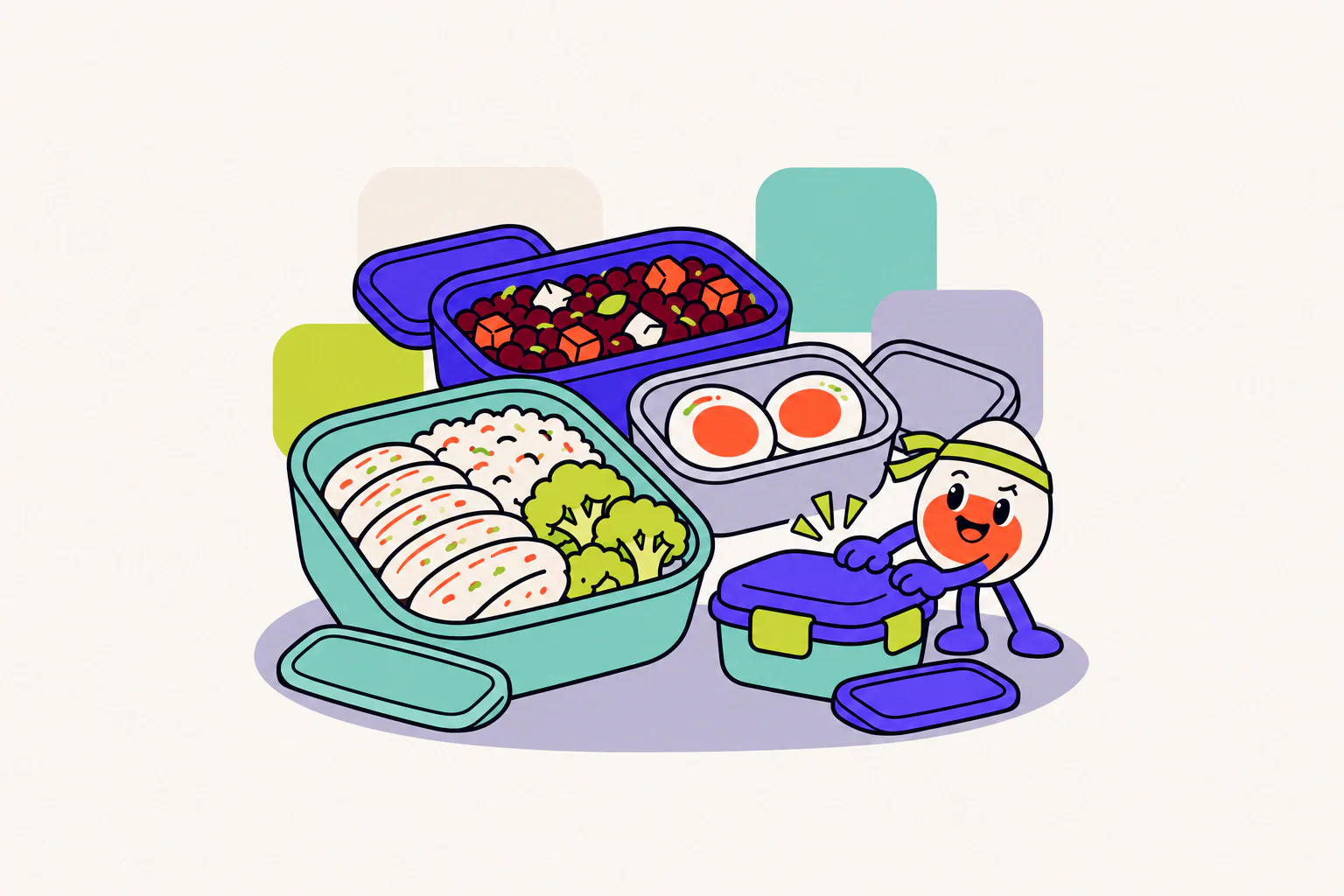
A week of meal prep needs two cooking days, or a freezer, because cooked food is not meant to sit in the refrigerator for seven days. The USDA Food Safety and Inspection Service (FSIS), on its Leftovers and Food Safety page last updated in July 2020, says leftovers can be kept in the refrigerator for 3 to 4 days or frozen for 3 to 4 months. The FoodSafety.gov Cold Food Storage Chart, last reviewed in September 2023, gives the same 3 to 4 days for cooked meat or poultry and 2 to 6 months in the freezer.
In practice, Thursday is four days after Sunday, so the cooking and eating times matter. Freeze Thursday’s portion on prep day if its timing is uncertain; Friday’s lunch needs frozen components or a second cook. The chart and FSIS guidance give these storage windows:
| Food | Refrigerator (40°F or below) | Freezer (0°F or below) |
|---|---|---|
| Cooked meat or poultry | 3 to 4 days | 2 to 6 months |
| Other leftovers, such as cooked beans, lentils and grains | 3 to 4 days | 3 to 4 months |
| Hard-cooked eggs | 1 week | Do not freeze |
| Egg, chicken, tuna and macaroni salads | 3 to 4 days | Does not freeze well |
| Soups and stews with vegetables or meat | 3 to 4 days | 2 to 3 months |
| Baked egg casseroles | 3 to 4 days | 2 to 3 months |
| Opened or deli-sliced luncheon meat | 3 to 5 days | 1 to 2 months |
A 2017 cross-sectional study by Ducrot and colleagues found that meal planning was associated with higher diet quality and food variety in 40,554 French adults. The study cannot establish cause and effect.
What goes into a high-protein prep?
A high-protein prep can start with 2–3 proteins, one or two bases, a vegetable and a sauce. Cook the parts plain and combine them when you pack.
The estimates below use USDA FoodData Central’s SR Legacy dataset (April 2018), checked November 10, 2026. Weigh cooked foods after cooking and yogurt as served. Household measures are approximate; the gram weights determine the totals. Oil and seasonings are excluded. Broccoli uses a boiled, drained entry; other preparations can differ. For poultry substitutions, protein in turkey explains differences between breast, ground and deli entries. The recipe protein calculator adds up a batch’s protein and splits it by servings or portion weight.
| Part | Protein | Calories (kcal) |
|---|---|---|
| Roasted chicken breast, no skin3 oz (85 g) | 26 g | 140 |
| Ground turkey, 93% lean, pan-broiled3 oz (85 g) | 23 g | 181 |
| Hard-boiled eggs2 large (100 g) | 13 g | 155 |
| Lentils, boiled¾ cup (148 g) | 13 g | 172 |
| Quinoa, cooked1 cup (185 g) | 8.1 g | 222 |
| Medium-grain brown rice, cooked1 cup (195 g) | 4.5 g | 218 |
| Sweet potato, baked flesh without skin1 cup (200 g) | 4.0 g | 180 |
| Broccoli, boiled1 cup (156 g) | 3.7 g | 55 |
| Plain nonfat Greek yogurt, as a sauce base2 oz (57 g) | 5.8 g | 34 |
Which bowls can you build from these parts?
Five bowls use the parts above. USDA SR Legacy (2018) totals use unrounded ingredient values, so adding displayed rounded values can give a slightly different result.
| Bowl | Built from | Protein | Calories (kcal) |
|---|---|---|---|
| Chicken and quinoa | Chicken 3 oz (85 g), quinoa 1 cup (185 g), broccoli 1 cup (156 g), plain yogurt 2 oz (57 g) | 44 g | 450 |
| Chicken, lentil and sweet potato | Chicken 3 oz (85 g), lentils ¾ cup (148 g), sweet potato 1 cup (200 g) | 44 g | 492 |
| Egg and quinoa | Eggs 3 large (150 g), quinoa 1 cup (185 g), broccoli 1 cup (156 g), plain yogurt 2 oz (57 g) | 37 g | 543 |
| Lentil and egg (vegetarian) | Lentils 1 cup (198 g), eggs 2 large (100 g), broccoli 1 cup (156 g) | 34 g | 439 |
| Turkey and rice | Turkey 3 oz (85 g), medium-grain brown rice 1 cup (195 g), broccoli 1 cup (156 g) | 31 g | 454 |
For a sauce, stir lemon, pepper and garlic into the yogurt and pack it separately. For a bowl that falls short of your target, try these easy ways to add about 10 grams of protein.
What does a five-day high-protein meal prep calendar look like?
A five-day high-protein meal prep calendar can use the same five bowls above, with Sunday cooking for Monday–Thursday and a Wednesday session for Friday. The calendar is a packing suggestion, not a full day’s meal plan. Cooked food weights and protein totals stay as listed in the bowl table.
| Eat on | Bowl | Prep session | Refrigerator or freezer? |
|---|---|---|---|
| Monday | Chicken and quinoa | Sunday | Refrigerate the cooked parts promptly; pack yogurt separately. |
| Tuesday | Egg and quinoa | Sunday | Refrigerate; keep eggs and yogurt separate from anything you plan to heat. |
| Wednesday | Lentil and egg | Sunday | Refrigerate; assemble from the chilled components. |
| Thursday | Chicken, lentil and sweet potato | Sunday | Divide into shallow containers and chill rapidly; freeze promptly on Sunday. Label with Sunday’s cooking date and “Thursday”. Thaw in the refrigerator before use; reheat to 165°F. |
| Friday | Turkey and rice | Wednesday | Refrigerate the freshly cooked turkey, rice and broccoli promptly. |
USDA FSIS’s 2020 leftovers guidance sets a 3–4 day refrigerator window, so Thursday’s bowl goes into the freezer on prep day rather than waiting until Thursday. Refrigerate food within 2 hours, or 1 hour above 90°F. The cooking steps below explain the quantities; the storage section explains safe cooling and reheating.
What does a sample prep session look like?
A Sunday prep can supply four bowls: chicken and quinoa on Monday, egg and quinoa on Tuesday, lentil and egg on Wednesday, and chicken, lentil and sweet potato on Thursday. Freeze Thursday’s components promptly, plus two extra portions each of chicken and lentils as backups.
- Roast the chicken. Roast enough breast for 12 oz (340 g) of cooked weight, which makes four 3 oz portions, until a food thermometer reads 165°F, the poultry temperature in the FSIS leftovers guidance.
- Boil eggs and lentils. Hard-boil 8 large eggs, leaving three spare. Following package directions, make 3½ cups of cooked lentils, not dry.
- Cook the sides. Make 2 cups of cooked quinoa, enough baked sweet potato for 1 cup (200 g) of flesh without skin, and 3 cups of boiled, drained broccoli.
- Make the sauce. Use 4 oz (114 g) of plain nonfat Greek yogurt for the two quinoa bowls; add seasonings if you like.
- Cool and sort. Use shallow containers and refrigerate within FSIS’s 2-hour limit (1 hour above 90°F). Refrigerate Monday–Wednesday’s portions; freeze Thursday’s chicken, lentils and sweet potato, plus the two spare 3 oz chicken portions and two ¾-cup cooked-lentil portions. Label with the cooking date.
On Wednesday, cook ground turkey to the FSIS poultry minimum of 165°F and make fresh rice and broccoli for Friday’s turkey bowl. Thaw Thursday’s frozen components in the refrigerator before use. For one Sunday session instead, freeze later cooked portions promptly and keep hard-boiled eggs refrigerated separately. Make extra sides for any backup bowls. For nights without prep, see easy high-protein dinners. The guide to high-protein slow cooker meals covers chicken, turkey and tofu meals, a finished-batch weighing method and storage steps.
How do you cool, store, thaw and reheat prepped food?
Prepped food needs safe handling as well as a storage date. FSIS’s 2020 leftovers guidance says bacteria grow rapidly between 40°F and 140°F, the Danger Zone. Refrigerate within 2 hours of cooking, or 1 hour above 90°F; discard perishable food left out longer.
- Cool fast. FSIS advises shallow containers and smaller portions; hot food can go directly into the refrigerator.
- Wrap well. FSIS advises covering leftovers or sealing them in airtight containers.
- Thaw in the refrigerator. FSIS allows 3 to 4 days after refrigerator thawing, or refreezing. For planning, follow the shortest applicable ingredient limit in mixed bowls.
- Reheat to 165°F. Check leftovers with a food thermometer, following FSIS guidance. Keep cold yogurt sauce separate; bring soups and cooking sauces to a rolling boil when reheating.
For insulated bags and cold sources when transporting a bowl, see high-protein lunches for work.
What high-protein meal prep ideas can replace chicken?
High-protein meal prep ideas can rotate a meat component, an egg-and-dairy component and a plant component instead of using chicken in every bowl. You can keep the base you like and change the protein and sauce. These are flavor options; changing the sauce does not guarantee the same protein portion.
- Meat: try the turkey-and-rice bowl with a tomato-and-herb sauce instead of another chicken bowl.
- Egg and dairy: try the egg-and-quinoa bowl with lemon, dill and plain yogurt packed separately.
- Plant: try lentils over a grain base with a lemon-and-tahini dressing. Leave out eggs and yogurt when you want a fully plant-based bowl; recalculate the portion rather than carrying over the lentil-and-egg total.
Swaps need recalculating: USDA SR Legacy (2018) gives about 26 g in roasted skinless chicken breast, 3 oz (85 g), compared with 13 g in two large hard-boiled eggs (100 g) or 13 g in boiled lentils, ¾ cup (148 g). Those are the same cooked entries used above; sauce additions are not counted. For a cold make-ahead bowl built on beans, see the dense bean salad page. For a cold pasta-based lunch, the guide to high-protein pasta salad uses chicken or chickpeas. For a whole plant-based week with portions already worked out, use the seven-day high-protein vegan meal plan.
How big should each prepped portion be?
Prepped portions can fit your appetite and daily target. A 2018 review by Schoenfeld and Aragon suggested about 0.4 g/kg, meaning grams per kilogram of body weight, per meal across at least four meals for adults building muscle. For a 70 kg (154 lb) adult, that is about 28 g per meal. The review’s proposal is not a requirement for everyone.
The 2025–2030 Dietary Guidelines for Americans (USDA and HHS, January 2026) say to “Prioritize Protein Foods at Every Meal”. Use the protein calculator to explore a daily target. For smaller portions, try high-protein meals for small appetites; for plates with carbohydrate totals, see high-protein, low-carb meals.
Who should check with a professional first?
People with kidney disease, people who are pregnant and anyone on a medical diet should ask their care team about protein targets and safe food choices. If you are under 18, ask a clinician or dietitian before using adult targets. These meal ideas are for healthy adults.
Calories in the tables are optional information, not intake targets. People with a history of disordered eating should skip calorie counting and talk to a clinician; tracking protein without counting calories is another option.
YolkPal lets you save a bowl you repeat as a saved food, then log it again each time you eat it. Photo-based protein estimates can be checked and edited before saving.
Your next step
Pick two proteins and one base, then decide which later portions need freezing or a second cook. Weigh the cooked portions and log each meal when you eat it. For a simple daily routine, read how to track protein without counting calories.
Sources
- USDA Food Safety and Inspection Service. Leftovers and Food Safety. Last updated July 31, 2020. fsis.usda.gov
- FoodSafety.gov (US Department of Health and Human Services). Cold Food Storage Chart. Date last reviewed September 19, 2023. foodsafety.gov
- Ducrot P, et al. Meal planning is associated with food variety, diet quality and body weight status in a large sample of French adults. Int J Behav Nutr Phys Act 2017;14:12. doi:10.1186/s12966-017-0461-7
- Schoenfeld BJ, Aragon AA. How much protein can the body use in a single meal for muscle-building? Implications for daily protein distribution. J Int Soc Sports Nutr 2018;15:10. doi:10.1186/s12970-018-0215-1
- USDA and HHS. Dietary Guidelines for Americans, 2025–2030. January 2026. realfood.gov/documents/DGA.pdf
- USDA FoodData Central, SR Legacy (April 2018), calculations checked November 10, 2026: baked sweet potato flesh (168483); cooked medium-grain brown rice (168875); cooked quinoa (168917); boiled broccoli (169967); plain nonfat Greek yogurt (170894); roasted skinless chicken breast (171477); boiled lentils (172421); cooked 93% lean ground turkey (172851); hard-boiled eggs (173424). fdc.nal.usda.gov
This article is general information, not medical advice. If you have a health condition, are pregnant, or follow a diet set by your doctor, talk to them or a registered dietitian before changing how you eat.