On this page
- Does tofu or chicken have more protein?
- Which tofu and chicken preparations are being compared?
- How do tofu vs chicken macros compare at equal weight?
- What meal-sized portions provide similar protein?
- How much tofu or chicken supplies about 30 g of protein?
- What does tofu vs chicken protein per calorie mean?
- How do oil, sauce and breading change the meal swap?
- Does tofu protein count the same toward your daily total?
- Who needs a different comparison?
- What should you do for your next meal?
Does tofu or chicken have more protein?
The tofu vs chicken protein comparison favors roasted skinless chicken breast for protein concentration. USDA FoodData Central’s SR Legacy dataset, released in April 2018 and checked in November 2026, lists about 31 g of protein in 3.5 oz (100 g) of roasted breast, compared with about 17 g in the same weight of firm tofu prepared with calcium sulfate. A larger tofu portion can close that gap.
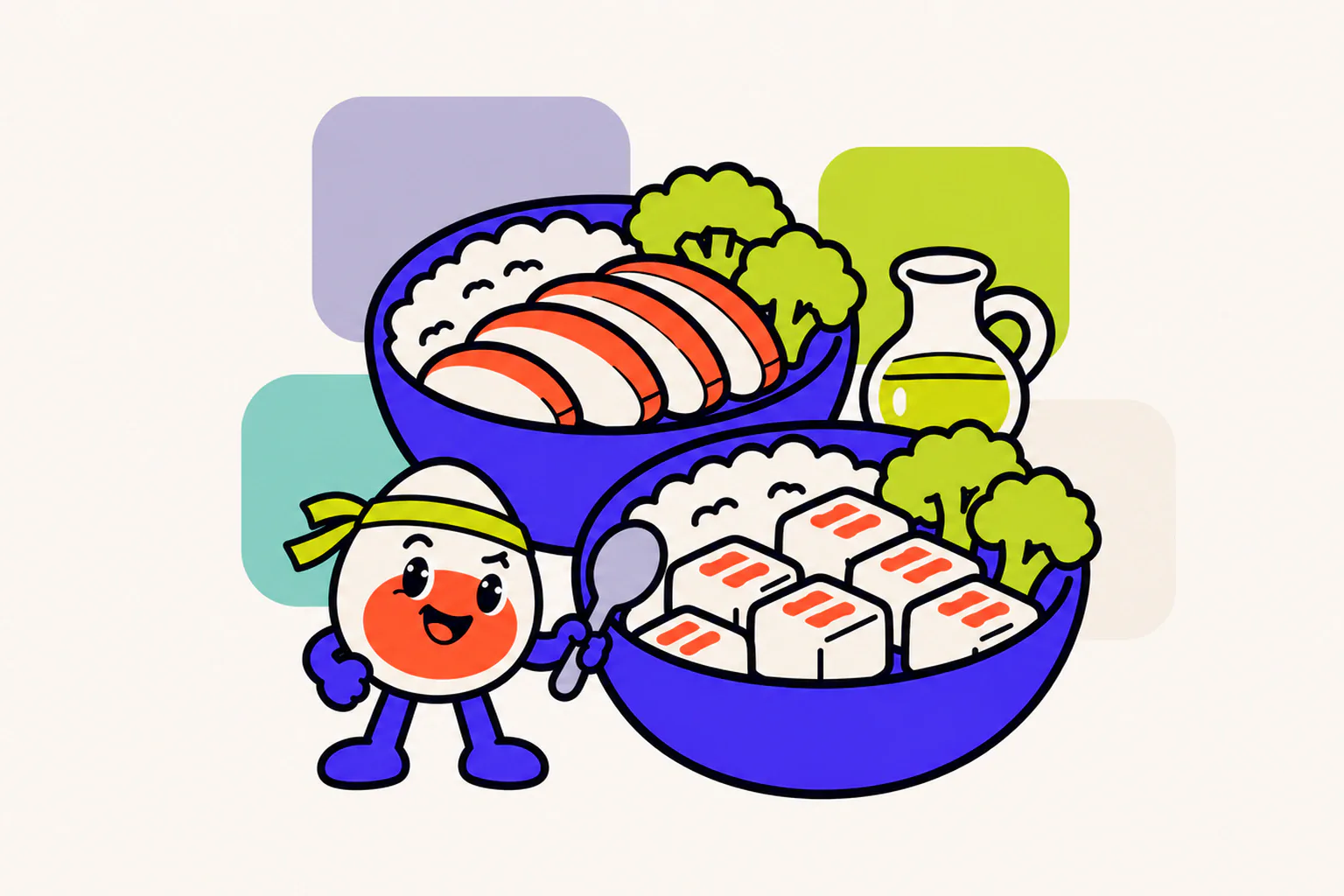
The decision here is a meal substitution: how much tofu to put in the bowl when you would otherwise use chicken. The tables separate equal weight, useful meal portions and equal protein. You can use the comparison that matches your question without assuming the foods have identical calories or that either food is the right choice for everyone.
For more foods alongside these choices, see the high-protein foods chart. The dedicated guides to protein in tofu, tempeh and edamame and protein in chicken breast cover the wider range of soy foods, chicken cuts and preparations.
Which tofu and chicken preparations are being compared?
The tofu comparison uses plain firm tofu prepared with calcium sulfate, USDA record FDC 172475, which USDA calls “raw.” For these calculations, weigh the edible tofu without packing liquid, before any additional pressing or cooking; this is the measurement assumption, not a USDA guarantee about every packaged block. Illinois Extension’s 2023 tofu guide explains that tofu can be eaten from the package, so the word does not mean uncooked poultry. Follow your own package’s preparation and storage directions.
The chicken comparison uses roasted breast meat only, FDC 171477: cooked edible meat without skin or bone. Both foods are compared in edible states, with no extra oil, coating or sauce included. These are reference foods, not a comparison between raw chicken and a finished tofu dinner.
Tofu weighed after pressing or baking needs additional care. Illinois Extension (2023) describes pressing as removing water. In practice, a lighter finished block can have a different protein concentration from its starting weight. For the worked swap below, measure the tofu before pressing or further cooking, and keep that starting amount with your recipe. Do not apply the packaged-tofu value to a heavily dried finished portion as though nothing changed.
How do tofu vs chicken macros compare at equal weight?
The equal-weight comparison shows more protein and less fat in the selected chicken breast than in the selected tofu, using USDA’s 2018 entries. “Macros” means the main nutrients protein, carbohydrate and fat. The table also gives calories, expressed as kcal, the calorie unit used on food labels.
| Plain food, 3.5 oz (100 g) | Protein | Calories | Fat | Carbohydrate |
|---|---|---|---|---|
| Firm tofu, calcium-set, packaged | 17 g | 144 kcal | 8.7 g | 2.8 g |
| Chicken breast, skinless, roasted | 31 g | 165 kcal | 3.6 g | 0 g |
The equal-weight table answers what fits into the same food weight. It does not tell you how much of either food you want to eat. A bowl containing a bigger tofu portion can provide similar protein to a smaller chicken portion, which is why a serving comparison belongs beside the concentration comparison.
What meal-sized portions provide similar protein?
A larger portion of this firm tofu can replace a smaller chicken portion for roughly the same protein. The following amounts are practical examples calculated from USDA’s 2018 records, not prescribed serving sizes. Choose amounts that suit your appetite and the rest of the meal.
| Protein food | Meal portion | About protein | Calories |
|---|---|---|---|
| Firm tofu, packaged weight | 5.3 oz (150 g) | 26 g | 216 kcal |
| Chicken breast, roasted weight | 3 oz (85 g) | 26 g | 140 kcal |
The meal swap is approximate rather than an exact nutrient match. You can keep your usual vegetables and grain alongside either option, then decide whether the larger tofu portion feels comfortable. If you prefer a smaller tofu portion, another protein food elsewhere in the meal or day is an option; there is no need to force every plate into the same shape.
Package serving sizes are reference amounts, not personal prescriptions. The FDA’s Nutrition Facts label guide, read in November 2026, says to check both serving size and servings per container. A block or a breast is not a fixed unit across packages. Weigh the edible amount you use rather than assuming the entire package is a serving.
How much tofu or chicken supplies about 30 g of protein?
An equal-protein comparison starts with a chosen protein amount and solves for food weight. Here, 30 g is an illustration, not a recommendation for every meal. The calculation is target protein divided by the food’s protein per gram, with the resulting food weight rounded to a practical gram amount.
| Plain food | Portion for about 30 g protein | About protein | Calories |
|---|---|---|---|
| Firm tofu, packaged weight | 6.1 oz (174 g) | 30 g | 251 kcal |
| Chicken breast, roasted weight | 3.4 oz (97 g) | 30 g | 160 kcal |
The equal-protein portions have different calorie totals in USDA’s 2018 data. That difference does not require removing another food from your plate. Use it as information if calories are something you choose to track, while keeping appetite, preferences and your overall eating pattern in view.
What does tofu vs chicken protein per calorie mean?
Protein per calorie describes protein relative to energy rather than portion weight. Calculated from USDA’s 2018 entries, each 100 kcal provides about 12 g of protein from this firm tofu or 19 g from roasted chicken breast. Those values are protein divided by calories, multiplied by the comparison unit. They describe the plain foods only.
The ratio is useful if you want to compare protein within an energy budget. It says nothing by itself about meal enjoyment, affordability, dietary variety or the food you can safely eat. You can also ignore this ratio and use the meal-portion table.
If you have a history of disordered eating, skip calorie counting and discuss food tracking with a clinician. The guides to whether counting calories is healthy and tracking protein without counting calories explain alternatives.
How do oil, sauce and breading change the meal swap?
Cooking additions belong beside the protein food in your calculation. For a realistic bowl swap, start with the meal portions above and keep the vegetable and grain portions unchanged. In this worked example, each protein portion receives 1 tsp (4.5 g) of olive oil, all assumed to remain in the food you eat.
| Protein component with retained oil | About protein | Calories |
|---|---|---|
| Firm tofu, 5.3 oz (150 g), plus 1 tsp olive oil | 26 g | 256 kcal |
| Roasted breast, 3 oz (85 g), plus 1 tsp olive oil | 26 g | 180 kcal |
The oil itself contributes about 40 kcal and no protein at 1 tsp (4.5 g), according to USDA’s 2018 olive oil entry. The assumption is retained oil, not simply everything poured into the pan. If oil or sauce stays behind, the amount you consume is uncertain. You can record your best estimate consistently rather than claiming exact absorption.
Count sauce separately using its label and the amount eaten, following the FDA’s label-reading guidance (read November 2026). For a breaded version, count the coating that stays on the food and its cooking oil. A prepared breaded-food entry may already include these ingredients, so check before adding them again. The totals above cover only the protein component; they are not complete bowl totals.
Does tofu protein count the same toward your daily total?
Tofu protein counts toward your daily intake, while protein grams alone do not establish identical nutritional effects. Mariotti and Gardner’s 2019 review discusses protein and amino acid adequacy in vegetarian diets. Amino acids are the building blocks of protein; essential amino acids must come from food. Food variety and sufficient overall intake matter when planning meals.
Mariotti and Gardner’s 2019 review explains that protein quality involves amino acid composition and digestibility. In that context, “complete protein” concerns essential amino acid adequacy, not the size of a serving or a guarantee of identical digestion. The guide to complete proteins and amino acid balance explains the distinction. For everyday variety beyond a single soy food, use plant protein basics. Matching the protein numbers in these tables is a food-composition calculation, not a trial showing identical muscle growth.
Who needs a different comparison?
People with a soy allergy should avoid tofu. The FDA’s Food Allergies guidance (2026) identifies soybeans as a major allergen. Read the ingredients and any “Contains” statement on tofu, marinades and sauces; an allergen can be identified within the ingredient list. Ask about cross-contact when someone else prepares the meal, and follow your allergy care plan.
People with kidney disease, those who are pregnant or breastfeeding, readers under 18 and anyone following a medically managed diet should ask their care team about appropriate protein amounts and food choices. The example target is not a personal prescription.
Food safety still applies to the chicken option. FoodSafety.gov’s chart, reviewed November 2024, says all poultry should reach 165°F (74°C), checked with a food thermometer. Follow tofu package directions rather than borrowing poultry cooking instructions.
The comparison does not establish a universal health or environmental winner. Its evidence covers named food compositions and a meal substitution, not a full assessment of either food’s health effects or production footprint. You can make your choice based on the question you actually need answered.
What should you do for your next meal?
Your next meal swap starts with the tofu label and the chicken’s cooked weight. Check the protein and serving weight on your tofu, compare your intended portion, and keep additions as separate ingredients. If your tofu label differs from the USDA example, use that label rather than forcing the reference number onto your block.
Choose a portion you enjoy eating, then see how it fits your day with the guide to tracking protein without counting calories. Repeat that portion when it works for you, and reassess when the tofu product or preparation changes.
Sources
- USDA FoodData Central, SR Legacy (April 2018): tofu, raw, firm, prepared with calcium sulfate (FDC 172475); chicken, broilers or fryers, breast, meat only, cooked, roasted (FDC 171477); oil, olive, salad or cooking (FDC 171413). Nutrient records checked November 11, 2026. fdc.nal.usda.gov. FoodData Central data type documentation.
- U.S. Food and Drug Administration. How to Understand and Use the Nutrition Facts Label. Read November 11, 2026. fda.gov.
- U.S. Food and Drug Administration. Food Allergies. Content current as of March 11, 2026. fda.gov.
- Samson M. All About Tofu. University of Illinois Extension, March 6, 2023. eat-move-save.extension.illinois.edu.
- Mariotti F, Gardner CD. Dietary Protein and Amino Acids in Vegetarian Diets—A Review. Nutrients 2019;11(11):2661. doi:10.3390/nu11112661.
- FoodSafety.gov. Cook to a Safe Minimum Internal Temperature. Reviewed November 21, 2024. foodsafety.gov.
This article is general information, not medical advice. If you have a health condition, are pregnant, or follow a diet set by your doctor, talk to them or a registered dietitian before changing how you eat.