On this page
- What is volume eating, and what is energy density?
- Does eating lower-energy-dense food reduce how much you eat?
- Which foods are very low, low, medium or high in energy density?
- What can high-protein volume eating recipes look like?
- How do you calculate density for the meal you actually serve?
- Why am I still hungry after a huge bowl of vegetables?
- How can you build a lower-density plate?
- Where does the evidence on volume eating stop?
- Who should skip volume eating or ask a professional first?
- A simple next step
What is volume eating, and what is energy density?
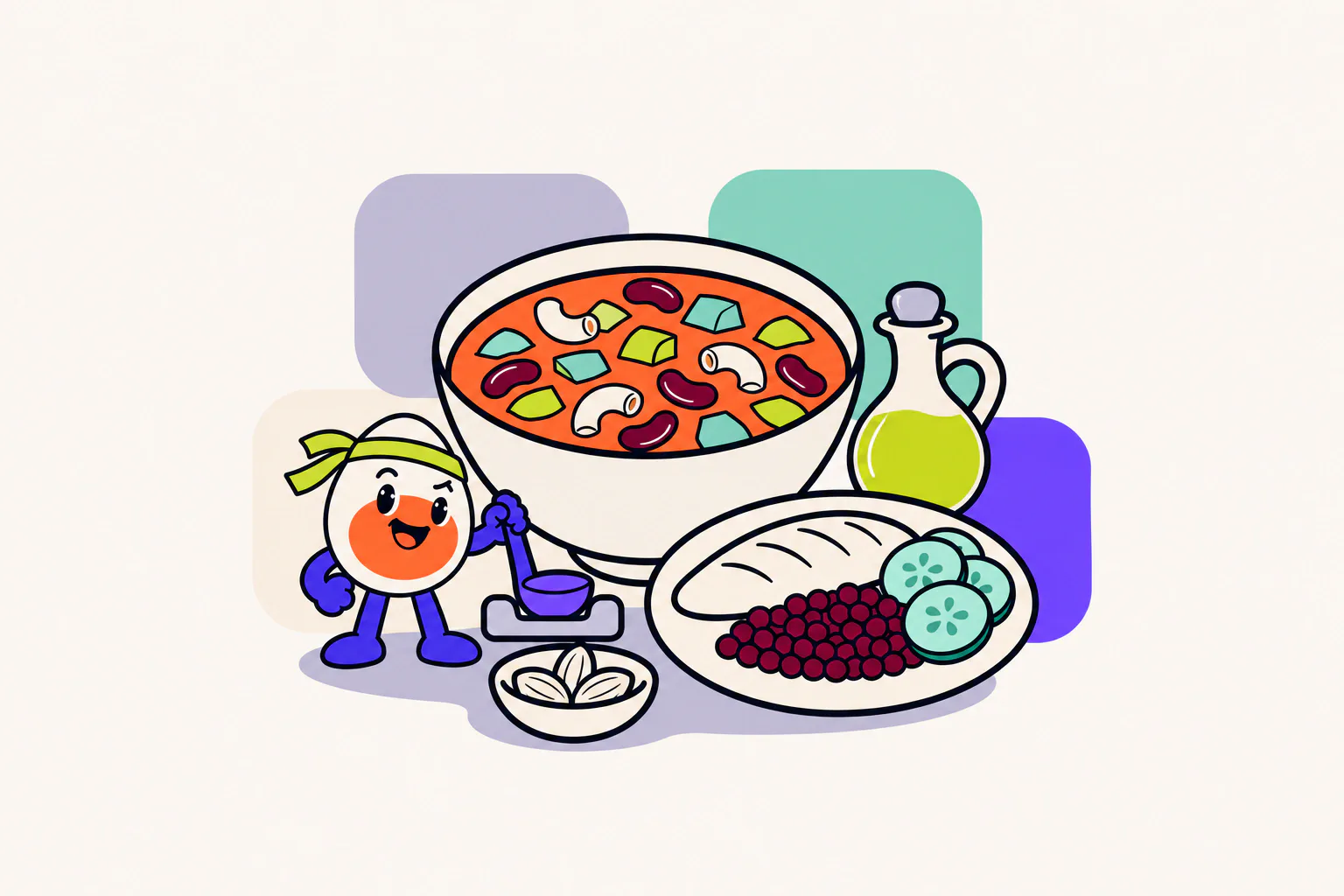
Volume eating means building meals with foods that have few calories for their weight. The research term is energy density: calories per gram of food. Barbara Rolls’s 2017 review in Nutrition Bulletin explains the approach.
Energy density depends on food composition. The general energy factors are about 9 kcal/g for fat and about 4 kcal/g for protein and carbohydrate each (FAO Food and Nutrition Paper 77, 2003), while water adds weight and volume with 0 kcal/g (Rolls, 2017). Kcal means kilocalorie, the “calories” unit on a food label.
Rolls’s 2017 review gives four approximate bands. Examples from the USDA table below include:
- Very low, under 0.6 kcal/g: berries, salad vegetables and minestrone.
- Low, 0.6–1.5 kcal/g: cooked oats, lentils, fish and cottage cheese.
- Medium, 1.6–3.9 kcal/g: roasted chicken breast, bread and ice cream.
- High, 4.0–9.0 kcal/g: oil, almonds, chips and sharp cheddar.
Per 100 g of food, the same bands are under 60 kcal, 60–150 kcal, 160–390 kcal and 400–900 kcal. The published endpoints leave small gaps; treat these as broad categories, not exact cutoffs or measures of nutritional quality.
Does eating lower-energy-dense food reduce how much you eat?
Lower-energy-density menus reduced intake in Bell and colleagues’ 1998 laboratory study. Eighteen normal-weight women ate lab-provided meals for 2 days in each condition. Average intake was 1,376 kcal on the lower-density menu, 1,519 kcal on the intermediate one and 1,800 kcal on the higher-density one, with similar food weights and no detected hunger difference. These are study observations, not daily targets.
Ledikwe and colleagues’ 2006 survey analysis also linked lower-density diets to lower calorie intake despite higher food weights. The observational design cannot establish causation.
Ello-Martin and colleagues’ 2007 year-long trial assigned 97 women with obesity to reduce fat, with or without extra water-rich fruit and vegetables. Among the 71 who finished, the fruit and vegetable group lost 7.9 kg (17 lb) and the fat-reduction group lost 6.4 kg (14 lb). Both groups also had frequent dietitian visits and a daily step goal.
Buckland and colleagues’ 2018 trial recruited 96 women with overweight or obesity and included lab probe days. Breakfast and lunch had matched calories; dinner and snacks were eaten freely. Total intake was 36% lower on the lower-density days. The meals also differed in protein, fiber and fat, so the authors say the effect is likely not due to energy density alone.
Pérez-Escamilla and colleagues’ 2012 systematic review covered 17 adult studies, including 7 randomized trials. The review supported lower-density diets for weight loss and maintenance; it does not promise an individual result.
Which foods are very low, low, medium or high in energy density?
The table groups 26 foods into Rolls’s approximate bands using USDA SR Legacy (2018). The final column compares food weight for 100 kcal.
| Food | Calories per 100 g | Amount that gives 100 kcal |
|---|---|---|
| Very low: under 0.6 kcal/g | ||
| Cucumber, with peel, raw | 15 kcal | 667 g |
| Romaine lettuce, raw | 17 kcal | 588 g |
| Watermelon, raw | 30 kcal | 333 g |
| Strawberries, raw | 32 kcal | 313 g |
| Minestrone soup, canned, prepared with equal water | 34 kcal | 294 g |
| Broccoli, boiled | 35 kcal | 286 g |
| Apple, raw, with skin | 52 kcal | 192 g |
| Egg white, raw | 52 kcal | 192 g |
| Greek yogurt, plain, nonfat | 59 kcal | 169 g |
| Low: 0.6–1.5 kcal/g | ||
| Oatmeal, cooked with water | 71 kcal | 141 g |
| Cottage cheese, 2% milkfat | 81 kcal | 123 g |
| Tuna, light, canned in water, drained | 86 kcal | 116 g |
| Potato, boiled in skin, flesh only | 87 kcal | 115 g |
| Banana, raw | 89 kcal | 112 g |
| Atlantic cod, baked | 105 kcal | 95 g |
| Lentils, boiled | 116 kcal | 86 g |
| Shrimp, cooked | 119 kcal | 84 g |
| Tofu, firm, raw, calcium-set | 144 kcal | 69 g |
| Medium: 1.6–3.9 kcal/g | ||
| Chicken breast, skinless, roasted | 165 kcal | 61 g |
| Hummus, home prepared | 177 kcal | 56 g |
| Vanilla ice cream | 207 kcal | 48 g |
| Whole-wheat bread | 252 kcal | 40 g |
| High: 4.0–9.0 kcal/g | ||
| Cheddar cheese, sharp, sliced | 410 kcal | 24 g |
| Potato chips, plain, salted | 532 kcal | 19 g |
| Almonds, raw | 579 kcal | 17 g |
| Olive oil | 884 kcal | 11 g |
USDA SR Legacy (2018) shows why the food entry matters: roasted chicken breast has 165 kcal per 100 g, which is 1.65 kcal/g and falls in the medium band. Rolls’s 2017 review gives lean proteins as a low-band example, not a universal classification. A high density does not make a food a poor choice; see protein in nuts and seeds for another way to compare those foods.
Cooking changes the number, because water goes in or out. USDA lists boiled lentils at 116 kcal per 100 g and raw lentils at 352 kcal per 100 g, so match the entry to the state you weigh. The high-protein foods chart compares protein per 100 kcal for many of these foods.
What can high-protein volume eating recipes look like?
A volume meal can pair protein with vegetables, fruit or broth. These 7 USDA SR Legacy (2018) examples are light meals or meal components; add food to suit your hunger and needs. The table estimates density from total calories divided by the sum of ingredient weights before assembly. That sum is not a measured weight of the finished edible dish after cooking or reheating.
| Meal | Ingredient weight before assembly | Protein | Calories | Estimated calories per gram |
|---|---|---|---|---|
| Yogurt, strawberry and apple bowl6 oz (170 g) nonfat Greek yogurt, 1 cup (152 g) strawberry halves, 1 cup (125 g) chopped apple | 447 g | 19 g | 214 kcal | 0.48 |
| Cottage cheese and watermelon1 cup (226 g) 2% cottage cheese, 2 cups (304 g) diced watermelon | 530 g | 25 g | 274 kcal | 0.52 |
| Chicken salad, no dressing3 oz (85 g) roasted chicken breast, 2 cups (94 g) shredded romaine, 1 medium tomato (123 g), 1 cup (104 g) cucumber slices | 406 g | 29 g | 194 kcal | 0.48 |
| The same salad with olive oilthe salad above plus 1 tbsp (13.5 g) olive oil | 420 g | 29 g | 313 kcal | 0.75 |
| Baked cod, potato and broccoli3 oz (85 g) baked cod, 1 potato boiled in its skin, flesh only (136 g), 1 cup (156 g) boiled broccoli | 377 g | 26 g | 262 kcal | 0.70 |
| Lentil, broccoli and tomato soup1 cup (198 g) boiled lentils, 1 cup (240 g) reduced-sodium chicken broth, 1 cup (156 g) boiled broccoli, 1 medium tomato (123 g) | 717 g | 26 g | 323 kcal | 0.45 |
| Shrimp, rice and vegetable bowl3 oz (85 g) shrimp, ½ cup (101 g) cooked brown rice, 1 cup (156 g) boiled broccoli, 1 cup (70 g) sliced raw mushrooms | 412 g | 28 g | 295 kcal | 0.72 |
USDA SR Legacy (2018) puts all seven examples at 0.75 kcal/g or below. Adding 1 tbsp (13.5 g) of olive oil adds 119 kcal and moves the salad from 0.48 to 0.75 kcal/g. You can include oil for flavor and count it if you track; hidden calories in oils, sauces and drinks covers logging add-ons. Protein and fiber foods has more meals that pair the two, and high-protein low-calorie desserts applies the same idea to sweets. For a breakfast bowl, the guide to high protein cereal bowls compares the dry serving first, then adds milk or yogurt. For the potato in the cod meal, the guide to macros in potatoes compares cooking methods and toppings.
How do you calculate density for the meal you actually serve?
As-served meal density is total meal calories ÷ final edible grams. Weigh the finished food without its pot, bowl or inedible scraps. FAO’s recipe-calculation guidance (2003) separates summed ingredient weights from cooked yield and adjusts for water and fat changes. Our table uses the ingredient-weight estimate; cooking or reheating can change that denominator.
For an arithmetic example, suppose a whole finished batch contains 600 kcal and weighs 1,000 g: 600 ÷ 1,000 = 0.60 kcal/g. If only plain water is added and the measured final batch weighs 1,200 g, its density becomes 600 ÷ 1,200 = 0.50 kcal/g. These are hypothetical batch values, not a tested recipe or an intake target.
Adding only water creates no protein and removes no energy from the batch; evaporation alone does not either. Water changes concentration, as Rolls’s 2017 review explains. If you drain away cooking liquid or fat, or leave food in the pan, the edible batch may also lose nutrients: account for that rather than assuming its original totals remain.
For another meal option, high-protein lentil recipes with cooked portions separates dry, cooked and drained weights. Match each ingredient entry to the state you weigh.
Why am I still hungry after a huge bowl of vegetables?
A huge bowl of vegetables can leave you hungry; more bulk is not always the next useful step. Stomach volume, satisfaction after a meal and adequate nutrition are different questions. Rolls’s 2017 review describes appetite regulation as an interaction of sensory, gastrointestinal, hormonal and other influences. Bowl size alone cannot predict your response.
For a practical meal check, look beyond vegetables. The CDC’s 2026 meal guidance includes protein foods, fruits and vegetables, whole grains and fats with essential fatty acids. You can keep the vegetables and add a protein base such as tofu, lentils, eggs or fish, a side such as rice or bread, and a dressing or topping such as olive oil or nuts. These are options for building a meal, not a promise of hours of fullness.
If you are still hungry, you can eat more food or choose a more substantial meal instead of continually enlarging the vegetable portion. The light meals above are examples, not a limit on what you should eat. With low appetite, avoid making meals bulkier just to lower their density; use the small-appetite guidance below. If hunger or food rules are causing distress, talk with a clinician or registered dietitian.
How can you build a lower-density plate?
A lower-density plate can start with a different side or first course. These are options, not requirements.
- Try a lower-density starter. In Rolls and colleagues’ 2004 study, 42 women finished assigned salads before eating pasta freely. The salads ranged from 0.33 to 1.33 kcal/g and came in 150 g or 300 g portions. Compared with no salad, lower-density salads reduced total meal calories by 7% (small) and 12% (large); higher-density salads increased them by 8% and 17%. These are experimental comparisons, not the table’s band names.
- Swap, don’t only add. Rolls’s 2017 review describes a trial in which adding more vegetables to a meal did not lower the meal’s energy intake, but substituting a bigger portion of vegetables for the more energy-dense meat and grain did.
- Put water in the food. The same review reports that water had a greater effect on fullness when it was built into a food than when it was drunk alongside.
- Consider the whole meal. Rolls’s 2017 review notes that a low-density starter does not necessarily offset large portions of higher-density food afterward.
For protein’s role in fullness, see protein for weight loss; protein at every meal covers meal targets.
Where does the evidence on volume eating stop?
Volume eating cannot promise fullness or weight change. Rolls’s 2017 review calls for studies following individual responses over time. In practice, check how a meal feels for you rather than assuming a large plate will satisfy.
Time and design matter. Bell’s 1998 study and the salad experiment were short; Ello-Martin’s 2007 trial lost 26 participants. Buckland’s 2018 intake results came from lab days; its parallel weight-loss-program comparison was not randomized. The 2012 review also included observational studies.
Energy density is only one influence. Rolls and colleagues’ 2025 review also identifies portion size and food variety as drivers of intake.
Source independence also matters: several studies here involve Rolls, whose 2017 review discloses book royalties. Buckland’s 2018 trial had commercial weight-loss-program funding and author ties to that funder. In practice, keep enough protein and energy on the plate, especially if your appetite is small.
Who should skip volume eating or ask a professional first?
People with a history of disordered eating should skip calorie counting and calorie-per-gram approaches like this one, and talk to a clinician first. If counting could be a problem for you, is counting calories healthy? and how to track protein without counting calories cover the risks and alternatives. Protein-only tracking also needs care-team guidance if numbers or food rules cause distress.
Talk to your doctor or a registered dietitian before changing intake if you have kidney disease, are pregnant or breastfeeding, are under 18, or follow a medical diet. Ask your prescriber before cutting calories if you take a glucagon-like peptide-1 (GLP-1) receptor agonist or another diabetes medicine. If your appetite is small, high-protein meals for small appetites and protein on GLP-1 medications start from the opposite problem: getting enough into a small space.
A simple next step
Pick one familiar meal and replace part of a dense side with vegetables, while keeping the protein. If you want the numbers behind this, how to count calories covers the methods and their limits. You can also try the meal idea without tracking numbers.
YolkPal is an iPhone protein tracker with optional calories. You can type grams, take a meal photo, scan a barcode, read a label or log by voice. AI results are estimates you check and edit before saving.
Sources
- Food and Agriculture Organization of the United Nations. Food energy: methods of analysis and conversion factors. FAO Food and Nutrition Paper 77, Rome, 2003, section 3.5.1 on the Atwater general factor system. fao.org/4/y5022e/y5022e04.htm
- Rolls BJ. Dietary energy density: applying behavioural science to weight management. Nutr Bull 2017;42(3):246–253. doi:10.1111/nbu.12280
- Bell EA, et al. Energy density of foods affects energy intake in normal-weight women. Am J Clin Nutr 1998;67(3):412–420. doi:10.1093/ajcn/67.3.412
- Ledikwe JH, et al. Dietary energy density is associated with energy intake and weight status in US adults. Am J Clin Nutr 2006;83(6):1362–1368. doi:10.1093/ajcn/83.6.1362
- Ello-Martin JA, et al. Dietary energy density in the treatment of obesity: a year-long trial comparing 2 weight-loss diets. Am J Clin Nutr 2007;85(6):1465–1477. doi:10.1093/ajcn/85.6.1465
- Buckland NJ, et al. A low energy–dense diet in the context of a weight-management program affects appetite control in overweight and obese women. J Nutr 2018;148(5):798–806. doi:10.1093/jn/nxy041
- Pérez-Escamilla R, et al. Dietary energy density and body weight in adults and children: a systematic review. J Acad Nutr Diet 2012;112(5):671–684. doi:10.1016/j.jand.2012.01.020
- Rolls BJ, Roe LS, Meengs JS. Salad and satiety: energy density and portion size of a first-course salad affect energy intake at lunch. J Am Diet Assoc 2004;104(10):1570–1576. doi:10.1016/j.jada.2004.07.001
- Rolls BJ, Cunningham PM, Zuraikat FM. “The Big Three” properties of food that drive intake. Physiol Behav 2025;299:114994. doi:10.1016/j.physbeh.2025.114994
- USDA FoodData Central, SR Legacy (2018; checked November 10, 2026): cucumber, with peel, raw (FDC 168409); lettuce, cos or romaine, raw (169247); watermelon, raw (167765); strawberries, raw (167762); soup, minestrone, canned, prepared with equal volume water (172913); broccoli, cooked, boiled, drained, without salt (169967); apples, raw, with skin (171688); egg, white, raw, fresh (172183); tomatoes, red, ripe, raw, year round average (170457); yogurt, Greek, plain, nonfat (170894); cereals, oats, regular and quick, cooked with water, without salt (173905); cheese, cottage, lowfat, 2% milkfat (172182); fish, tuna, light, canned in water, drained solids (173709); potatoes, boiled, cooked in skin, flesh, without salt (170438); bananas, raw (173944); fish, cod, Atlantic, cooked, dry heat (171956); lentils, mature seeds, cooked, boiled, without salt (172421); lentils, raw (172420); crustaceans, shrimp, mixed species, cooked, moist heat (171971); tofu, raw, firm, prepared with calcium sulfate (172475); chicken, broilers or fryers, breast, meat only, cooked, roasted (171477); hummus, home prepared (172454); ice creams, vanilla (167575); bread, whole-wheat, commercially prepared (172688); cheese, cheddar, sharp, sliced (170899); snacks, potato chips, plain, salted (169677); nuts, almonds (170567); oil, olive, salad or cooking (171413); rice, brown, long-grain, cooked (169704); mushrooms, white, raw (169251); soup, chicken broth, less/reduced sodium, ready to serve (172888). fdc.nal.usda.gov
- U.S. Food and Drug Administration. What You Need to Know About Egg Safety. Content current as of March 5, 2024. fda.gov
- Greenfield H, Southgate DAT. Food Composition Data: Production, Management and Use. FAO, 2003, Appendix 6: Calculation of the composition of dishes prepared from recipes. fao.org/4/y4705e/y4705e23.htm
- Centers for Disease Control and Prevention. How to Have Healthier Meals and Snacks. April 29, 2026. cdc.gov
This article is general information, not medical advice. If you have a health condition, are pregnant, or follow a diet set by your doctor, talk to them or a registered dietitian before changing how you eat.