On this page
- What makes a dense bean salad a meal?
- Which bean weight should you use?
- How do the tofu and chicken bowls compare?
- How should you count dressing oil?
- How do you turn a batch into actual servings?
- Which dense bean salad variations need a new calculation?
- How long is dense bean salad meal prep safe?
- What if a large bean portion does not suit you?
What makes a dense bean salad a meal?
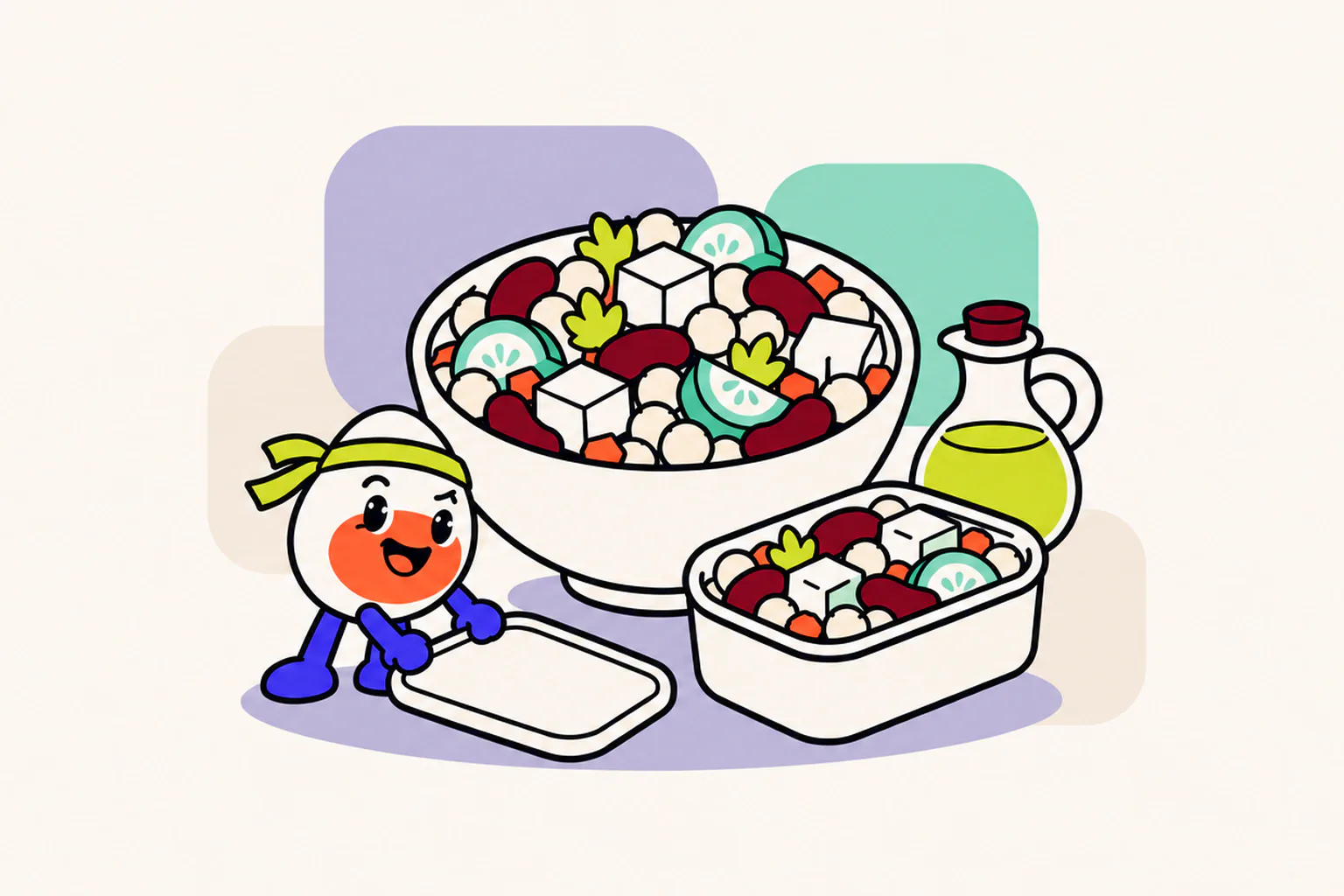
A dense bean salad becomes a repeatable meal when you know the bean portion, the extra protein, the dressing and the serving you actually pack. For the framework here, beans form the base, cucumber adds crunch, and tofu or cooked chicken changes the protein total. There is no need to copy a particular creator’s recipe to use that structure.
Beans bring protein and fiber together, according to USDA FoodData Central’s SR Legacy dataset (April 2018). Adding chicken changes the protein without adding fiber; the tofu entry used below contributes both. In practice, “bean-based” tells you the main ingredient, while the amounts determine the nutrition. A side serving and a lunch-sized bowl deserve different entries in a food log.
The examples below are calculated assembly frameworks, not kitchen-tested recipes. Their ingredient weights and nutritional estimates are specified; finished texture, seasoning, volume and actual batch yield have not been tested. Use them to understand the arithmetic and adapt an established preparation you already enjoy.
Which bean weight should you use?
Canned beans need an entry that matches what reaches the bowl. For this page’s examples, drain canned chickpeas, rinse them, let excess water drain away and weigh the edible solids. USDA’s 2018 entry specifically describes canned chickpeas drained and rinsed in tap water. Do not use a with-liquid entry for a bowl from which you discarded that liquid.
USDA’s 2018 portion record lists 1 cup of drained, rinsed chickpeas as 152 g. That amount supplies about 11 g of protein and 9.6 g of fiber. The database also lists a drained-and-rinsed can portion, but your can’s size and actual yield can differ. Weigh what you have instead of assuming every can provides the same amount.
A plain drained entry is a different record from a drained-and-rinsed entry. Beans cooked from dry need a cooked entry, not a dry weight. USDA’s boiled red kidney bean record, for example, does not describe canned kidney beans. Match the preparation before doing the arithmetic. The ingredient guide to protein in beans and lentils covers those comparisons in detail.
For a packaged food, check whether its Nutrition Facts information applies to drained solids or the contents as sold. FDA’s label guide, updated in 2024, explains that nutrient amounts refer to the stated serving and must be scaled to the amount eaten. A package label with a clear matching preparation can be more useful for your particular product than a generic entry.
How do the tofu and chicken bowls compare?
The tofu and chicken bowls use the same chickpeas, cucumber and dressing, so the main change is the protein addition. USDA SR Legacy (2018) supplies the estimates below. All foods are weighed as added: beans drained and rinsed, cucumber raw with peel, tofu uncooked and chicken cooked, roasted, skinless breast meat.
The household measures are approximate guides; the gram amounts control the calculations. Use the tofu only as its package directs. If it requires cooking, cook it appropriately and use nutrition data matching the prepared food rather than assuming its cooked weight is equivalent.
| Ingredient per bowl | Protein, about | Calories, about |
|---|---|---|
| Chickpeas, canned, drained and rinsed1 cup (152 g) | 11 g | 210 kcal |
| Cucumber, raw with peel½ cup sliced (52 g) | 0.3 g | 8 kcal |
| Olive oil1 tbsp (13.5 g) | 0 g | 119 kcal |
| Raw lemon juiceAbout 1 tbsp (15 g) | 0.1 g | 3 kcal |
| Plant option: firm tofu, calcium-set3 oz (85 g) | 15 g | 122 kcal |
| Omnivorous option: roasted chicken breast3 oz (85 g) | 26 g | 140 kcal |
For the plant-based worked bowl, combine the shared ingredients with the tofu option. For the omnivorous worked bowl, replace that tofu with the chicken option. The dressing is included in both totals, with all of it assumed eaten. These are ingredient sums, not measured finished yields.
| One calculated bowl | Protein, about | Fiber, about | Calories, about |
|---|---|---|---|
| Chickpea, cucumber and tofu bowl | 26 g | 12 g | 463 kcal |
| Chickpea, cucumber and chicken bowl | 37 g | 9.9 g | 480 kcal |
The chicken bowl has more protein in this particular comparison. That does not mean a plant-based bowl must be changed: you can adjust the tofu portion, choose a different soy food or spread protein across your other meals. For other small additions, see easy ways to add about 10 grams of protein.
How should you count dressing oil?
Dressing oil belongs in its own ingredient entry rather than disappearing into a generic “salad” total. The USDA 2018 olive-oil value shown above contributes calories without protein. Measuring oil gives you a clearer estimate; it does not make oil an ingredient to avoid.
You can weigh the oil into a separate dressing container, then add the lemon juice. For a shared batch, account for the dressing distributed to each portion. If some stays behind, the amount actually eaten is uncertain. Either portion dressing separately or state that your estimate assumes the whole measured amount was consumed.
Packaged dressings, yogurt sauces, cheese, nuts and olives change the calculation. Use the matching food entry or label and the amount added. Do not keep the table’s total after adding extras, and do not count a dressing twice if you already entered its ingredients.
Calories are optional information here. If you have a history of disordered eating, skip calorie counting and talk to a clinician about a supportive approach. Is counting calories healthy? discusses that decision, and tracking protein without counting calories offers another approach.
How do you turn a batch into actual servings?
A batch total becomes useful only after you identify the portion you eat. Keep a list of the edible ingredient weights and their preparation states, calculate the batch once, then divide it according to the servings actually packed.
- Record ingredients before combining. Include drained beans, prepared protein, vegetables and dressing. Keep raw and cooked entries separate.
- Distribute the main ingredients evenly. You can put a measured share of beans and protein into each container before adding vegetables and dressing. This avoids one portion receiving most of the chicken.
- Measure the real yield. Weigh the finished food without the container. The ingredient sum is only a planned mass; transfer losses, retained liquid and any preparation changes affect the actual yield.
- Use your actual serving. For a well-mixed batch, multiply its nutrient total by the serving weight divided by the finished batch weight. Uneven distribution makes that estimate less reliable.
For example, if you double the tofu framework and divide every ingredient evenly between two containers, each retains the single-bowl estimate. If you make unequal portions, do not log both as the same serving. Save the ingredients and portion method along with the meal’s name so you can repeat the calculation.
Which dense bean salad variations need a new calculation?
Dense bean salad variations need a new calculation whenever the ingredients or their amounts change. The table below offers flavor directions rather than additional tested recipes or nutrition totals.
| Variation | What to account for |
|---|---|
| Herby plant-based bowl | Keep chickpeas and tofu; add chopped herbs or different crunchy vegetables. Enter substantial additions. |
| Dense bean salad with chicken | Use cooked edible meat weight. Skin, dark meat or sauce needs a matching entry. |
| Fish and bean bowl | Use the fish’s edible weight and match canned fish packed in oil or water, drained as eaten. |
| Dairy addition | Count cheese or plain yogurt separately. Replacing oil with a yogurt sauce changes both the ingredients and totals. |
| Mixed-bean bowl | Weigh each drained bean separately and use its own matching entry. |
You can keep the same basic portioning method while changing flavors. For a wider ingredient choice, foods with both protein and fiber compares foods beyond beans. That guide covers the broader nutrition question; this page focuses on the assembled salad. If you want pasta as the base, the guide to high-protein pasta salad covers chicken and chickpea versions. For other salads built with chicken, tuna, egg or tofu, see the guide to high-protein salad recipes. For another chickpea food, how much protein is in falafel covers pieces, patties and wraps.
How long is dense bean salad meal prep safe?
Dense bean salad meal prep needs a cold-storage plan rather than an “all week” promise. USDA FSIS’s Leftovers and Food Safety, updated in 2020, gives leftovers 3–4 refrigerated days. Mixing older cooked chicken into freshly opened beans does not restart its storage clock.
FSIS’s 2020 guidance advises cooking poultry to an internal temperature of 165°F measured with a food thermometer, keeping cold perishable food at 40°F or below, and refrigerating promptly in shallow containers. Discard perishable food left out longer than 2 hours, or 1 hour above 90°F. Lemon juice is a flavor ingredient here, not a validated preservation method.
For later lunches, you can prepare a fresh batch midweek or freeze suitable cooked components promptly and assemble after refrigerator thawing. Label containers with preparation dates and follow any shorter package instructions. These examples have no validated shelf life. The guide to high-protein meal prep explains how to organize refrigerator and freezer portions.
What if a large bean portion does not suit you?
A large bean portion is optional. NIDDK’s constipation nutrition guidance, reviewed in 2018, advises adding fiber gradually and discussing an appropriate amount with a health professional. You can begin with a smaller bean portion and choose the rest of the meal around what you tolerate.
Ask your care team before making a substantial protein or fiber change if you have bowel disease, kidney disease or a prescribed diet. Pregnancy and under-18 nutrition questions also belong with your clinician or dietitian. These adult meal examples cannot set an individual medical diet.
For your next bowl, choose the protein addition, weigh the drained beans and decide which day you will eat it. Then use how to track protein without counting calories to record a serving you can repeat.
Sources
- USDA FoodData Central, SR Legacy (April 2018): chickpeas, canned, drained and rinsed (FDC 173801); chickpeas, canned, drained solids (FDC 173800); red kidney beans, boiled without salt (FDC 175194); firm tofu prepared with calcium sulfate (FDC 172475); roasted chicken breast, meat only (FDC 171477); cucumber with peel, raw (FDC 168409); olive oil (FDC 171413); lemon juice, raw (FDC 167747). Entries and calculations checked November 11, 2026. fdc.nal.usda.gov
- U.S. Food and Drug Administration. How to Understand and Use the Nutrition Facts Label. Content current as of March 5, 2024. fda.gov
- USDA Food Safety and Inspection Service. Leftovers and Food Safety. Updated July 31, 2020. fsis.usda.gov
- National Institute of Diabetes and Digestive and Kidney Diseases. Eating, Diet, & Nutrition for Constipation. Reviewed May 2018. niddk.nih.gov
This article is general information, not medical advice. If you have a health condition, are pregnant, or follow a diet set by your doctor, talk to them or a registered dietitian before changing how you eat.