On this page
- How much protein should a dinner have?
- What is the formula for an easy high-protein dinner?
- How were these numbers worked out?
- Which poultry and meat dinners are easy?
- Which fish and shellfish dinners are easy?
- Which egg and plant-based dinners are easy?
- Which high-protein dinner uses one pan and no oven?
- Which dinners use five ingredients?
- Which high-protein dinners can you make without chicken?
- Which cooking setup does each dinner need?
- How do you make a dinner lighter?
- How should you cook the protein safely?
- Who should check with a professional first?
- Your next step
How much protein should a dinner have?
Dinner portions can fit your appetite and daily protein goal. A 2018 review by Schoenfeld and Aragon suggested about 0.4 g/kg per meal across at least four meals for adults aiming to maximize muscle building. For a 70 kg (154 lb) adult that is about 28 g. The review’s target is not a requirement for everyone.
The 2025–2030 Dietary Guidelines for Americans (USDA and HHS, January 2026) say to “Prioritize Protein Foods at Every Meal.” For help sharing your daily goal across meals, see protein at every meal. You can make the dinners below smaller or add sides to suit your needs.
What is the formula for an easy high-protein dinner?
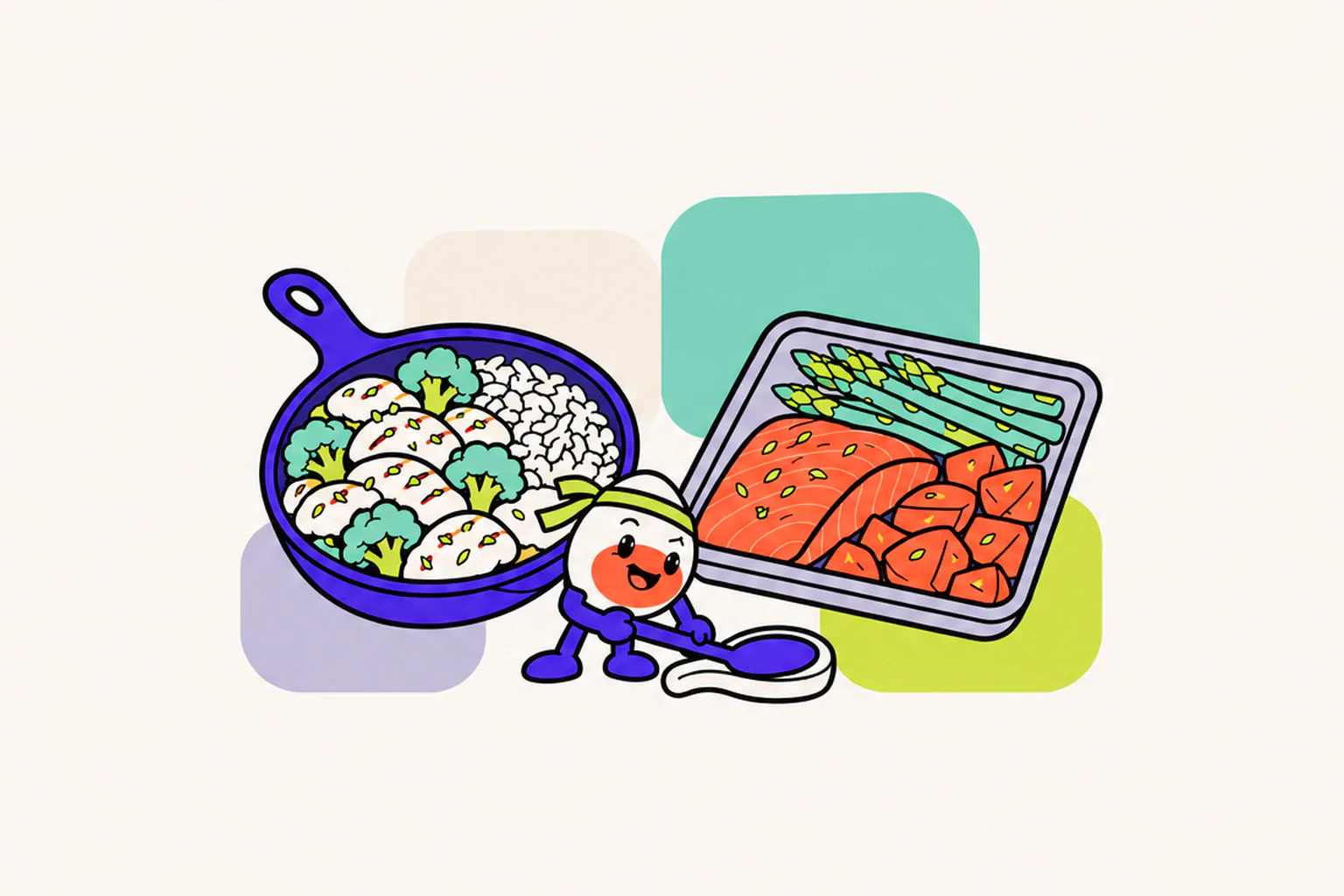
An easy dinner formula is a main protein food, vegetables and a base. You can start with a cooked portion of chicken, fish or meat, or use eggs, tofu or tempeh. Add vegetables and rice, quinoa, beans or a potato. For rice, see macros in rice, which compares cooked cups and dry weights. The chicken skillet shows how the parts add up.
| Part of the formula | Protein | Calories |
|---|---|---|
| Main proteinRoasted skinless chicken breast, 4 oz (113 g) | 35 g | 186 kcal |
| VegetableBoiled broccoli, 1 cup (156 g) | 3.7 g | 55 kcal |
| BaseCooked brown rice, ½ cup (101 g) | 2.8 g | 124 kcal |
| Cooking oilOlive oil, 1 tsp (4.5 g) | 0 g | 40 kcal |
| Whole dinnerAll four | 42 g | 405 kcal |
In this calculation using the USDA roasted chicken breast entry, chicken supplies most of the protein. With 3 oz (85 g) of chicken instead of 4 oz, the same plate has about 33 g of protein and 359 kcal.
How were these numbers worked out?
All nutrition estimates use USDA FoodData Central’s SR Legacy dataset (2018), checked November 10, 2026. Each ingredient list makes one serving. Meat, poultry, seafood, grains, beans, tempeh and boiled vegetables are weighed after cooking; tofu, eggs and vegetables marked raw are weighed before cooking. Cook the amount you need, then serve the cooked portion listed. Raw shopping weights will differ. Beans and chickpeas use boiled-from-dry, unsalted entries; canned substitutes need their labels.
The short directions describe cooking or assembling the dish; the listed cooked ingredients do not need cooking from raw again. For quicker assembly, start with cooked grains and beans. These dinners were not timed. Follow package directions for frozen vegetables, including edamame. Reheated leftovers must reach 165°F, according to the USDA FSIS temperature chart (2025).
Oil is counted where listed. Optional herbs, garlic, lemon, mustard and spices are excluded, so additions can change the totals. Protein is rounded to whole grams, with one decimal below 10 g in the formula table; calories are rounded to whole numbers. Tofu, sauces, bread and canned foods can differ from these reference entries: reading a nutrition label for protein helps you check substitutions.
Which poultry and meat dinners are easy?
Poultry and meat dinners can use cooked chicken or small cuts cooked while you prepare the vegetables. The serving estimates use USDA SR Legacy (2018).
Chicken, broccoli and brown rice skillet
Ingredients: 4 oz (113 g) roasted skinless chicken breast, 1 cup (156 g) boiled broccoli, ½ cup (101 g) cooked brown rice and 1 tsp (4.5 g) olive oil. Total: about 42 g of protein and 405 kcal.
No-oven route, reheat and assemble: Start with the listed roasted chicken, already-boiled broccoli and already-cooked rice, all safely refrigerated if prepared ahead. Use one lidded skillet, a spoon, a food thermometer, a knife, a cutting board and a serving bowl. Slice the chicken, add it to the skillet with the oil, broccoli and rice, and add a splash of water if needed to prevent sticking. Cover and stir as the food heats; check that the reheated food reaches 165°F before serving. Add optional garlic and lemon if you like. This route does not cook raw chicken or dry rice; preparing those first needs separate equipment and time.
Lighter version: Skip the rice and use 2 cups (312 g) of broccoli. Total: about 42 g of protein and 335 kcal.
Turkey taco bowl
Ingredients: 4 oz (113 g) cooked 93% lean ground turkey, ½ cup (86 g) cooked black beans, 1 cup (47 g) shredded romaine, ½ cup (90 g) chopped raw tomato, ¼ cup (65 g) salsa and ¼ avocado (50 g). Total: about 42 g of protein and 477 kcal.
No-oven route, cook from raw and assemble: Start with raw ground turkey, already-cooked black beans, raw washed romaine and tomato, salsa and avocado. Use one nonstick skillet with a lid, a spoon, a food thermometer, a kitchen scale, a cutting board, a knife and a serving bowl. Prepare the cold toppings first and set them aside. Cook the turkey in the skillet, breaking it up, until it reaches 165°F; weigh the listed cooked portion for this bowl. Raw turkey weight will differ, so do not treat the cooked weight as a shopping weight. Add the cooked beans to the portioned turkey with a splash of water if needed. If using refrigerated leftover beans, cover and reheat the hot mixture to 165°F. Spoon it over the lettuce and add the tomato, salsa and avocado. Dry beans require a separate cooking step; canned beans are an alternative whose label you should check.
Lighter version: Skip the avocado, halve the beans to ¼ cup (43 g) and use 2 cups (94 g) of romaine. Total: about 37 g of protein and 348 kcal.
Pork tenderloin medallions with green beans and quinoa
Ingredients: 5 oz (142 g) roasted pork tenderloin, lean only, 1 cup (125 g) boiled green beans, ½ cup (93 g) cooked quinoa and 1 tsp (4.5 g) olive oil. Total: about 44 g of protein and 398 kcal.
Roast trimmed raw tenderloin to 145°F and rest for 3 minutes. Slice and serve the cooked portion with boiled green beans, cooked quinoa and the measured oil.
Lighter version: Skip the quinoa and use 2 cups (250 g) of green beans. Total: about 42 g of protein and 330 kcal. The guide to protein in pork cuts compares tenderloin with chops and other cuts.
Sirloin steak with baked potato and spinach
Ingredients: 4 oz (113 g) broiled top sirloin steak, lean only, 1 small (138 g) baked potato, 3 cups (90 g) raw spinach wilted in the pan and 1 tsp (4.5 g) olive oil. Total: about 40 g of protein and 401 kcal.
Broil raw steak to 145°F and rest for 3 minutes. Serve the cooked portion with a baked potato and spinach wilted in the oil.
Lighter version: Skip the potato and add 1 cup (149 g) of raw cherry tomatoes to the spinach. Total: about 38 g of protein and 300 kcal.
Beef and tomato whole-wheat spaghetti
Ingredients: 3 oz (85 g) cooked 93% lean ground beef, 1 cup (117 g) cooked whole-wheat spaghetti, ½ cup (132 g) jarred marinara sauce and 1 cup (180 g) boiled, drained sliced zucchini. Total: about 35 g of protein and 445 kcal.
Brown raw beef to 160°F, portion out the cooked amount, and stir in the marinara and boiled zucchini. Serve over the pasta.
Lighter version: Use ½ cup (58 g) of spaghetti and 2 cups (360 g) of zucchini. Total: about 34 g of protein and 384 kcal.
Which fish and shellfish dinners are easy?
Fish and shellfish dinners can be assembled around a cooked fillet, shrimp or canned tuna. The USDA SR Legacy entries (2018) distinguish the seafood type and preparation. For white fish, see protein in cod, compared with haddock and tilapia. For meatless Friday dinners with fish or vegetarian options, see high-protein Lent meals.
Sheet-pan salmon with sweet potato and asparagus
Ingredients: 5 oz (142 g) farmed Atlantic salmon, cooked with dry heat, 3½ oz (100 g) baked sweet potato, 1 cup (180 g) boiled asparagus and 1 tsp (4.5 g) olive oil. Total: about 38 g of protein and 462 kcal.
Roast small sweet-potato cubes, then add raw salmon and cook the fish to 145°F. Serve the cooked portions with boiled asparagus and the measured oil. See protein in salmon for differences between salmon types.
Lighter version: Skip the sweet potato and use 2 cups (360 g) of asparagus. Total: about 40 g of protein and 412 kcal.
Shrimp and pepper stir-fry over rice
Ingredients: 5 oz (142 g) cooked shrimp, 1 cup (149 g) chopped raw red bell pepper, 2 oz (55 g) chopped raw onion, ½ cup (79 g) cooked white rice, 1 tbsp (16 g) soy sauce and 1 tsp (4.5 g) olive oil. Total: about 40 g of protein and 352 kcal.
Stir-fry the pepper and onion in the oil. Add raw shrimp and cook to 145°F, then portion out the cooked shrimp and serve with rice and soy sauce. If using leftover cooked shrimp, reheat to 165°F.
Lighter version: Swap the rice for 1 cup (124 g) of finely chopped cooked cauliflower. Total: about 40 g of protein and 278 kcal.
Cod with chickpeas, tomatoes and spinach
Ingredients: 5 oz (142 g) cooked Atlantic cod, ½ cup (82 g) chickpeas cooked from dry, 1 cup (149 g) raw cherry tomatoes, 2 cups (60 g) raw spinach and 2 tsp (9 g) olive oil. Total: about 43 g of protein and 404 kcal.
Bake raw cod to 145°F. Warm the tomatoes and cooked chickpeas in the oil, stir in the spinach and serve with the listed cooked fish portion. Canned chickpeas are an alternative, but use their label to recalculate.
Lighter version: Halve the chickpeas to ¼ cup (41 g) and double the tomatoes to 2 cups (298 g). Total: about 40 g of protein and 363 kcal.
Tuna and white bean skillet
Ingredients: 5 oz (142 g) canned light tuna in water, drained, ½ cup (90 g) cooked white beans, 3 cups (90 g) raw spinach, 1 cup (149 g) raw cherry tomatoes and 1 tsp (4.5 g) olive oil. Total: about 40 g of protein and 335 kcal.
Warm the cooked beans and tomatoes in the oil, wilt the spinach, and fold in the drained tuna off the heat.
Lighter version: Halve the beans to ¼ cup (45 g) and use 6 cups (180 g) of spinach. Total: about 38 g of protein and 293 kcal.
Which egg and plant-based dinners are easy?
Egg and plant-based dinners can pair eggs with cottage cheese or combine soy foods with beans. The USDA-based estimates (SR Legacy, 2018) use the same mix-and-match formula.
Spinach and mushroom frittata with cottage cheese
Ingredients: 3 large raw eggs (150 g without shells), ½ cup (113 g) 2% cottage cheese, 2 cups (60 g) raw spinach, ½ cup (78 g) boiled, drained mushrooms, 1 slice (32 g) whole-wheat bread and 1 tsp (4.5 g) olive oil. Total: about 38 g of protein and 462 kcal.
Mix cottage cheese with beaten eggs. Wilt spinach with the cooked mushrooms in the oil, add the egg mixture and bake in an oven-safe pan until the center reaches 160°F. Serve with bread.
Lighter version: Skip the bread and use 4 cups (120 g) of spinach. Total: about 36 g of protein and 395 kcal.
Tofu and edamame stir-fry
Ingredients: 5 oz (140 g) raw firm tofu made with calcium sulfate, ½ cup (78 g) cooked shelled edamame, 1 cup (156 g) boiled broccoli, ½ cup (101 g) cooked brown rice, 1 tbsp (16 g) soy sauce and 1 tsp (4.5 g) olive oil. Total: about 41 g of protein and 523 kcal.
Weigh the tofu before pressing, then cube and brown it in the oil. Cook edamame according to its package directions; add it with boiled broccoli and soy sauce, and serve over rice. Check your tofu label when substituting.
Lighter version: Skip the rice and use 2 cups (312 g) of broccoli. Total: about 42 g of protein and 453 kcal.
Tempeh and black bean bowl
Ingredients: 4 oz (113 g) cooked tempeh, ½ cup (86 g) cooked black beans, ½ cup (93 g) cooked quinoa, 1 cup (149 g) chopped raw red bell pepper and ¼ cup (65 g) salsa. Total: about 37 g of protein and 503 kcal.
Cook tempeh according to its package directions, then portion it out. Warm the beans and pepper in a nonstick pan with a splash of water, and serve over quinoa with salsa.
Lighter version: Skip the quinoa and use 2 cups (298 g) of bell pepper. Total: about 34 g of protein and 430 kcal.
Which high-protein dinner uses one pan and no oven?
The chicken skillet and turkey taco bowl above have explicit no-oven routes. The chicken route reheats cooked components; the turkey route cooks raw poultry and assumes the beans are already cooked. “One pan” describes the hot cooking stage, not the bowls, utensils or earlier preparation. Neither route requires a microwave.
For either route, keep raw poultry separate from ready-to-eat toppings. USDA FSIS’s temperature chart (2025) sets 165°F for poultry and leftovers. Its leftovers guidance (2020) recommends covering food during reheating. A thermometer check is the endpoint, rather than a promised number of minutes.
Active preparation includes chopping, stirring and portioning; elapsed cooking also includes heating the pan, cooking raw ingredients and any earlier grain or bean preparation. These are suggested workflows, not kitchen-tested recipes. Active and total times remain untested.
Which dinners use five ingredients?
The tuna and white bean skillet, cod plate and tempeh bowl each list five ingredients when oil and salsa count as ingredients. The tuna skillet uses tuna, white beans, spinach, tomatoes and olive oil. The pork plate, chicken skillet and beef spaghetti each list four. Here, count every listed food, oil and sauce; water is not counted. Optional salt, herbs, spices, garlic and lemon are extras, so adding them increases the ingredient count. A prepared sauce counts as one purchased item, but may contain several ingredients of its own; read its label if that matters to you. The nutrition totals exclude optional extras.
Which high-protein dinners can you make without chicken?
Every dinner except the chicken skillet is chicken-free as written. Choose turkey, pork, either beef dinner, salmon, shrimp, cod, tuna, the egg frittata, tofu or tempeh. Chicken-free does not mean vegetarian: the tofu and tempeh dinners are the plant-based options, while the frittata contains eggs and dairy. For more soy-food comparisons, see protein in tofu, tempeh and edamame.
Which cooking setup does each dinner need?
The comparison table summarizes the USDA estimates for each serving and its lighter variation, alongside a suggested cooking setup. Every route also uses serving dishes, a kitchen scale, measuring utensils and a spoon; raw produce needs a knife and cutting board. Use a food thermometer for the safety checks below. A saucepan used to boil vegetables also needs a strainer. No route below assumes a microwave. Extra cookware for the earlier preparation of components marked “already cooked” is not included in the dinner-stage equipment.
| Dinner | Main protein | Route and dinner-stage equipment | Starting state and prior preparation | Protein | Calories (kcal) | Lighter version (kcal) |
|---|---|---|---|---|---|---|
| Chicken, broccoli and brown rice skillet | Poultry | Reheat and assemble: stove, lidded skillet, serving bowl | Chicken roasted; broccoli boiled; brown rice cooked. No raw protein or dry grain in this route. | 42 g | 405 | 335 |
| Turkey taco bowl | Poultry | Cook from raw and assemble: stove, nonstick lidded skillet, serving bowl | Turkey raw; black beans already cooked; lettuce, tomato and avocado raw; salsa ready to use. Weigh turkey after cooking. | 42 g | 477 | 348 |
| Pork tenderloin medallions with green beans and quinoa | Pork | Cook from raw: oven, roasting pan; stove, saucepan for green beans; serving plate | Pork raw, portion weighed after roasting; quinoa already cooked; green beans raw before boiling. | 44 g | 398 | 330 |
| Sirloin steak with baked potato and spinach | Beef | Cook from raw: oven broiler, broiler-safe pan; stove, skillet for spinach; serving plate | Steak raw, portion weighed after broiling; potato already baked; spinach raw. | 40 g | 401 | 300 |
| Beef and tomato whole-wheat spaghetti | Beef | Cook from raw and assemble: stove, skillet, serving bowl | Ground beef raw, portion weighed after cooking; spaghetti already cooked; zucchini already boiled and drained; marinara ready to use. | 35 g | 445 | 384 |
| Sheet-pan salmon with sweet potato and asparagus | Fish | Cook from raw: oven, sheet pan; stove, saucepan for asparagus; serving plate | Salmon and sweet potato raw, portions weighed after roasting; asparagus raw before boiling. | 38 g | 462 | 412 |
| Shrimp and pepper stir-fry over rice | Shellfish | Cook from raw and assemble: stove, skillet or wok, serving bowl | Shrimp raw, portion weighed after cooking; white rice already cooked; pepper and onion raw; soy sauce ready to use. | 40 g | 352 | 278 |
| Cod with chickpeas, tomatoes and spinach | Fish | Cook from raw and assemble: oven, baking dish; stove, skillet; serving plate | Cod raw, portion weighed after baking; chickpeas already cooked; tomatoes and spinach raw. | 43 g | 404 | 363 |
| Tuna and white bean skillet | Fish | Heat and assemble: stove, skillet, serving bowl | Tuna canned and drained; white beans already cooked; spinach and tomatoes raw. | 40 g | 335 | 293 |
| Spinach and mushroom frittata with cottage cheese | Eggs | Cook from raw: stove and oven, oven-safe skillet, mixing bowl, serving plate | Eggs raw without shells; cottage cheese ready to use; spinach raw; mushrooms already boiled and drained; bread ready to serve. | 38 g | 462 | 395 |
| Tofu and edamame stir-fry | Plant-based | Cook and assemble: stove, skillet or wok; saucepan for edamame; serving bowl | Firm tofu raw, weighed before pressing; edamame cooked per package directions; broccoli already boiled; brown rice already cooked; soy sauce ready to use. | 41 g | 523 | 453 |
| Tempeh and black bean bowl | Plant-based | Heat and assemble: stove, nonstick skillet, serving bowl | Tempeh already cooked per package directions; black beans and quinoa already cooked; pepper raw; salsa ready to use. | 37 g | 503 | 430 |
How do you make a dinner lighter?
A lighter dinner can keep the main protein food while reducing a starchy side or changing a topping. The differences between the displayed standard and lighter calorie totals are 41–129 kcal. Protein changes with the sides, so check each version’s total. For plates with carbohydrate counted, see high-protein, low-carb meals.
These calorie totals are comparisons, not suggested meal limits. You can increase portions or add sides to match your appetite and needs. If counting brings back disordered-eating habits, skip the numbers and talk to a clinician or dietitian.
How should you cook the protein safely?
Cook meat, poultry, fish, shellfish and eggs to the USDA minimum internal temperatures, measured with a food thermometer. The USDA Food Safety and Inspection Service (FSIS) Safe Minimum Internal Temperature Chart, last updated April 14, 2025, lists these values, and says to reach them before you take the food off the heat.
- Poultry, including ground poultry: 165°F (73.9°C). That covers the chicken skillet and the turkey bowl.
- Ground meats: 160°F (71.1°C). That covers the beef spaghetti.
- Beef, pork, veal and lamb steaks, chops and roasts: 145°F (62.8°C), then rest for at least 3 minutes. That covers the pork tenderloin and the sirloin steak.
- Fish and shellfish: 145°F (62.8°C). That covers the salmon, shrimp and cod.
- Egg dishes: 160°F (71.1°C), measured in the center of the frittata.
The chart has no entry for tofu or tempeh, so follow the package directions for those. Leftovers are covered in high-protein meal prep for the week.
Who should check with a professional first?
People with kidney disease, people who are pregnant and anyone on a medical diet should talk to their care team about protein targets and food choices. Ask about fish choices in pregnancy and sodium if your care plan limits it. If you are under 18, ask a clinician or dietitian about your needs before using adult protein targets or reducing portions.
YolkPal lets you save foods you repeat and review and edit photo-based protein estimates before logging them.
Your next step
Pick two dinners and shop for both at once. If you prefer a drink with protein earlier in the day, protein coffee explains that option. For small additions to a dinner you already cook, try easy ways to add about 10 grams of protein.
Sources
- USDA and HHS. Dietary Guidelines for Americans, 2025–2030. January 2026. realfood.gov/documents/DGA.pdf
- Schoenfeld BJ, Aragon AA. How much protein can the body use in a single meal for muscle-building? Implications for daily protein distribution. J Int Soc Sports Nutr 2018;15:10. doi:10.1186/s12970-018-0215-1
- USDA Food Safety and Inspection Service. Safe Minimum Internal Temperature Chart. Last updated April 14, 2025. fsis.usda.gov
- USDA Food Safety and Inspection Service. Leftovers and Food Safety. Last updated July 31, 2020. fsis.usda.gov
- USDA FoodData Central, SR Legacy, April 2018 release; calculations checked November 10, 2026 (FDC IDs 168250, 168390, 168411, 168462, 168483, 168537, 168635, 168878, 168910, 168917, 169141, 169247, 169292, 169704, 169967, 170000, 170093, 170108, 170397, 170457, 171192, 171287, 171413, 171477, 171705, 171956, 172182, 172467, 172475, 172688, 172851, 173709, 173735, 173757, 174277, 174524, 174755, 175168, 175180, 175203). fdc.nal.usda.gov
This article is general information, not medical advice. If you have a health condition, are pregnant, or follow a diet set by your doctor, talk to them or a registered dietitian before changing how you eat.