
On this page
- Which lunch fits your cooking and cooling setup?
- How much protein should a work lunch have?
- How were these numbers worked out?
- Which sandwich-style lunches work cold?
- Which salads and bowls work in a lunch bag?
- Which lunches can you assemble at your desk?
- What can you pack with no fridge and no microwave?
- How do the lunches compare?
- How do you keep a packed lunch safe?
- How can you plan a week around freezer and fridge access?
- How can you change a lunch?
- Who should check with a professional first?
- Your next step
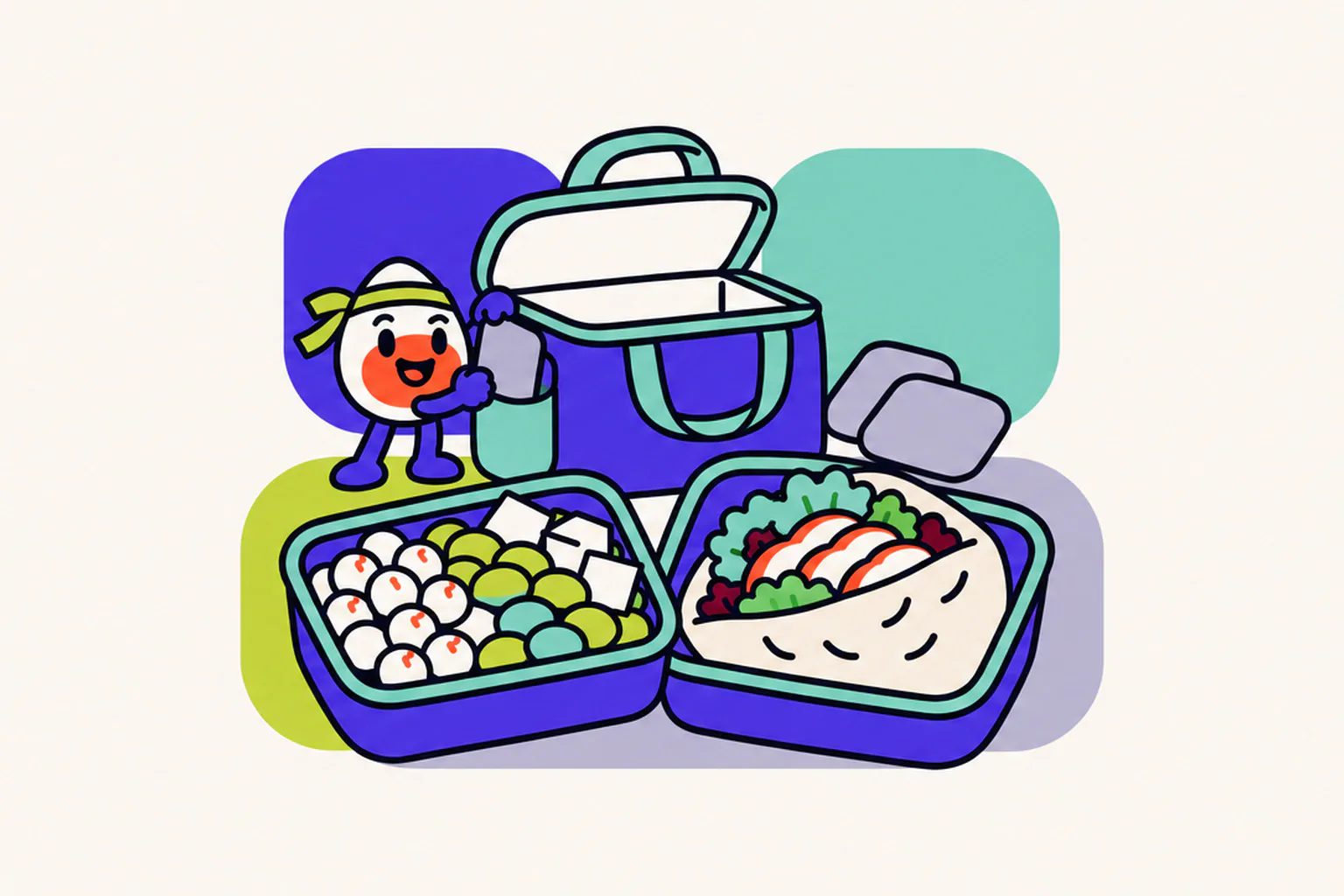
Which lunch fits your cooking and cooling setup?
Work lunches served cold are not automatically no-cook or shelf-stable. The chooser separates cooking at home from reheating at work. Home-boiled eggs, cooked shrimp, grains and beans still need preparation and chilling; buying ready-to-eat versions only changes who does the cooking. Follow each product’s cooking and storage directions.
| Lunch | Home preparation | Reheat at work? | Fridge or cooled bag? | Opening and assembly |
|---|---|---|---|---|
| Chicken pita | Cook chicken; chill | No | Yes | Mix chilled filling; fill at home |
| Turkey wrap | Heat tortilla as directed; cool | No, except high-risk deli-meat guidance below | Yes | Open deli meat; assemble at home |
| Tuna and chickpea salad | Cook chickpeas or use ready-to-eat; chill | No | Yes once mixed | Open and drain tuna; mix at home |
| Shrimp and quinoa salad | Cook shrimp and quinoa; chill | No | Yes | Assemble chilled parts |
| Chickpea, edamame and feta salad | Cook beans and edamame; chill | No | Yes | Open feta; mix chilled parts |
| Lentil, feta and egg salad | Cook lentils and egg; chill | No | Yes | Peel egg; assemble chilled parts |
| Tofu and soba bowl | Cook noodles and edamame; chill | No | Yes | Use ready-to-eat tofu; follow label |
| Egg and cottage cheese plate | Boil eggs; chill | No | Yes | Open cheese; keep crackers dry |
| Ham, cheddar and egg box | Boil egg; chill | No, except high-risk deli-meat guidance below | Yes | Open ham; pack chilled parts |
| Salmon and cheddar box | No home cooking | No | No, only under package conditions | Keep shelf-stable fish sealed until lunch |
Keep perishable lunches cold throughout the commute and until eating, even if an office fridge is available later. Without a fridge, use the insulated-bag method below. Without either a fridge or effective cooling, choose the unopened shelf-stable boxes. Keep cans and packages within their labeled storage conditions; a hot parked car is not pantry storage.
How much protein should a work lunch have?
The 2025–2030 Dietary Guidelines for Americans (USDA and HHS, January 2026) say to “Prioritize Protein Foods at Every Meal.” A 2018 review by Schoenfeld and Aragon suggests about 0.4 g/kg (grams per kilogram of body weight) per meal across at least four meals for adults doing resistance training. That is a muscle-building proposal, not everyone’s requirement. For a 70 kg (154 lb) adult, the calculation gives about 28 g per meal. See how much protein you need for daily targets, or 30-gram protein breakfasts for morning ideas.
How were these numbers worked out?
Totals use USDA FoodData Central’s 2018 SR Legacy entries at the listed gram weights; household measures are approximate. Grains, beans and edamame are cooked; eggs are hard-boiled. Chicken is skinless, tuna is drained light tuna in water, and salmon is drained without skin or bones. The tortilla is weighed before heating. Protein and calories are rounded to whole numbers. Listed oil, hummus and soy sauce count; optional seasonings and sides do not.
Packaged foods and tofu vary. Use nutrition labels to check protein for your products.
Which sandwich-style lunches work cold?
Sandwich-style lunches can be assembled after the cooked ingredients have chilled.
Chicken salad pita with Greek yogurt
Ingredients: 3 oz (85 g) roasted chicken breast, diced, ¼ cup (60 g) plain nonfat Greek yogurt, 1 stalk (40 g) of celery and 1 cup (30 g) raw spinach in 1 large (64 g) whole-wheat pita. Total: about 40 g of protein and 356 kcal.
Stir chicken, yogurt and celery together, then fill the pita with spinach and the mixture.
Turkey, Swiss and hummus wrap
Ingredients: 6 slices (96 g) of deli turkey breast, 1 oz (28 g) Swiss cheese, 2 tbsp (30 g) hummus and 1 cup (30 g) raw spinach in one 10-inch flour tortilla (72 g before heating). Total: about 31 g of protein and 510 kcal.
Heat the tortilla as its package directs, cool it, then fill and roll. Compare deli and roasted cuts in protein in turkey. For a lighter aside on tortillas in a very different setting, read what astronauts eat in space.
Which salads and bowls work in a lunch bag?
Salads and bowls can travel with dressing packed separately. For a pasta-based option, see the guide to high-protein pasta salad, with chicken or chickpea versions. For chicken, tuna, egg or tofu salads, see these high-protein salad recipes.
Tuna and chickpea salad
Ingredients: 4 oz (113 g) drained canned light tuna, 1 cup (164 g) cooked chickpeas, 1 cup (104 g) sliced cucumber, 1 cup (149 g) cherry tomatoes and 1 tsp (4.5 g) olive oil. Total: about 38 g of protein and 448 kcal.
Toss together; try lemon and pepper to taste.
Shrimp and quinoa salad
Ingredients: 4 oz (113 g) cooked shrimp, 1 cup (185 g) cooked quinoa, 1 cup (104 g) sliced cucumber, ¼ avocado (50 g) and 1 tsp (4.5 g) olive oil. Total: about 37 g of protein and 469 kcal.
Combine chilled ingredients; try lime over the avocado.
Chickpea, edamame and feta salad (vegetarian)
Ingredients: 1 cup (164 g) cooked chickpeas, ½ cup (78 g) cooked shelled edamame, 1 oz (28 g) feta, 1 cup (149 g) cherry tomatoes, 1 cup (30 g) raw spinach and 1 tsp (4.5 g) olive oil. Total: about 30 g of protein and 511 kcal.
Cook frozen edamame as directed, cool and drain before mixing. Health Canada’s Produce safety guidance (2026) advises cooking frozen vegetables before using them in cold dishes.
Lentil, feta and egg salad (vegetarian)
Ingredients: 1 cup (198 g) cooked lentils, 1⅓ oz (38 g) feta, 1 hard-boiled large egg (50 g), 1 cup (92 g) sliced red bell pepper and 1 tsp (4.5 g) olive oil. Total: about 30 g of protein and 472 kcal.
Toss chilled lentils with oil; add crumbled feta and quartered egg.
Cold tofu and soba bowl (plant-based)
Ingredients: 1 cup (114 g) cooked soba noodles, ½ cup (126 g) firm tofu, ½ cup (78 g) cooked shelled edamame, 1 medium carrot (61 g) and 1 tbsp (16 g) soy sauce. Total: about 28 g of protein and 339 kcal.
Use tofu suitable for eating without further cooking. Toss with chilled noodles, cooked-and-cooled edamame and grated carrot.
Which lunches can you assemble at your desk?
Desk boxes let you keep the parts separate until lunch.
Egg and cottage cheese plate
Ingredients: 3 hard-boiled large eggs (150 g), ½ cup (113 g) 2% cottage cheese, about 6 whole-wheat crackers (28 g), 1 cup (149 g) cherry tomatoes and 1 medium carrot (61 g). Total: about 36 g of protein and 495 kcal.
Keep crackers separate from the chilled eggs, cheese and vegetables.
Ham, cheddar and egg bento box
Ingredients: 3 oz (85 g) lean sliced deli ham, 1 oz (28 g) cheddar, 1 hard-boiled large egg (50 g), about 6 whole-wheat crackers (28 g) and 1 medium carrot (61 g). Total: about 31 g of protein and 426 kcal.
Roll ham around cheddar and pack everything in a divided box.
Salmon and cheddar box for a desk with no fridge
Ingredients: 3.5 oz (100 g) drained canned pink salmon, without skin or bones, about 6 whole-wheat crackers (28 g) and 1 oz (28 g) hard cheddar. Total: about 34 g of protein and 368 kcal.
Choose shelf-stable salmon close to that drained portion. Keep it sealed until lunch, then open, drain and eat; discard leftovers. Extra fish or a whole apple changes the totals.
What can you pack with no fridge and no microwave?
A shelf-stable chicken box and a vegetarian roasted soybean box offer fish-free alternatives to the salmon box. USDA FSIS’s 2025 lunch guidance lists canned meat, peanut butter, whole fruit and crackers among foods that need no cold source. Choose commercially packaged, ready-to-eat products labeled for room-temperature storage before opening. Refrigerated chicken strips and cooked beans from your home fridge do not qualify.
USDA FSIS’s Shelf-Stable Food Safety guidance (2024) says some canned foods still require refrigeration: read the label. Keep packages intact and within their storage directions until lunch, open only when ready to eat, and discard opened lunch leftovers when cooling is unavailable. Use small packs that match your portion; do not save an open can on your desk.
Fish-free chicken, crackers and apple box
Ingredients: 4 oz (113 g) canned chicken with no broth, about 6 whole-wheat crackers (28 g) and 1 medium whole raw apple with skin (182 g edible portion). Total: about 32 g of protein and 423 kcal, using USDA FoodData Central (SR Legacy, 2018). The calculation uses FDC IDs 171110, 172749 and 171688. The chicken weight is the meat portion without broth, not the unopened can’s gross weight.
Open the shelf-stable ready-to-eat chicken at lunch; drain any packing liquid and eat with the crackers and whole apple. Check the product label against the generic no-broth entry and recalculate the entire box if your portion or product differs. Bring a clean utensil and a can opener if needed.
Vegetarian roasted soybean, peanut butter and apple box
Ingredients: 2 oz (56 g) dry-roasted soybeans, 1 tbsp (16 g) smooth salted peanut butter, about 3 whole-wheat crackers (14 g) and 1 medium whole raw apple with skin (182 g edible portion). Total: about 30 g of protein and 502 kcal, using USDA FoodData Central (SR Legacy, 2018).
The calculation uses FDC IDs 172441, 174266, 172749 and 171688. Choose unopened, ready-to-eat dry-roasted soybeans, shelf-stable peanut butter portions and crackers labeled for room-temperature storage before opening. Keep the apple whole until lunch. Open the packages at lunch, spread peanut butter onto the crackers and eat the soybeans and apple alongside. Follow any after-opening refrigeration direction; discard opened leftovers when cooling is unavailable. Check labels and recalculate the entire box if your portions or products differ.
Preference tags describe these ingredients, not allergy safety. Soy and peanut are both major allergens. Check all labels, cheese ingredients and cross-contact information; the FDA’s food-allergy label guidance explains why ingredient lists and advisory statements matter. The FDA notes that “may contain” statements are voluntary, so their absence does not guarantee the absence of cross-contact. For another cold lunch with no tuna, the chicken pita, egg plate and tofu bowl above are options when you can keep them chilled. The egg plate and ham box are neither sandwiches nor salads. For more fish-free ideas that still need cooling, see high-protein vegetarian meals.
How do the lunches compare?
| Lunch | Type | Protein | Calories (kcal, optional) | Fridge/cooled bag? | Fish/seafood? | Dairy? | Vegetarian as written? |
|---|---|---|---|---|---|---|---|
| Chicken salad pita | Sandwich-style | 40 g | 356 | Yes | No | Yes | No |
| Turkey, Swiss and hummus wrap | Sandwich-style | 31 g | 510 | Yes | No | Yes | No |
| Tuna and chickpea salad | Salad | 38 g | 448 | Yes | Yes | No | No |
| Shrimp and quinoa salad | Salad | 37 g | 469 | Yes | Yes | No | No |
| Chickpea, edamame and feta salad | Vegetarian | 30 g | 511 | Yes | No | Yes | Yes, with vegetarian feta |
| Lentil, feta and egg salad | Vegetarian | 30 g | 472 | Yes | No | Yes | Yes, with vegetarian feta |
| Cold tofu and soba bowl | Plant-based | 28 g | 339 | Yes | No | No | Yes |
| Egg and cottage cheese plate | Desk box | 36 g | 495 | Yes | No | Yes | Yes |
| Ham, cheddar and egg bento box | Desk box | 31 g | 426 | Yes | No | Yes | No |
| Salmon and cheddar box | Desk box, no fridge | 34 g | 368 | No, label-dependent | Yes | Yes | No |
| Chicken, crackers and apple | Desk box, no fridge | 32 g | 423 | No, label-dependent | No | No | No |
| Roasted soybeans, peanut butter and apple | Vegetarian desk box, no fridge | 30 g | 502 | No, label-dependent | No | No | Yes |
How do you keep a packed lunch safe?
Packed perishable lunches need continuous chilling. USDA Food Safety and Inspection Service (FSIS), Keeping “Bag” Lunches Safe (2025), advises:
- Chill ahead: use shallow containers and refrigerate at 40°F or below. Pack just before leaving.
- Pack cold: use an insulated bag with at least two cold sources, above and below the food.
- Refrigerate on arrival: leave an insulated bag open inside the fridge.
- Limit time out: discard perishables left unrefrigerated beyond 2 hours, or 1 hour above 90°F.
- Pack what you’ll eat: discard lunch leftovers.
FSIS lists canned fish, hard cheese and crackers as foods needing no cold source. For the salmon box, keep fish unopened until eating; follow package storage instructions. The other nine lunches in the first set need chilling; the chicken-and-apple and roasted soybean boxes follow their package conditions above. For batch storage, see high-protein meal prep.
How can you plan a week around freezer and fridge access?
Start from the days you are actually in the office. For example, choose the chicken pita on Monday, a chilled chickpea salad on Tuesday, the tofu bowl on Wednesday, a chicken pita made with a thawed chicken portion on Thursday, and an unopened shelf-stable box on Friday if no cooling is available. Keep the listed ingredient portions unchanged when choosing storage; changing the container does not change the portion calculation.
- Prep and freeze: cook the chicken safely, divide into shallow containers for rapid chilling, and freeze the later-week portion promptly. Keep salad vegetables and yogurt separate for assembly later.
- Thaw in the fridge: move the frozen chicken portion to the refrigerator ahead of the planned lunch, allowing enough time to thaw completely. Do not thaw on the desk or kitchen counter.
- Pack cold: assemble with the chilled ingredients before leaving, using an insulated bag and two cold sources for the commute.
- Choose the destination: refrigerate on arrival, or maintain cooling in the insulated bag until lunch. If neither option works, take a shelf-stable box instead.
USDA FSIS’s Leftovers and Food Safety (2020) gives cooked leftovers 3–4 days refrigerated and identifies refrigerator thawing as a safe method. Plan a second prep session for later chilled bowls rather than leaving all of them in the fridge all week. For batch amounts and storage windows, use the high-protein meal prep guide.
How can you change a lunch?
Lunch portions can be scaled up or down. Compare substitutions in the high-protein foods chart, or choose from easy ways to add about 10 grams of protein. Recalculate when you change ingredients.
Who should check with a professional first?
People with kidney disease, people who are pregnant, anyone under 18 or on a medical diet should ask their care team about protein targets and food choices.
CDC’s Preventing Listeria Infection (2025) advises pregnant people, adults 65 or older and people with weakened immune systems to avoid unheated deli meat; its safer option is reheating to 165°F or until steaming hot. Choose another lunch if reheating is unavailable. CDC lists feta and cottage cheese made with pasteurized milk as safer choices.
Calories are optional information, not a requirement to track. If you have a history of disordered eating, skip calorie counting and talk with a clinician about an approach that supports you. The National Institute of Mental Health (2024) advises talking to a health care provider about concerns with eating behavior. See whether calorie counting is healthy for you.
Your next step
Pick a lunch and shop for its listed ingredients. The protein per dollar calculator compares ingredients using your package price and label. Prepare and chill the cooked parts before packing. See how to track protein without counting calories to fit lunch into your day.
YolkPal lets you save a lunch for repeat logging or photograph it for a protein estimate that you check and edit before saving.
Sources
- USDA and HHS. Dietary Guidelines for Americans, 2025–2030. January 2026. Dietary Guidelines
- Schoenfeld BJ, Aragon AA. How much protein can the body use in a single meal for muscle-building? Implications for daily protein distribution. J Int Soc Sports Nutr 2018;15:10. doi:10.1186/s12970-018-0215-1
- USDA FSIS. Keeping “Bag” Lunches Safe. Updated July 25, 2025. Lunch safety guidance
- Health Canada. Produce safety. August 25, 2026. Produce safety guidance
- CDC. Preventing Listeria Infection. January 31, 2025. Safer food choices
- USDA FSIS. Shelf-Stable Food Safety. October 24, 2024; accessed November 12, 2026. Shelf-stable storage guidance
- USDA FSIS. Leftovers and Food Safety. July 31, 2020. Leftover storage and thawing
- US FDA. Have Food Allergies? Read the Label. Accessed November 12, 2026. Food-allergy label guidance
- National Institute of Mental Health. Eating Disorders: What You Need to Know. Revised 2024. Eating disorders guidance
- USDA FoodData Central, SR Legacy, April 2018 (FDC IDs 171110, 174266, 172441, 171688, 168409, 168411, 168462, 168907, 168917, 169988, 170108, 170393, 170457, 170894, 171251, 171413, 171477, 171705, 172182, 172421, 172448, 172749, 172941, 173414, 173420, 173424, 173709, 173724, 173757, 173863, 174277, 174289, 174916, 175037, 175180). FoodData Central
This article is general information, not medical advice. If you have a health condition, are pregnant, or follow a diet set by your doctor, talk to them or a registered dietitian before changing how you eat.