
On this page
- How do you get 100 grams of protein a day?
- Who does a 100 g, 120 g or 150 g day fit?
- How were these days built?
- What does a 100 g day with meat and fish look like?
- What does a vegetarian 100 g day look like?
- What does a vegan 100 g day look like?
- What does a 150 g day look like?
- How do you move a day to 120 g, or down?
- Who should check with a clinician first?
- What if counting food makes you anxious?
- A simple next step
How do you get 100 grams of protein a day?
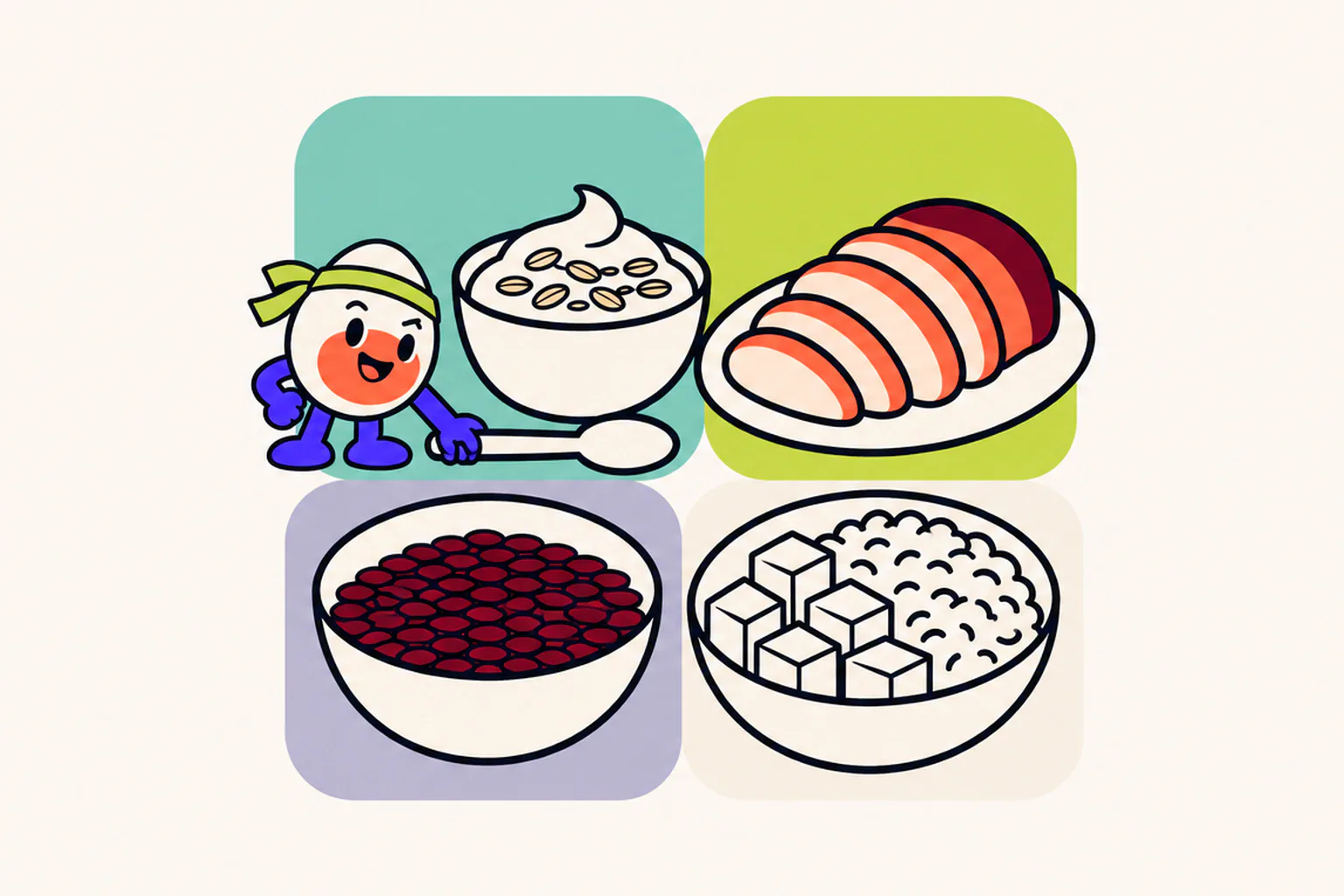
To build a day near 100 g, choose the food pattern you eat, use the weighed portions below as a starting point, and add up the protein across meals and snacks. The examples include grains and some vegetables, but they are not complete daily menus. Finish each day with the other foods you need; the calorie subtotals are not intake targets.
Who does a 100 g, 120 g or 150 g day fit?
The 2025–2030 Dietary Guidelines for Americans, which USDA and HHS published in January 2026, give the US goal to measure a 100 g day against. They set a protein serving goal of 1.2–1.6 grams per kilogram of body weight per day, adjusted for your calorie needs. “Grams per kilogram” (g/kg) means grams of protein for each kilogram you weigh. Divide the daily target by 1.6 and by 1.2 and you get the body weights in the table.
The Recommended Dietary Allowance (RDA) is lower. The Institute of Medicine’s 2005 Dietary Reference Intakes report puts the RDA at 0.8 g/kg a day, a baseline intended to cover the needs of nearly all healthy adults. At that rate a 100 g day is the RDA only for someone weighing 125 kg (276 lb). That comparison alone cannot establish your personal target. If you exercise, the International Society of Sports Nutrition suggested 1.4–2.0 g/kg a day for building or maintaining muscle in most healthy exercising adults in its 2017 position stand.
| Daily target | Body weight at 1.2–1.6 g/kg Dietary Guidelines | Body weight at 1.4–2.0 g/kg healthy people who exercise |
|---|---|---|
| 100 g day | 63–83 kg138–184 lb | 50–71 kg110–157 lb |
| 120 g day | 75–100 kg165–220 lb | 60–86 kg132–189 lb |
| 150 g day | 94–125 kg207–276 lb | 75–107 kg165–236 lb |
The table illustrates how a chosen target relates to body weight. For the evidence behind different goals, protein for weight loss and protein for muscle gain cover those questions. For help choosing a target, see how much protein you need. The protein calculator does the arithmetic for your own weight.
How were these days built?
Each day below uses foods from USDA FoodData Central, SR Legacy (April 2018), and Sources lists every food entry. Rice, pasta, beans, lentils, broccoli and tempeh use cooked weights; tuna is drained, tofu is weighed before cooking, and oats are dry. Eggs are large and weighed without shells. Household measures are approximate; the listed gram weights determine the totals. Protein is rounded to the nearest gram and calories to the nearest whole number, and each day total is the sum before rounding.
Every day puts a protein food at each meal, which follows the advice to “Prioritize Protein Foods at Every Meal” in the 2025–2030 Dietary Guidelines. Protein at every meal explains the evidence and limits of spreading it out. If you already use an eating window, protein with intermittent fasting covers fitting your target into fewer meals.
These partial menus leave out fruit, cooking fats, sauces and most drinks and vegetables. Add those around the foods listed. The 2025–2030 Dietary Guidelines say the calories you need depend on your age, sex, height, weight and level of physical activity. The calories shown are what the listed foods contribute, not a calorie target, so plan the rest of your food around your own energy needs. Packaged foods vary by brand, so check the label on yours.
What does a 100 g day with meat and fish look like?
The omnivore example provides about 104 g from all the listed foods, using USDA SR Legacy (2018). The listed protein meal components total about 1,213 kcal, not a complete menu or calorie target. Add fruit, more vegetables, fats and other foods to meet your needs. The 2025–2030 Dietary Guidelines advise full-fat dairy with no added sugars; if you swap the nonfat yogurt for another type, recalculate using its label.
| Meal | Protein meal components | Protein (approx.) | Calories (approx.) |
|---|---|---|---|
| Breakfast | Plain nonfat Greek yogurt 6 oz (170 g), dry rolled oats ½ cup (40 g) and almonds 1 oz (28 g) | 29 g | 414 kcal |
| Lunch | Canned light tuna in water, drained, 4 oz (113 g) on 2 slices of whole-wheat bread (64 g) | 30 g | 258 kcal |
| Snack | 2 large hard-boiled eggs (100 g) | 13 g | 155 kcal |
| Dinner | Roasted chicken breast 3 oz (85 g), brown rice 1 cup (195 g) and boiled broccoli ½ cup (78 g) | 33 g | 386 kcal |
| Component subtotal | Not a complete day; add other foods | about 104 g | 1,213 kcal |
For more breakfasts of this size, see 30-gram protein breakfasts. Easy high-protein dinners offers other dinners to swap in.
What does a vegetarian 100 g day look like?
A vegetarian day can reach 100 g with milk, cheese, eggs, beans, edamame and tempeh. This example includes dairy and eggs. Using USDA SR Legacy (2018), the protein meal components in the table add up to 1,602 kcal. This is not a complete menu or calorie target. Add fruit, more vegetables, fats and other foods to complete your day.
| Meal | Protein meal components | Protein (approx.) | Calories (approx.) |
|---|---|---|---|
| Breakfast | Dry rolled oats ½ cup (40 g) cooked in 1 cup (244 g) of 2% milk, with 2 tbsp (32 g) of peanut butter | 20 g | 465 kcal |
| Lunch | Boiled black beans 1 cup (172 g), cheddar 1 oz (28 g) and brown rice ½ cup (98 g) | 24 g | 450 kcal |
| Snack | Prepared shelled edamame 1 cup (155 g) and 1 large hard-boiled egg (50 g) | 25 g | 265 kcal |
| Dinner | Cooked tempeh 4 oz (113 g), cooked whole-wheat spaghetti 1 loose cup (117 g) and boiled broccoli ½ cup (78 g) | 31 g | 422 kcal |
| Component subtotal | Not a complete day; add other foods | about 100 g | 1,602 kcal |
You can swap foods to suit your appetite and goals, then total the revised portions. Vegetarian protein sources provides more foods by group, and high-protein vegetarian meals has full meals.
What does a vegan 100 g day look like?
The vegan example reaches about 101 g with oats, soy milk, hemp seeds, lentils, bread, edamame, almonds, tofu, rice and broccoli in USDA SR Legacy (2018). Its 1,616 kcal describe protein meal components, not a complete menu or calorie target. Add fruit, more vegetables, fats and other foods to complete your day. You can use this version if you eat no animal foods.
| Meal | Protein meal components | Protein (approx.) | Calories (approx.) |
|---|---|---|---|
| Breakfast | Dry rolled oats ½ cup (40 g) cooked in 1 cup (243 g) of original, unfortified soy milk, topped with 3 tbsp (30 g) of hulled hemp seeds | 23 g | 449 kcal |
| Lunch | Boiled lentils 1 cup (198 g) with 2 slices of whole-wheat bread (64 g) | 26 g | 391 kcal |
| Snack | Prepared shelled edamame 1 cup (155 g) and almonds 1 oz (28 g) | 24 g | 350 kcal |
| Dinner | Calcium-set firm tofu, raw weight, ½ cup (126 g), brown rice 1 cup (195 g) and boiled broccoli ½ cup (78 g) | 28 g | 427 kcal |
| Component subtotal | Not a complete day; add other foods | about 101 g | 1,616 kcal |
Plant protein basics covers protein quality and variety across the day. For a full week of meal ideas, a prep schedule and a shopping list, see the high-protein vegan meal plan. Ask a registered dietitian to help plan the other nutrients in a vegan diet too.
What does a 150 g day look like?
The 150 g example uses five eating occasions: three meals of 32–42 g and two snacks. Using USDA SR Legacy (2018), it reaches about 152 g and 1,623 kcal from the listed protein meal components. This is not a complete menu or calorie target: add fruit, more vegetables, fats and other foods to complete your day. More eating occasions are an option if you prefer smaller portions.
| Meal | Protein meal components | Protein (approx.) | Calories (approx.) |
|---|---|---|---|
| Breakfast | Plain nonfat Greek yogurt 6 oz (170 g), dry rolled oats ½ cup (40 g) and hemp seeds 3 tbsp (30 g) | 32 g | 418 kcal |
| Lunch | Roasted chicken breast 4 oz (113 g), brown rice 1 cup (195 g) and boiled broccoli ½ cup (78 g) | 41 g | 432 kcal |
| Snack 1 | 2% cottage cheese 1 cup (226 g) | 24 g | 183 kcal |
| Dinner | Farmed Atlantic salmon, cooked, 5 oz (142 g), boiled lentils ½ cup (99 g) and boiled broccoli ½ cup (78 g) | 42 g | 435 kcal |
| Snack 2 | 2 large hard-boiled eggs (100 g) | 13 g | 155 kcal |
| Component subtotal | Not a complete day; add other foods | about 152 g | 1,623 kcal |
You can replace either snack with something from high-protein snacks and recalculate. For details on the dinner protein, see protein in salmon. If your appetite is small, high-protein meals for small appetites has lower-volume ideas.
How do you move a day to 120 g, or down?
To reach a 120 g day, add one step of about 20 g to the omnivore day. Using USDA SR Legacy (2018), ½ cup (113 g) of 2% cottage cheese and 1 large hard-boiled egg (50 g) add about 18 g and 169 kcal, which brings the day to about 122 g. The 169 kcal are for that addition only; the combined components still need other foods to complete your day. The other two days take a step of their own. On the vegetarian day, 6 oz (170 g) of plain nonfat Greek yogurt adds about 17 g and 100 kcal, bringing the day to about 118 g; the 100 kcal describe only the added yogurt, not a complete day. On the vegan day, another ½ cup (126 g) of raw calcium-set firm tofu adds about 22 g and 181 kcal, bringing the day to about 123 g; the 181 kcal describe only the added tofu, not a complete day. On either day, 1 cup (172 g) of cooked black beans adds about 15 g and 227 kcal for that addition only. Complete either day with fruit, more vegetables, fats and other foods that fit your needs.
To estimate smaller portions, multiply the listed gram weights by your target divided by the day’s protein total. That also reduces the listed calories, so check the rest of your food rather than shrinking your whole diet by the same ratio. Easy ways to add about 10 grams of protein lists more steps, and the high-protein foods chart has more foods to swap.
Who should check with a clinician first?
Kidney disease calls for an individual protein plan: NIDDK’s healthy-eating guidance (reviewed January 2025) says some people need to moderate protein, while dialysis may increase needs. Ask your doctor or registered dietitian before changing your intake. Also seek individual advice if you are pregnant or breastfeeding, under 18, follow a medically managed diet, or take diabetes or weight-loss medicines. These adult examples cannot set your target. Can you eat too much protein? covers the safety question for healthy adults.
What if counting food makes you anxious?
If you have a history of disordered eating, skip calorie counting and talk with a clinician or registered dietitian about a plan that supports you. If tracking protein also brings anxiety or rigid food rules, you can step away from gram targets too. The National Institute of Mental Health’s 2024 guide encourages people with eating-disorder symptoms to seek help from a health care provider.
A simple next step
YolkPal is an iPhone protein tracker, with calories only if you want them. You can log a meal by typing the grams, taking a photo of the plate, scanning a barcode, reading a nutrition label or saying the meal out loud. AI results are estimates that you check and edit before saving.
Pick the day closest to how you eat and change one meal to something you like. The protein per dollar calculator compares foods using your package price and label. If tracking feels comfortable, you can add up your own grams for a few days to see how close you get; otherwise, use the meal ideas without counting. The guide to tracking protein without counting calories shows how to keep a running total.
Sources
- U.S. Department of Agriculture and U.S. Department of Health and Human Services. Dietary Guidelines for Americans, 2025–2030. January 2026. realfood.gov/documents/DGA.pdf
- Institute of Medicine. Dietary Reference Intakes for Energy, Carbohydrate, Fiber, Fat, Fatty Acids, Cholesterol, Protein, and Amino Acids. National Academies Press, 2005. doi:10.17226/10490
- Jäger R, et al. International Society of Sports Nutrition Position Stand: protein and exercise. J Int Soc Sports Nutr 2017;14:20. doi:10.1186/s12970-017-0177-8
- National Institute of Diabetes and Digestive and Kidney Diseases. Healthy Eating for Adults with Chronic Kidney Disease. Reviewed January 2025. niddk.nih.gov
- National Institute of Mental Health. Eating Disorders: What You Need to Know. Revised 2024. nimh.nih.gov
- USDA FoodData Central, SR Legacy (April 2018): yogurt, Greek, plain, nonfat (FDC 170894); cereals, oats, regular and quick, not fortified, dry (173904); nuts, almonds (170567); fish, tuna, light, canned in water, drained solids (173709); bread, whole-wheat, commercially prepared (172688); egg, whole, cooked, hard-boiled (173424); chicken, broilers or fryers, breast, meat only, cooked, roasted (171477); rice, brown, medium-grain, cooked (168875); broccoli, cooked, boiled, drained, without salt (169967); milk, reduced fat, fluid, 2% milkfat (171267); peanut butter, smooth style, without salt (172470); beans, black, mature seeds, cooked, boiled, without salt (173735); cheese, cheddar (173414); edamame, frozen, prepared (168411); tempeh, cooked (172467); pasta, whole-wheat, cooked (168910); soymilk, original and vanilla, unfortified (172446); seeds, hemp seed, hulled (170148); tofu, raw, firm, prepared with calcium sulfate (172475); lentils, mature seeds, cooked, boiled, without salt (172421); cheese, cottage, lowfat, 2% milkfat (172182); fish, salmon, Atlantic, farmed, cooked, dry heat (175168). fdc.nal.usda.gov
This article is general information, not medical advice. If you have a health condition, are pregnant, or follow a diet set by your doctor, talk to them or a registered dietitian before changing how you eat.