On this page
- What does a high-protein Christmas dinner look like?
- What do the sides and a whole plate add up to?
- What is a good high-protein vegetarian Christmas dinner?
- How were the numbers and recipes worked out?
- How do you scale a high-protein Christmas dinner for guests?
- Why can one Christmas dinner calorie total never be exact?
- How do you keep a Christmas dinner safe to eat?
- Who should check with a care team first?
- Your next step
What does a high-protein Christmas dinner look like?
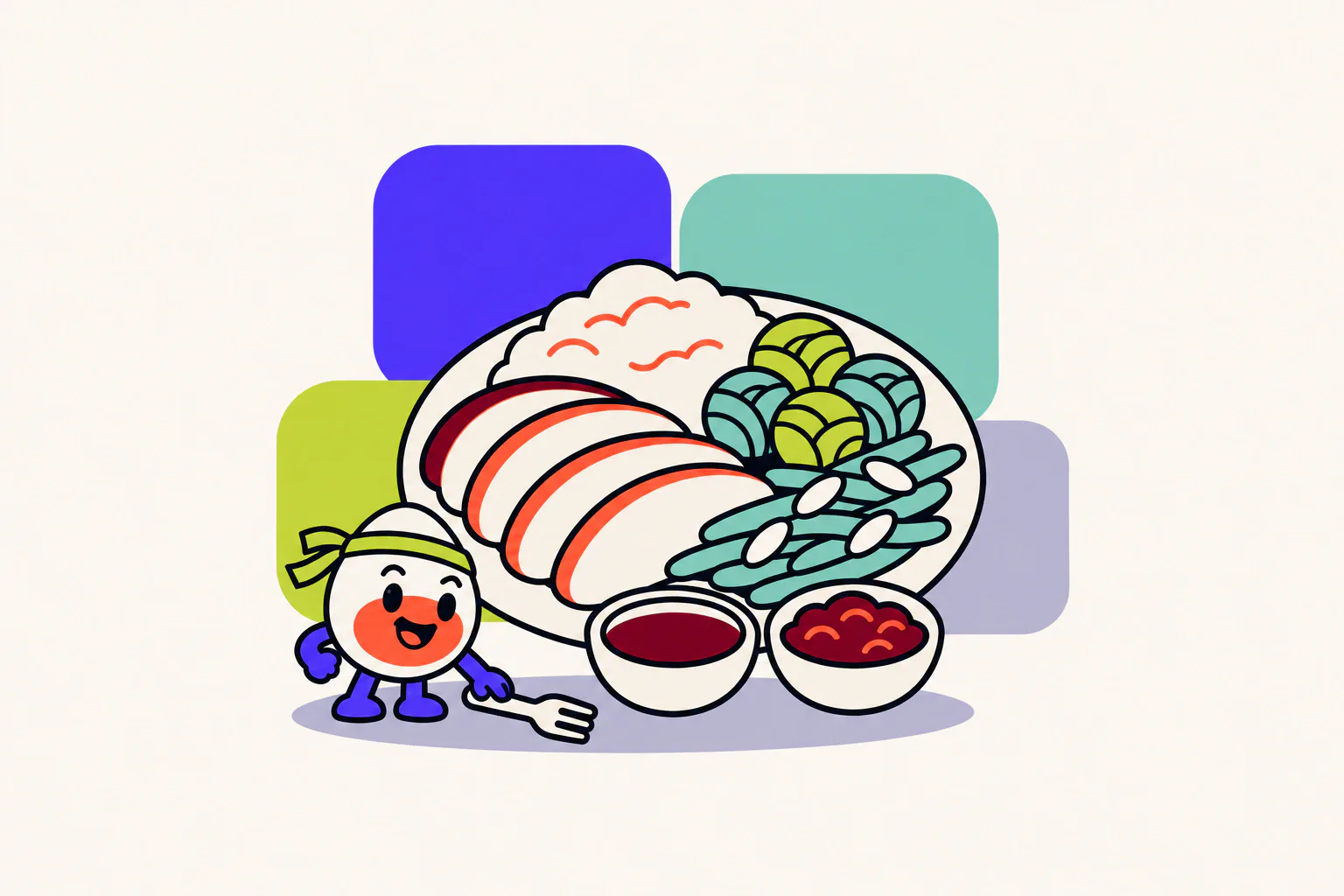
A high-protein Christmas dinner is a normal holiday plate where the main dish carries most of the protein and the sides add the rest. In the menu below, 4 oz (113 g) of roasted turkey breast with mashed potatoes made with Greek yogurt, roasted Brussels sprouts, green beans with almonds, gravy and cranberry sauce comes to about 49 g of protein and 619 kcal. The numbers use USDA FoodData Central’s SR Legacy values (2018). Kcal means kilocalories, the “calories” on food labels.
Protein is the focus here, and calories are an optional column for readers who choose to count them. Every nutrition number was calculated from USDA entries, not kitchen-tested, so treat the totals as estimates. Pick one main from the table: each row is a cooked weight, except the loaf, which is a slice of the recipe further down.
| Main dish | Protein | Calories (optional) |
|---|---|---|
| Roasted turkey breast, no skin4 oz (113 g) cooked | 34 g | 166 kcal |
| Roasted boneless ham, about 11% fat4 oz (113 g) cooked | 26 g | 201 kcal |
| Roasted rib roast, lean and fat4 oz (113 g) cooked | 26 g | 397 kcal |
| Baked farmed Atlantic salmon4 oz (113 g) cooked | 25 g | 233 kcal |
| Lentil, mushroom and cheddar loaf1 slice, one sixth of the recipe below | 23 g | 393 kcal |
| Optional starter: shrimp with cocktail sauce3 oz (85 g) shrimp, ¼ cup (60 g) sauce | 21 g | 161 kcal |
On these USDA values, turkey breast has the most protein for its calories and the cheddar-rich loaf has the least. For other cuts and the difference between breast and dark meat, see protein in turkey; for salmon types, see protein in salmon. For a different holiday main, protein in haggis covers cooked portions and a full plate. Cured ham is a salted product, so read the label if you limit sodium. For pork cuts and raw versus cooked weights, see how much protein is in pork.
What do the sides and a whole plate add up to?
The three vegetable sides add about 13 g of protein to a plate, and the mashed potatoes made with Greek yogurt supply the most of it. For other potato dishes and toppings, see macros in potatoes. Gravy and cranberry sauce add calories more than protein. Each side below is one serving from a batch for 8.
| Side or extra | Protein | Calories (optional) |
|---|---|---|
| Mashed potatoes with Greek yogurt6 oz (172 g), one eighth of the batch | 5.6 g | 157 kcal |
| Roasted Brussels sprouts3.5 oz (100 g) raw weight, with ¾ tsp (3.4 g) olive oil | 3.4 g | 73 kcal |
| Green beans with almonds1 cup (125 g) boiled beans, 1 tbsp (7 g) slivered almonds | 3.8 g | 83 kcal |
| Turkey gravy, canned ready-to-serve¼ cup (60 g) | 1.6 g | 31 kcal |
| Cranberry sauce, canned, sweetened¼ cup (69 g) | 0.6 g | 110 kcal |
| Optional: bread stuffing prepared from dry mix½ cup (100 g) | 2.7 g | 195 kcal |
Putting it together gives two plates. The vegetarian plate leaves out the gravy, because the canned entry is turkey gravy. Totals are summed from unrounded values and rounded once, so the rows can differ from the total by 1 kcal.
| Plate | Protein | Calories (optional) |
|---|---|---|
| Turkey plate4 oz turkey, mashed potatoes, sprouts, green beans, gravy, cranberry sauce | 49 g | 619 kcal |
| Vegetarian plate1 slice of loaf, mashed potatoes, sprouts, green beans, cranberry sauce | 36 g | 816 kcal |
| The three vegetable sides aloneMashed potatoes, sprouts, green beans | 13 g | 313 kcal |
What is a good high-protein vegetarian Christmas dinner?
A high-protein vegetarian Christmas dinner can be built on lentils, eggs and cheese. The loaf in the recipe table gives about 23 g of protein a slice, and the whole vegetarian plate comes to about 36 g. That is less protein and more calories than the turkey plate, because the cheddar and walnuts add fat as well as protein. A bigger slice or an extra bean dish closes some of the gap; high-protein vegetarian meals and vegetarian protein sources have more options.
This loaf uses eggs and cheese, so it suits vegetarians who eat both and does not suit vegans. A vegan menu needs different foods and a new calculation; the high-protein vegan meal plan covers it. Because the loaf contains eggs, bake it until the center reaches 160°F, the USDA Food Safety and Inspection Service (FSIS) minimum for eggs (chart last updated April 14, 2025). If you bake it ahead, the FDA says egg dishes should be thoroughly reheated to 165°F before serving.
How were the numbers and recipes worked out?
The numbers use USDA FoodData Central’s SR Legacy dataset (2018), checked November 11, 2026, and none of the recipes was kitchen-tested. Meat, fish, lentils, potatoes and green beans are cooked weights. Brussels sprouts, mushrooms, onion, eggs, oats, cheese and nuts in the recipes are raw or dry weights. Salt, pepper, herbs, spices, rolls, drinks and dessert are not counted. For dessert, the high protein Christmas cookies guide covers batch portions and icing.
| Dish | Batch ingredients | Makes |
|---|---|---|
| Mashed potatoes with Greek yogurt | 1,000 g boiled, peeled potatoes; 8 oz (227 g) plain nonfat Greek yogurt; ½ cup (122 g) 2% milk; 2 tbsp (28 g) butter. Mash together. | 8 servings of 6 oz (172 g) |
| Roasted Brussels sprouts | 800 g raw trimmed sprouts; 2 tbsp (27 g) olive oil. Toss and roast until browned and tender. | 8 servings of 3.5 oz (100 g) raw weight |
| Green beans with almonds | 1,000 g boiled, drained green beans; ½ cup (54 g) slivered almonds. Toss together. | 8 servings of 1 cup (125 g) beans with 1 tbsp (7 g) almonds |
| Lentil, mushroom and cheddar loaf | 3 cups (594 g) cooked lentils; 4 large eggs (200 g); 80 g dry oats; 60 g chopped walnuts; 1 cup (113 g) shredded cheddar; 280 g sliced raw white mushrooms and 1 medium onion (110 g), cooked in 1 tbsp (13.5 g) olive oil. Mix and bake in a loaf pan until the center reaches 160°F. | 6 slices |
Four things move these numbers most. First, the meat is a cooked weight: a bone-in roast or whole bird loses weight to bones, fat and cooking, so follow the package or your butcher for what to buy. Second, oil and butter count only where listed, and 1 tbsp (13.5 g) of olive oil has about 119 kcal (USDA, 2018); hidden calories: oils, sauces and drinks shows how pours add up. Third, the gravy is a canned ready-to-serve entry, so gravy made from drippings, flour and butter will differ; use its label or weigh your own and recalculate. Fourth, if the loaf mixture is too loose and you add oats or an egg, recalculate the slice.
How do you scale a high-protein Christmas dinner for guests?
Scale by cooked weight of the main per guest, and let guests choose a plate size, because no single protein target fits everyone at the table. The 2025–2030 Dietary Guidelines for Americans (USDA and HHS, January 2026) say to “Prioritize Protein Foods at Every Meal,” without a per-guest figure for one dinner. A 2018 review by Schoenfeld and Aragon suggested about 0.4 g/kg per meal, across at least four meals a day, for people who do resistance training and want to maximize muscle building. For a 70 kg (154 lb) adult that is about 28 g, a reference point and not a requirement for any guest.
Children, older adults, pregnant guests and people with small appetites may need different amounts. Guests who track a goal can find theirs with the how much protein you need guide or the protein calculator. For splitting a day’s protein across meals, see protein at every meal.
| Guests | 3 oz (85 g) each | 4 oz (113 g) each | 6 oz (170 g) each |
|---|---|---|---|
| 4 guests | 12 oz (340 g) | 1 lb (454 g) | 1½ lb (680 g) |
| 8 guests | 1½ lb (680 g) | 2 lb (907 g) | 3 lb (1,361 g) |
| 12 guests | 2¼ lb (1,021 g) | 3 lb (1,361 g) | 4½ lb (2,041 g) |
For a mixed table, plan the middle column and carve extra for the larger plates. The side batches above serve 8 and the loaf serves 6, so multiply every ingredient in a recipe by the same factor to scale it. Protein for a turkey portion is in the main-dish table above (4 oz) and the calorie-variation table below (3 oz and 6 oz). The turkey thawing calculator helps plan a whole bird’s thawing schedule.
Why can one Christmas dinner calorie total never be exact?
Christmas dinner calories depend on choices no recipe card can fix: portion size, skin, gravy, oil, butter and extras. The table changes one choice at a time, then combines them. The same menu spans about 509 kcal to about 1,198 kcal, so any single published total describes one particular plate rather than every plate.
| What changes | Smaller choice | Bigger choice |
|---|---|---|
| Turkey portion, roasted breast, no skin | 3 oz (85 g): 26 g protein, 125 kcal | 6 oz (170 g): 51 g protein, 250 kcal |
| Turkey skin, 4 oz (113 g) | Breast meat only: 166 kcal | Meat and skin: 214 kcal |
| Gravy, canned ready-to-serve | 2 tbsp (30 g): 15 kcal | ¾ cup (179 g): 91 kcal |
| Cranberry sauce, canned, sweetened | 2 tbsp (35 g): 56 kcal | ¼ cup (69 g): 110 kcal |
| Olive oil on the sprouts | ¾ tsp (3.4 g): 30 kcal | 1 tbsp (13.5 g): 119 kcal |
| Mashed potatoes, 6 oz (172 g) | With Greek yogurt: 5.6 g protein, 157 kcal | With whole milk and butter: 3.2 g protein, 195 kcal |
| Stuffing | None | ½ cup (100 g): 195 kcal |
| Whole turkey plate, every choice above together except the potato recipe | 39 g protein, 509 kcal | 72 g protein, 1,198 kcal |
The smaller plate is 3 oz (85 g) of skinless turkey, 2 tbsp (30 g) of gravy and 2 tbsp (35 g) of cranberry sauce with the sides as written and no stuffing. The bigger plate is 6 oz (170 g) of turkey with skin, 1½ servings (258 g) of the Greek-yogurt mashed potatoes, 1 tbsp (13.5 g) of oil on the sprouts, ¾ cup (179 g) of gravy, ¼ cup (69 g) of cranberry sauce and ½ cup (100 g) of stuffing. Both are ordinary plates, and neither is a recommendation.
If you choose to count, add up the batch ingredients, divide by the portions you actually served and use the label for any product. How to count calories walks through the method, and the calorie calculator is there if you want a daily target. If you would rather not count, how to track protein without counting calories covers a protein-only approach. Drinks are a separate question; calories in alcohol explains them. For another drink option, high protein hot chocolate covers milk choices, mug sizes and toppings.
If you have a history of disordered eating, skip calorie counting and talk to a clinician or dietitian. Is counting calories healthy? covers who counting may not suit. Nothing on this page asks you to skip meals, fast, follow a cleanse or add exercise to make up for a holiday dinner, and none of these numbers promises a change in weight.
How do you keep a Christmas dinner safe to eat?
A Christmas dinner stays safe when meat reaches its minimum internal temperature, hot food stays hot, cold food stays cold, and leftovers go into the refrigerator within 2 hours. Use a food thermometer for the temperatures. The USDA FSIS Safe Minimum Internal Temperature Chart (last updated April 14, 2025) sets these minimums:
- Poultry and stuffing: 165°F (73.9°C), so the turkey breast and any stuffing.
- Beef, pork and lamb roasts: 145°F (62.8°C), then rest for at least 3 minutes, so the rib roast and a fresh ham.
- Fully cooked ham, to reheat: 140°F (60°C) if it was packaged in a USDA-inspected plant, and 165°F (73.9°C) for all others.
- Fish and shellfish: 145°F (62.8°C), so the salmon and shrimp.
- Eggs: 160°F (71.1°C), so the lentil loaf, which is made with eggs.
The turkey cooking time calculator covers roasting windows and thermometer checks for a whole bird.
For a buffet, the FDA’s Serving Up Safe Buffets page (content current as of March 5, 2024) says hot foods should be kept at 140°F or warmer and cold foods at 40°F or colder. It says to discard perishables left out at room temperature for more than 2 hours, or 1 hour if the room is above 90°F, and to replace nearly empty serving dishes with freshly filled ones. The same page lists eggnog among traditional recipes that may call for raw or lightly cooked eggs, and says such recipes can be adapted by heating the eggs with the liquid to 160°F on a food thermometer, or by using store-bought products or pasteurized eggs. The high protein eggnog recipe walks through cooking and thermometer checks.
For leftovers, USDA FSIS (Leftovers and Food Safety, retrieved November 11, 2026) says to divide large amounts into shallow containers and to slice roasts and turkey breast before refrigerating. Leftovers keep 3 to 4 days in the refrigerator or 3 to 4 months in the freezer. Reheat them to 165°F, and bring gravies to a rolling boil. For planning leftovers into lunches, see high-protein meal prep.
Who should check with a care team first?
People with kidney disease, people who are pregnant or breastfeeding and anyone on a medical or prescribed diet should talk to their care team before using this menu’s protein amounts. That includes diets for diabetes, allergies or sodium limits. In pregnancy, ask about eggnog, cured meats and fish choices; protein during pregnancy has the general picture. If you take medicines that affect appetite, ask your prescriber before changing how much you eat. If you are under 18, ask a clinician or dietitian before using adult portions or reducing them.
YolkPal is an iPhone protein tracker coming soon to the App Store. It lets you save foods you repeat and review and edit photo-based protein estimates before logging them.
Your next step
Choose one main and two sides from the tables, then write the cooked weight per guest on your shopping list. To add protein to the rest of the holiday week, try easy ways to add about 10 grams of protein, and for a starter, high-protein appetizers.
Sources
- USDA and HHS. Dietary Guidelines for Americans, 2025–2030. January 2026. realfood.gov/documents/DGA.pdf
- Schoenfeld BJ, Aragon AA. How much protein can the body use in a single meal for muscle-building? Implications for daily protein distribution. J Int Soc Sports Nutr 2018;15:10. doi:10.1186/s12970-018-0215-1
- USDA Food Safety and Inspection Service. Safe Minimum Internal Temperature Chart. Last updated April 14, 2025. fsis.usda.gov
- USDA Food Safety and Inspection Service. Leftovers and Food Safety. Retrieved November 11, 2026. fsis.usda.gov
- U.S. Food and Drug Administration. Serving Up Safe Buffets. Content current as of March 5, 2024. fda.gov
- USDA FoodData Central, SR Legacy, April 2018 release; calculations checked November 11, 2026. Entries used: turkey, whole, breast, meat only, cooked, roasted (FDC 171496); turkey, all classes, breast, meat and skin, cooked, roasted (FDC 171492); pork, cured, ham, boneless, regular (approximately 11% fat), roasted (FDC 167872); beef, rib, whole (ribs 6–12), separable lean and fat, trimmed to 1/8" fat, all grades, cooked, roasted (FDC 169500); fish, salmon, Atlantic, farmed, cooked, dry heat (FDC 175168); crustaceans, shrimp, cooked (FDC 175180); sauce, cocktail, ready-to-serve (FDC 174067); gravy, turkey, canned, ready-to-serve (FDC 171568); cranberry sauce, canned, sweetened (FDC 173961); bread, stuffing, dry mix, prepared (FDC 174931); potatoes, boiled, cooked without skin, flesh, without salt (FDC 170440); potatoes, mashed, home-prepared, whole milk and butter added (FDC 168555); yogurt, Greek, plain, nonfat (FDC 170894); milk, reduced fat, 2% (FDC 171267); butter, salted (FDC 173410); Brussels sprouts, raw (FDC 170383); beans, snap, green, cooked, boiled, drained, without salt (FDC 169141); nuts, almonds (FDC 170567); oil, olive, salad or cooking (FDC 171413); lentils, mature seeds, cooked, boiled, without salt (FDC 172421); egg, whole, raw, fresh (FDC 171287); oats (FDC 169705); nuts, walnuts, english (FDC 170187); cheese, cheddar (FDC 173414); mushrooms, white, raw (FDC 169251); onions, raw (FDC 170000). fdc.nal.usda.gov
This article is general information, not medical advice. If you have a health condition, are pregnant, or follow a diet set by your doctor, talk to them or a registered dietitian before changing how you eat.